Category Archives: art

Electoral politics in Iceland: anarchist performance art

I appreciated Constantin Seibt’s article on the anarchists playing with the Icelandic electoral system.  The Best party had a wonderful list of campaign promises:

A glance at the most important campaign promises of the Best Party is more than enough to highlight the audacity of Reykjavik’s voters. They were promised free towels at swimming pools, a polar bear for the zoo, the import of Jews, «so that someone who understands something about economics finally comes to Iceland», a drug-free parliament by 2020, inaction «we’ve worked hard all our lives and want to take a well-paid four-year break now», Disneyland with free weekly passes for the unemployed «where they can have themselves photographed with Goofy», greater understanding for the rural population «every Icelandic farmer should be able to take a sheep to a hotel for free», free bus tickets. And all this with the caveat: «We can promise more than any other party because we will break every campaign promise.»The Best Party emerged from an idea for a sketch show.

via More punk, less hell! – News Ausland: Europa – tagesanzeiger.ch.

You know how it goes, they win the election, form a coalition government, fix the budget, and suggest that humorous performance art may be more effective than traditional governance.

An assessment of four years of anarchist rule yields a rather surprising conclusion: the punks put the city’s financial house in order. They can also look back on some very successful speeches, a few dozen kilometers of bike paths, a zoning plan, a new school organization that no one complains about any more and a relaxed, booming city – tourism is growing by 20% a year and some say that is the new bubble. In speeches, president Grímsson no longer praises Icelanders’ killer instinct, but their creativity. Real estate prices are again on the rise and the Range Rovers are back too. In polls last October, the Best Party hit its high-water mark of 38%. Shortly thereafter, Gnarr announced he would retire and dissolve the Best Party. His reason: «I’m a comedian, not a politician.» He added: «I was a cab driver for four years, a really good one even, and I quit doing that as well.»«My question was always: ‹How do we fuck the system?›» says Örn. «And the answer was, we show that non-politicians can do the job as well. But quitting with a certain election victory within reach, that’s truly fucking the system!»

via More punk, less hell! – News Ausland: Europa – tagesanzeiger.ch.

Thanks to longreads for the suggestion.
Leave a comment

Filed under art, capitalism, communication, do-it-yourself, humor, media, protest, punk, representation, resistance

Performing arguments: The Roots . . . And then you shoot your cousin

Okayplayer has a slightly obtuse review of the live performance of The Roots new album.  The album is called . . . And then you shoot your cousin.  Here is a snippet from the review by Eddie “Stats” which highlights the use of performance to make some interesting arguments:

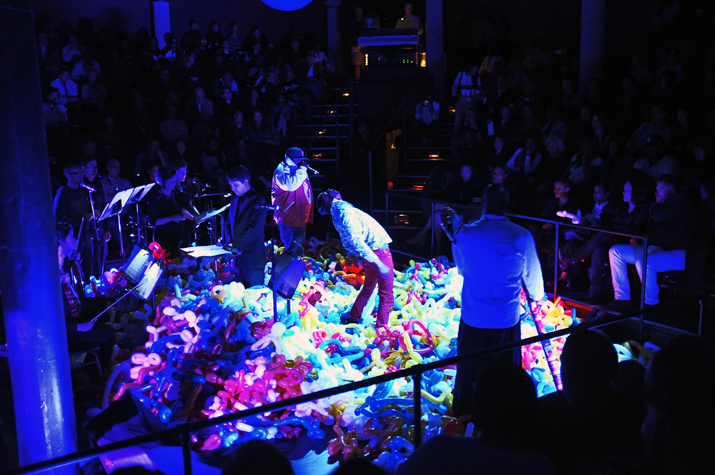
Questlove is at the decks now and as the lights strobe a massive avalanche of balloon animals suddenly falls on the stage, a Jeff Koons flood of meaningless forms, falling in the framedrop slo-mo created by the flash of the strobe. A doo-ragged character enters the stage, humming, holding a gigantic red balloon like a kite. There’s something clownish in his dancerly movements, he has his mouth absurdly open, recalling at once a mime, Flavor Flav in wop-mode, the broom-wielding enforcer of the Apollo as he sweeps balloons away in the wake of his feet. In silence his dance picks up in intensity and his movements resemble Flav less than legendary b-boy choreographer Pee Wee Danz. As he steps and swims through balloons, the pop of dying inflatables echo like gunshots. We are fully in Fluxus territory now, improvisation colliding with a wickeder kind of randomness to create an ‘anything could happen’ tension in the room.

via The Roots chop up their new LP into art live (photos + recap) Okayplayer.

The Roots performing live among some balloon animals.  Photo by Mel D. Cole taken with respect from Okayplayer.

The Roots performing live among some balloon animals. Photo by Mel D. Cole taken with respect from Okayplayer.

Leave a comment

Filed under art, communication, dance, hip hop, music, race, representation, resistance

Power, autonomy, body and twerking: Kimari Brand

Brilliant breakdown of twerking and bodily representation.  Smart insights from Kimari Brand about power and the significance of the dance form (film by Irma L. Garcia).  Brought to me by the ever-on-point Feministing.  Good preview of the video by Sesali Bowen in Feministing:

Utilizing multiple experiences — including a course on performance, feminism and social justice, a trip abroad to study Afro-Caribbean culture and politics, and her experiences as a Black girl at an institution of higher education that prioritizes white supremacist “credibility and status” — Brand has reframed the dialogue about twerking.

via “Twerk It Girl” examines twerking for autonomy and resistance.

I think twerking is at the heart of a lot of the moral panics about young women’s sexuality.  More particularly the moral panic attached to twerking is represented along racial and/or sexual and/or class lines depending on the expected audience (Miley Cyrus).  Worth discussion and re-presenting which Brand and the filmmaker Garcia do really well.

Leave a comment

Filed under academics, art, class, cultural appropriation, dance, documentary, feminism, hip hop, race, representation, resistance, rhetoric

Food, authenticity and cultural appropriation

Thanks to Bitch Media for the comic frame.

Shing Yin Khor has a wonderful comic about cultural appropriation and food at Bitch Media.  Five stars.

Leave a comment

Filed under art, colonialism, cultural appropriation, food, representation

Twist on tagging

I woke up thinking about the fame/anonymity line that successful artists/graffiti practitioners have to navigate.  Made me think about SF’s Barry McGee/Twist.

From a cool interview by Samuel Borkson where Barry McGee emphasizes living, eating kale and going surfing.  When asked what he’d do with a lot of money Twist replies:

BMG: I’m more interested in less than more. Our society has become obsessed with having more, having it all. To what end? Excess, while fascinating to watch, is not the answer to me. Most over budgeted art projects I have seen are terrible.

via BARRY MCGEE AND SAMUEL BORKSON: A CONVERSATION | Dirty Magazine.


Leave a comment

Filed under art, communication, graffiti, health, media

Run the jewels: overdetermination and puppets

I wrote a little piece on El-P and Killer Mike’s Run the jewels album and rape culture.   I guess I was thinking about the socially conscious history of both of the artists.  You might describe El-P as a nihilist leftist and Killer Mike as an organic intellectual.

Of course Run the jewels is competitive over-the-top rap music.  In the effort to make the best art — artists attempt to outdo each other.  In the genre of hip hop this means bigger, harder, louder, and more outlandish.

The financial claims of most rappers have grown to ridiculous levels, with a number of artists simply shouting out expensive brand names to convey their own particular shopping allegiances.

It makes sense that the claims about violence, drugs and sex would also become more and more outlandish.

MF DOOM always seemed like a hip-hop critic.  His villainous characters (and in particular the masked versions of DOOM) always seemed pitiful — articulated as a mockery of other rappers whose representations of criminality seemed shallow in comparison to the lyrical work of the clever DOOM.

In the same way modern hip hop can be critiqued from the traditional morality perspective.  It might also be performed and overdetermined (made excessive and taken to the extreme) in order to achieve a very similar moral critique.

Which works as a basic introduction for “36” Chain,” a video which contains violence against old women, violence against young women, gun violence, violence against Andrew W.K, and a dual sense of mockery/sincerity that will probably excite some people and deeply offend others.

Noting the character Killums — the kidnapped puppet plays such an important role it might be worth including the El-P video for “Full retard” in this discussion.

Of course this video contains some drinking and driving, a lot of drug stuff, violence against moms, nudity, and of course, the lightly disturbing choice to have the puppet Killums lead in most of the debauchery. We can note that the expressive fiction of a puppet gives liberty . . . a kind of implicit defense.  At the same time thumbing the nose at the idea of childhood as an innocent time.

Killums seems to be El-P’s id. An expression of what he would like to do . . . the unfettered brain presented as a sex and drug obsessed squirrel.   Some artists make up Tyler Durdin . . . El-P chooses a one-eyed junkie squirrel.

Dave Chappelle’s sesame street mockery Kneehigh park runs through some of the same transgressions.   Pushing buttons with ever-increasingly crass discussions voiced by puppets that seems to be giving humorous versions of public service announcements.

You can say anything if you have a puppet voice the idea.  And as I’ve written about before — any moralistic critique sounds silly when lodged against a cute fuzzy animal with a human voice.  It is insulated against these kinds of arguments because you can always say “it’s just a puppet.”

Leave a comment

Filed under art, communication, drugs, hip hop, music, representation

Juxtaposition: Fiona Apple and Dave Chappelle walk off the stage

Artifact One: Fiona Apple at a Tokyo fashion event.

Apple grew frustrated with the ongoing chatter in the venue, a hall at Tokyo Station Hotel, where the exhibition makes its home. Partway through her short set, she climbed on top of her grand piano and asked the audience to be quiet so that she could perform. She then challenged everyone to be silent for the duration of a tone she created by striking a small metal bell. The performer grew even more angry when the noise in the venue continued.

Apple instructed the audience to “shut the f–k up” and uttered other expletives, both audibly and under her breath, calling the event’s attendees “rude.” She continued with her set before shouting, “Predictable! Predictable fashion, what the f–k?” as she stormed off the stage. The show was punctuated with other bizarre moments, such as when she hit her head with her microphone, did a back bend over her piano bench and stared intensely at her guitarist as if in a love-struck trance.

via Louis Vuitton Toasts ‘Timeless Muses’ in Tokyo – Parties – Eye – WWD.com.

Artifact 2: Dave Chappelle walking off the stage at a Connecticut comedy club.

Chappelle wasn’t having a meltdown. This was a Black artist shrugging the weight of White consumption, deciding when enough was enough. This isn’t the first time Chappelle has done so and it isn’t the first time his behavior has been characterized as a meltdown.

There is a long history of asking African-Americans to endure racism silently; it’s characterized as grace, as strength. Chappelle’s Connecticut audience, made up of largely young White males, demanded a shuck and jive. Men who seemed to have missed the fine satire of the Chappelle show demanded he do characters who, out of the context of the show look more like more racist tropes, than mockery of America’s belief in them.

When he expressed shock at the fact that he’d sat there and been yelled at for so long, people yelled that they’d paid him. They felt paying for a show meant they could verbally harass him, direct him in any tone of voice, as though they’d bought him.

via Dave Chappelle Didn’t Melt Down – Entertainment & Culture – EBONY.

Leave a comment

Filed under art, fashion, juxtaposition, media, protest, race, representation, resistance, vulnerability

Martin Luther King improvising

I heard a nice tribute to Martin Luther King Junior and his speech at the March on Washington on the radio this morning.  Another version of this showed up in my RSS feed thanks to the fantastic “Daily Feminist Cheat Sheet” on Feministing.

Apparently, the essential chorus of “I have a dream” was a semi-improvisation for King.  It was a response to Mahalia Jackson.

As King neared the end, he came to a sentence that wasn’t quite right. He had planned to introduce his conclusion with a call to “go back to our communities as members of the international association for the advancement of creative dissatisfaction.” He skipped that, read a few more lines, and then improvised: “Go back to Mississippi; go back to Alabama; go back to South Carolina; go back to Georgia; go back to Louisiana; go back to the slums and ghettos of our Northern cities, knowing that somehow this situation can and will be changed.”

Nearby, off to one side, Mahalia Jackson shouted: “Tell them about the dream, Martin!” King looked out over the crowd. As he later explained in an interview, “all of a sudden this thing came to me that I have used — I’d used many times before, that thing about ‘I have a dream’ — and I just felt that I wanted to use it here.” He said, “I say to you today, my friends, so even though we face the difficulties of today and tomorrow, I still have a dream.” And he was off, delivering some of the most beloved lines in American history, a speech that he never intended to give and that some of the other civil rights leaders believed no one but the marchers would ever remember.

via Mahalia Jackson, and King’s Improvisation – NYTimes.com.

Don’t sleep on the impact of the solid gospel choices of Mahalia Jackson in motivating a political crowd.  Remember that music is key for every liberation movement I can think of.

She sang two spirituals, “I Been ’Buked and I Been Scorned” and “How I Got Over.” King was seated nearby, clapping his hands on his knees and calling out to her as she sang. Roger Mudd, covering the event for CBS News, said after the first song: “Mahalia Jackson. And all the speeches in the world couldn’t have brought the response that just came from the hymns she sang. Miss Mahalia Jackson.”

***

I hope you have some remaining monthly New York Times tokens!  Or else you won’t be able to follow the link I’ve recommended to read the whole article.  Pretty short-sighted New York Times.  #newyorktimeshatesfreeinformation

Leave a comment

Filed under art, communication, memorial, music, protest, race, vulnerability

Ricky Jay: cons, cards and the correctly structured drama

I guess it’s Ricky Jay day here at Life of refinement.  There are several great moments in this Ricky Jay video.  My favorite was the description of conning by David Mamet at 39:00:

“The idea that intelligent people, such as you and me, can be deprived of our hard-earned money and self respect by the correct . . . by a correctly structured drama.”

A correctly structured drama indeed.  Stick around for the poker lesson at the end.


Leave a comment

Filed under art, communication, gambling, magic

Killer Mike exposed

Killer Mike is a grown up hip hop artist, thinking about serious stuff.  He and El-P ran through the Combat Jack show and came off with this nice little exchange. 

1. Notice the fundamentals, Dallas Penn sets this off.  I don’t love his consumerist Polo identity, but there is no discounting how smart and insightful that guy really is.  If you aren’t reading and donating to Dallas Penn’s web site, you aren’t living right.

2. Good interviewers.  Ask the question and get out of the way.  Combat Jack is serious, Dallas Penn is serious.  That means listening when ideas are flowing.

3. How about two grown men getting honest with each other?  El-P telling Killer Mike he is just starting his career.  Killer Mike talking about having to expose parts of his vulnerabilities and fears to work with El.

***

Updated a few days later . . . May 9, 2013.  Part 3 is out.

El-P, Killer Mike, Combat Jack, and Dallas Penn.  The third clip is a conversation about race.  Nice discussion.

1. For those educators out there looking for an example of a “race pass” check out Dallas Penn saying to El-P: “I don’t call you a white rapper.”

Absolutely on point, El-P rejects the offer of the card.  “I’m a white guy, I rap. There’s no question about it.” Just because you are cool doesn’t mean that you don’t have privilege.  And leave it to Killer Mike to remind us of that.  When asked about white-identified rap fans Killer Mike responds:

“I’m not saying their experience isn’t worthy, I’m not saying it isn’t valuable. I’m saying it’s not special.  Because every human being experiences love and pain and let down.  Your thing is no more special.  And a lot of times, as Americans, and in this country, we feel like our suffering makes us special. You are special because you are a human being.”  – Killer Mike

3.  This argument is a dumb prompt from Combat Jack.  I think it might be a kind of policing — because of Killer Mike’s reference in segment one to his increasing vulnerability.   I appreciate all the examples of great black emcees who recorded some vulnerable verses that are quickly volunteered by the panelists.

Leave a comment

Filed under art, hip hop, media, music, vulnerability