Category Archives: communication

Cannibal Capitalism: Nate Jackson’s medical records

How do you sustain the gladiators of cannibal capitalism?  The folks whose bodies we consume when they fall?

Keep their medical records from them.

Next to that piece of paper was a file as large as a dictionary that contained my injury history. Every injury I ever had was described somewhere in that file. But I never saw it. It wasn’t my property.

Had I owned that file, that information, I would have had a better idea of what was happening to me. Every treatment was in there. Every report written up by Greek or our team doctors. The results of every physical. And an unbiased report from the off-site imaging center that conducted our post-injury MRIs. These MRI reports contain information of great value to a player, because they are unfiltered. But I never saw the file. As far as I knew, I never even had access to it.

During my football career, I dislocated my shoulder multiple times, separated both shoulders, broke my tibia, broke a rib, broke my fingers, tore my medial collateral ligament in my right knee, tore my groin off the bone, tore my hamstring off the bone twice. I had bone chips in my elbow, bone chips in my ankle, concussions, sub-concussions, countless muscle strains, labral tears in either hip, cumulative trauma in the lower spine, sciatic nerve damage, achilles tendinitis, plantar fasciitis in both feet, blisters—oh the blisters! My neck is bad. My clavicles are misaligned. I probably have brain damage.

via My Injury File: How I Shot, Smoked, And Screwed My Way Through The NFL.

Leave a comment

Filed under capitalism, communication, health, sport

Accountability for trolls: Jeopardy edition

Arthur Chu has won a couple of Jeopardy episodes with an eye for strategy.  Along the way he has received a ton of abuse from the inter webs.  He reports in a interview with Slate that his wife encouraged him to engage with the trolls.

I have to give my wife credit for this because she’s a strong believer that dragging trolls into the sunlight to name and shame them is better than ignoring them, and the way she was kind of goading me by retweeting all the offensive tweets and getting me to reply to them got me to see that there were two choices—retreat behind a rock and wait for the trolling to blow over, or consciously engage the trolls, take control of the conversation and own my image as a nerdy rumpled “Jeopardy! jerk” and embrace it. And the latter has turned out to be a lot of fun—and in the end generated a lot more positivity than negativity, though it would’ve been hard to believe that’s how it would’ve ended up that first night of angry people calling me out.

via Arthur Chu, Jeopardy!’s reigning champion, talks to Ken Jennings about the strategy of a quiz show master..

I tend to think that likeliness of success with trolls increases with social status, but this is a good snapshot of the ‘feed the trolls’ argument.

Leave a comment

Filed under communication, intersectionality, race, representation

Juxtaposition from death row: Ray Jasper

Ray Jasper is scheduled to be executed by the state of Texas.  From death row, he wrote a strong piece on his impending death and the practice of state killing.   I appreciate the juxtaposition he paints about race.  Referencing a passage by Lisa Maxwell, Jasper explains:

Imagine you’re a young white guy facing capital murder charges where you can receive the death penalty… the victim in the case is a black man… when you go to trial and step into the courtroom… the judge is a black man… the two State prosecutors seeking the death penalty on you… are also black men… you couldn’t afford an attorney, so the Judge appointed you two defense lawyers who are also black men… you look in the jury box… there’s 8 more black people and 4 hispanics… the only white person in the courtroom is you… How would you feel facing the death penalty? Do you believe you’ll receive justice?

As outside of the box as that scene is, those were the exact circumstances of my trial. I was the only black person in the courtroom.

Again, I’m not playing the race card, but empathy is putting the shoe on the other foot.

via A Letter From Ray Jasper, Who Is About to Be Executed.

If the people in Texas is going to kill this dude, the least I can do is read his letter.

Leave a comment

Filed under communication, juxtaposition, race, representation, rhetoric

Describing the call out as oppression: Paula Deen

There is something toxic about people who have public histories of being offensive arguing that being criticized for hateful comments is comparable to experiencing hate itself.

Here is Zerlina Maxwell explaining why Paula Deen’s recent articulation is exactly this kind of hijack of experience.

“In a recent interview with People, Deen said (via CNN):

“I feel like ‘embattled’ or ‘disgraced’ will always follow my name,” she tells People. “It’s like that black football player who recently came out,” referring to NFL prospect and former University of Missouri football standout, Michael Sam.

“He (Sam) said, ‘I just want to be known as a football player. I don’t want to be known as a gay football player.’ I know exactly what he’s saying.”

It’s no surprise that Deen would feel embattled, but as someone who said racially insensitive things, it is a surprise that Deen sees herself as the oppressed, instead of the one doing the oppressing.  How is Paula the victim if she was the mastermind behind the slave themed wedding?  It seems to me that actually being oppressed and embattled by structural inequality and policies that lead to disparate outcomes for people of color is worse than being called out for your bigotry.  And being the first openly gay player in the NFL like Michael Sam is nothing like being a celebrity chef exposed for referring to your Black employees in explicitly racist terms.”

via Paula Deen thinks she’s oppressed like “that Black” gay NFL player.

1.  Writing words or speaking it aloud usually archive ideas marked to bodies.

2. It is worthwhile developing critical vocabulary for this rhetorical maneuver.   It is one of the best tactics to resist the call-out.

3.  Thanks Feministing.  You rock.

Leave a comment

Filed under communication, Gay, learning, media, representation, rhetoric

Women intellectuals under attack . . . on the internets!

The interwebs are structurally sexist – with whole areas where women are disrespected and policed through abuse and threats of violence.

Recently some academic dude wrote some article suggesting that professors  learn about twitter and blogging.  A good reminder to “ask the other question” (Matsuda) when Gwendolyn Beetham points out the risks to women who enter the internet public sphere.

In fact, I cannot think of a prominent woman in the public sphere who has not been the target of sexism, usually in the form of being threatened with sexual assault, which in the case of women of color undoubtedly takes a racist tone.  Amongst countless others, recent incidents of female public scholars who have had these experiences include Mary Beard (@wmarybeard), who was threatened with rape and having her home bombed via Twitter, and Brittney Cooper (@ProfessorCrunk), who was physically threatened while speaking on a panel at the Brecht Forum in New York. If you’d like to do your own test of this, read the comments of any article published by a woman in a mainstream news media outlet – or read almost any mainstream account of women in the public sphere. Indeed, as Mary Beard recently stated in a talk at the British Museum (recounted in The Guardian ), the very real, and very negative, push-back against women who enter the public sphere is nothing new in Western culture: it extends all the way back to Homer.  Although not surprising, it is nevertheless disappointing that Kristof and others continue to ignore the risks that women have faced when entering the public sphere for the past two millennia.

via Women and Public Scholarship | Inside Higher Ed.

Thanks to Feministing’s Daily Feminist Cheat Sheet for the link.

Leave a comment

Filed under academics, communication, feminism, sexual assault, technology

Cannibal capitalism: Chief Keef and rehab

I’m interested in the idea that folks would become famous because they harmed themselves or allowed someone else to harm them on camera.  I’ve been calling it cannibal capitalism – as a means of describing this wide scope on popular media.    Cannibal in the sense that viewers consume of the body of another human being who is on camera taking years off of their life

Chief Keef is in rehab for ganja and let’s loose with some great insights about how unpleasant it is.

Nestled inside a nondescript beach house, one of hip-hop’s most controversial rising stars is holed up in court-ordered rehab, and he’s feeling frustrated and alone.

“It’s like being locked up,” Chief Keef, 18, tells Billboard, in his first interview since he entered rehab. “And when I’m locked up, I don’t want anybody to come see me. I won’t let my family come here. I haven’t seen my 2-year-old daughter.”

via Chief Keef Talks Rehab, ‘Bang 3’ Album & Learning How to Surf | Billboard.

Cannibal Capitalism is best thought of as a pattern of mediated communication about morality.  Along with viewing people getting hurt and enjoying it (Jackass, NFL, Ultimate Fighting) we also get the moral commentary from the narrators and participants about that suffering.

Part of the narration of morality that comes with hip hop and cannibal capitalism is a kind of racism+classism+paternalism.  When the articles were popping about Odd Future, the dominant story was just how naughty they were and emphasizing the difficulties they got into.  Very little conversation about music, and heavy emphasis on the disciplining of (usually) young black men.

The quote from the Billboard article is the opening passage.  Do you think it invites a kind of moral judgement?  Do you wonder what this rapper did to get this punishment?  Is it framed in a way to encourage you to read it as an omniscient person who hasn’t had this kind of difficulty, shaking your head in faux-sympathy?

There is no doubt that Chief Keef is at the core of a major moral panic.  One part of the division is the fascinating language used to divide people up.  Richard Sherman and the significance of the representation of thug:

I wonder if the exciting pleasure of the music and imagery of Chief Keef experiencing suffering, particularly mapping up to the discipline and punish strategy of suffering/redemption (recycled) is part of the appeal?

Public consumption of rap stars and their back stories usually includes a kind of nefarious sharing of information.  I went over to my buddies house and we listened to music and also to a 5 minute rant from KRS-ONE threatening some dude over a van robbery.

Hip hop fans are usually fiends for gossip, and interested in the music, culture, language and well, anything of our favorite musicians.

Leave a comment

Filed under capitalism, communication, hip hop, media, prisons, punishment, race, representation

Waka Flocka Flame mean girls scene

In the Waka / Gucci contrast I’ve noted before that Waka holds the Snoop Dogg path of long-term success. Despite releasing albums like Flockavelli where he is splattered with blood.

Waka simultaneously seems to be welcome in the pop culture sphere.  In some ways because of his bloody rhyme content and choice of representation and his willingness to play a role in the phone scene from mean girls.
http://www.mtv.com/videos/misc/997405/throwback-theater-mean-girls.jhtml#id=1721274


Leave a comment

Filed under communication, hip hop, juxtaposition, representation

Rick-rolling your teacher

I’ve gotten papers with little comments or song lyrics embedded in the prose.  I assumed they were little tests to see if I was actually reading the paper.  I note it as a technique of surveillance or accountability.

Thanks to openculture.org for the image.

This is a whole extra level of thoughtfulness.  Rick-rolling without really altering the content of your paper.

I wonder if this was really a paper for this class or was it made as a gag?  

Shout out to openculture.org for the story.

Leave a comment

Filed under academics, communication, hacking, media, music

Changing hateful language in hip hop

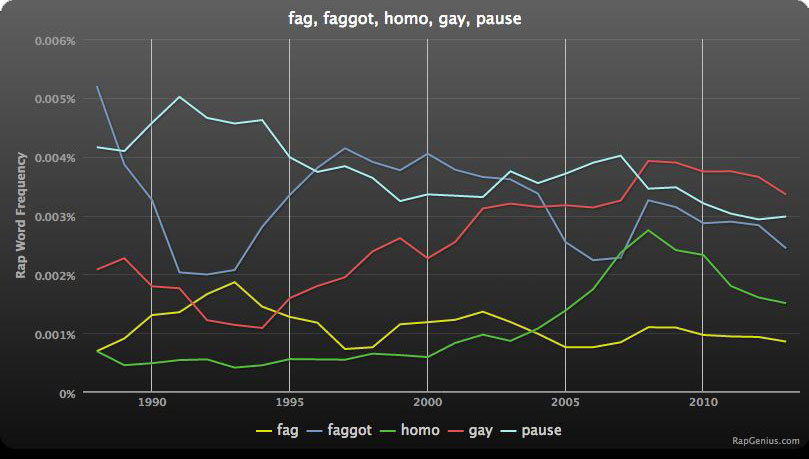
decline in language

I like this article on anti-gay language in hip hop (although the title seems unnecessary).  The above graphic is from the much hated rapgenius.com (not affiliated with the GZA).   But the graphic was included in a nice long write up on Gawker by Rich Juzwiak where he does some lyrical analysis.  While discussing a Frank Ocean lyric Juzwiak writes:

“This is a conversation that hasn’t made its way to mainstream hip-hop before now. It’s probably not as tidy as the most sensitive listeners would prefer. There’s ambiguity there as to whether Ocean’s proposed gunplay is a reaction to homophobia (because saying “faggot” is wrong) or an insult (because being “faggot” is wrong). Ocean is typically terse and selective on these identity matters—it’s possible that he’s still working out this question himself.”

When talking about the number of hit records that seemed to have made it without needing verbal violence toward gay people, Juzwiak explains:

“Hip-hop doesn’t hate gay people. Not all of it, at least. Even when it stumbles in these attempts, even when rappers don’t exhibit the full enlightenment that we’d want from them (Too $hort: “Just go with it, it’s just a lifestyle, you know, so whatever“), it’s still making attempts at engagement, which is more than it was doing even last year and far more than it was doing two years ago.

Still, we’re talking about a vast, varied pool of points of view and opinions. There’s still plenty of homophobic language.”

Here is the link to the article.

Leave a comment

Filed under communication, Gay, hip hop, music, representation

Twist on tagging

I woke up thinking about the fame/anonymity line that successful artists/graffiti practitioners have to navigate.  Made me think about SF’s Barry McGee/Twist.

From a cool interview by Samuel Borkson where Barry McGee emphasizes living, eating kale and going surfing.  When asked what he’d do with a lot of money Twist replies:

BMG: I’m more interested in less than more. Our society has become obsessed with having more, having it all. To what end? Excess, while fascinating to watch, is not the answer to me. Most over budgeted art projects I have seen are terrible.

via BARRY MCGEE AND SAMUEL BORKSON: A CONVERSATION | Dirty Magazine.


Leave a comment

Filed under art, communication, graffiti, health, media