Category Archives: health

Military and toxic waste: ghost fleet

Don’t forget that the most significant polluter in United States history is the nation’s armed services.  Scott Haefner and some colleagues snuck aboard decommissioned boats in the Navy fleet near San Francisco.  Haefner notes:

The ships have shed more than 20 tons of toxic paint debris that have settled into bay sediments, where they will cause problems long after the ships are gone. Even though Congress and the State of California ordered MARAD to address the situation, nothing was done for most of the past decade. Lawsuits filed by environmental groups were also unsuccessful in forcing MARAD to remove the ships. However, after Barack Obama took the Oval Office in 2008, the tide shifted and MARAD began working diligently to clean up and remove the ships.

via Inside the Ghost Ships of the Mothball Fleet | Beyond the Photos.

Leave a comment

Filed under colonialism, disaster, health, learning

Flex! University articulation of labor as duty

The Feminist Wire comes through with a nice write up about academic labor.  Here Paul Seltzer, a GW Women’s Studies major, articulates the painful implications of the academic culture which insists on students and faculty suffering in order to retain connection to the school.

Flexible instructors and flexible students, dependent upon the corporate university for a wage and a future, are those whose labors and bodies stretch to satisfy the requirements that would make them valued members of the university’s community, less at-risk to a budget cut here or a rise in tuition there.  Flexibility means that when the corporate university applies such pressures, instructors and students will bend as much as they can so that they will not snap.  Sure, I can teach another class for minimal pay.  Sure, I will work freshman orientation in return for free housing.  Sure, I will go into debt.

I observe in my own academic life that the credibility of the institution is used to help justify these kinds of decisions.


Leave a comment

Filed under academics, capitalism, feminism, health, learning, propaganda, representation, resistance

Cannibal capitalism: diving and the NFL

I’ve been struggling with the idea I call cannibal capitalism — the idea that one would trade of your body, health and well-being in order to get money.  It makes the most sense to help understand some current rappers — Gucci Mane in particular.

But this morning I got two recomendations from Longreads — one on the NFL and the other on deep-sea industrial diving.  Both seem to suggest that there is a popular understanding that in some occupations — the danger and assumption of self-harm is part of the job.  That one trades of their body in order to continue to survive, and occasionally thrive.  I guess one element of surviving in cannibal capitalism is that one often has a limited selection of options and choices.  In my opinion this is driven by the previous discourse one is saturated in — learn, as the NFL players do — that one is expected to endure suffering for pay and success and one is more likely to see this behavior as normal and participate.

The perspective of pain is what this story is about. For fans, injuries are like commercials, the price of watching the game as well as harrowing advertisements for the humanity of the armored giants who play it. For gamblers and fantasy-football enthusiasts, they are data, a reason to vet the arcane shorthand (knee, doubtful) of the injury report the NFL issues every week; for sportswriters they are kernels of reliable narrative. For players, though, injuries are a day-to-day reality, indeed both the central reality of their lives and an alternate reality that turns life into a theater of pain. Experienced in public and endured almost entirely in private, injuries are what players think about and try to put out of their minds; what they talk about to one another and what they make a point to suffer without complaint; what they’re proud of and what they’re ashamed by; what they are never able to count and always able to remember.

via Worst NFL Injuries – Tom Junod on Injury Issue in the NFL – Esquire.

The deeper you dive, the more you get paid. In his second or third year an apprentice may be promoted, or “broken out,” to a full-time diver. His salary will increase to between $60,000 and $75,000. He will start as an “air diver,” diving as deep as 120 feet while breathing regular air. Jobs at this depth might include retrieving tools from the worksite, or cutting and retrieving the polypropylene cord that runs between the surface vessel and the underwater worksite. Next the diver will be assigned to more complex jobs below a hundred feet, for which he must breathe mixed gas in order to avoid suffering the effects of nitrogen narcosis while working with heavy machinery. A full-time mixed-gas diver can earn more than $100,000 a year. He will perform jobs at ever greater depths, with higher degrees of technical difficulty, until his diving supervisor deems him ready to graduate to saturation diving. Sat divers can make $200,000 a year. Sat’s where it’s at.

via Diving Deep into Danger by Nathaniel Rich | The New York Review of Books.

Leave a comment

Filed under communication, health, learning

Pepsi panic: Beyonce and Mark Bittman

I’m bored with the moral panic associated with Beyonce’s decision to take a big pile of money from Pepsi.  I’m not sure it is fair to expect political leadership or moral consistency from Beyonce.  She is a staggeringly talented entertainer — and anyone who makes personal decisions based on what Beyonce does has their own problems.

Mark Bittman has a pretty hard-worded critique of Beyonce’s Pepsi contract, mostly from the perspective of health in today’s New York Times.

I think we should criticize Pepsi, not the celebrities that they rent to hock their brand.  In some ways Beyonce is an easy target.  Attacking her might even distract from the substantial conversations we need to have about the health harms of soda.  We could note the historical antecedents of disrespecting and diminishing the power of black women entertainers.

And I can’t help but feel a little sorry for Beyonce, because, as a child of the eighties, the Pepsi sponsorship was a sign that a star had become a mega-star.  It is a sign of the shifting culture that we are now moving soda manufacturers into the category with cigarette companies, and her sponsorship is now *bad press*.

I like Mark Bittman, and he is welcome for dinner at my house any time.  I appreciate that he uses his platform in the New York Times to talk about important cultural and health dynamics of food.  In this essay he reminds us of the pervasive ability of sugary beverage manufacturers to advertise to us.  Product placement for instance:

My friend Laurie David counted 26 on-air shots of Coke during last season’s “American Idol” finale and an incredible 324 shots of Snapple in a June episode of “America’s Got Talent.” (“There are Snapple cups placed in front of each judge,” she wrote me. “I counted every time I saw a Snapple cup.”)

To those jaded enough to ask “So what?” I’d reply that’s a measure of how successful these kinds of campaigns are.

via Why Do Stars Think It’s O.K. To Sell Soda? – NYTimes.com.

Leave a comment

Filed under capitalism, food, health, media, race, representation

Lead and crime

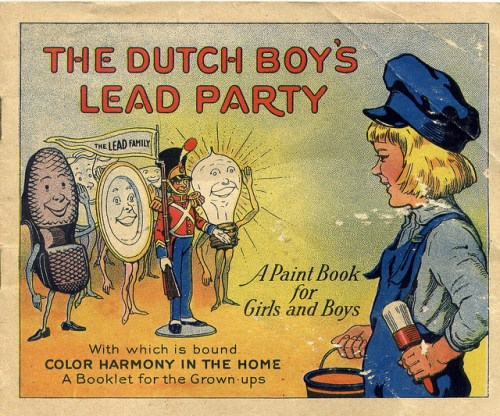
selling toxins with cute kids

We used to market toxins to little kids with ads like the above.  Seems appropriate to connect up with the new studies that suggest that lead toxicity is a lot more destructive than we thought.

Put all this together and you have an astonishing body of evidence. We now have studies at the international level, the national level, the state level, the city level, and even the individual level. Groups of children have been followed from the womb to adulthood, and higher childhood blood lead levels are consistently associated with higher adult arrest rates for violent crimes. All of these studies tell the same story: Gasoline lead is responsible for a good share of the rise and fall of violent crime over the past half century.

via America’s Real Criminal Element: Lead | Mother Jones.

Leave a comment

Filed under capitalism, health, learning

Andrew W.K. parties with the My Little Pony crew

I’m thinking about Iris Young and her notion of the city.

“What ever you want to play with, it’s okay.  It’s more than okay. It’s good.”

‘It was only released in Japan.  But you can get it on illegal downloading.  Please do.’

50 minutes and the party cannon emerges.

‘I would tell them.  It’s totally fine to be in the corner.’

Dude sounds wicked Canadian.

Previously, I wrote about Andrew W.K performing in a wheelchair.

Leave a comment

Filed under health, juxtaposition, learning, music, representation

Two takes on bath salts

Thanks for retronaut for the image

When bath salts first appeared in 2010, the products were crudely packaged — a label from an ink-jet printer slapped onto a plastic container, Ryan said. But over time, they began to look increasingly more professional and often specifically tailored to the place. Products in Louisiana donned names like Hurricane Charlie, NOLA Diamond, Bayou Ivory Flower. Bath salts had also surfaced in Illinois, Kentucky and Florida, but Louisiana was hit especially hard.

The product that Sanders snorted was called Cloud 9. At the time of his death, he was in a drug program for marijuana abuse, actively attending group meetings and undergoing frequent drug tests. He was told that the drug was legal, a great high and wouldn’t show up on a drug test.

via The Drug That Never Lets Go.

This contrast came about organically.  My RSS feed contained this lengthy essay on the chemical make up of bath salts and the erotic towel advertisement about three hours apart from each other.  It was ordained.

Leave a comment

Filed under art, colonialism, drugs, health, juxtaposition, representation

Obama on keeping it together

I was not impressed with the rest of this essay, but the paragraph about the President keeping his shit together seems relevant to my life right now.

“You have to exercise,” he said, for instance. “Or at some point you’ll just break down.” You also need to remove from your life the day-to-day problems that absorb most people for meaningful parts of their day. “You’ll see I wear only gray or blue suits,” he said. “I’m trying to pare down decisions. I don’t want to make decisions about what I’m eating or wearing. Because I have too many other decisions to make.” He mentioned research that shows the simple act of making decisions degrades one’s ability to make further decisions. It’s why shopping is so exhausting. “You need to focus your decision-making energy. You need to routinize yourself. You can’t be going through the day distracted by trivia.” The self-discipline he believes is required to do the job well comes at a high price. “You can’t wander around,” he said. “It’s much harder to be surprised. You don’t have those moments of serendipity. You don’t bump into a friend in a restaurant you haven’t seen in years. The loss of anonymity and the loss of surprise is an unnatural state. You adapt to it, but you don’t get used to it—at least I don’t.”

via Michael Lewis: Obama’s Way | Vanity Fair.

Leave a comment

Filed under communication, health

Rhetoric, sports and ability

Sporting events are exceptionally significant in human culture.  In every corner of the planet kids kick a ball around.  While sports are ever present, we also have to navigate the stories that define what that play means.  Competition, fair play, hard work, hierarchy, teamwork — we are steeped in the narratives that permeates sports stories.  These stories invite participation, and they also exclude.  It is worth considering what happens when the desire to play a sport doesn’t conform to the bodily requirements of that sport.

One punchline for these stories ends with Rudy Ruettiger, the pint-sized Notre Dame football player whose hard work eventually leads the coach to put him in the game.  Another possible ending is for accommodation through the development of a new sport.  Wheelchair rugby comes to mind.

Recent convert to wheelchair racing, Victoria Stagg Elliott wonders why more  people don’t get involved in adaptive sports in an essay at The Rumpus.

What if more runners, when faced with having to hang up their shoes for whatever reason, switched to wheelchair racing rather than cycling or swimming or giving up physical activity completely?

Here’s what I think would happen:

So-called disabled athletes would have more opportunities to participate in able-bodied sports and vice-versa. We would all realize that we are more alike than different, and that playing alone really isn’t very much fun.

via What If Wheelchair Racing Were Just Another Sport? – The Rumpus.net.

I like Elliot’s take on adaptive sports, and the encouragement for people to simply play.  It seems like sports and play are worthwhile fundamental human desires — it is worth crafting a world where people who wanted to participate in any activity would get the chance.

It also takes a certain amount of work to change sports stories.  With sports the concept of fairness can help to persuade some people to make sports inclusive, but the Title IX separate-but-equal is a predictable pressure release valve.  It seems valuable to push forward on all intellectual fronts to bring forward inclusion.  To support adaptive sports, to fund and celebrate sports communities who become more inclusive, and to engage in sporting play ourselves — regardless of our level of ability.

Leave a comment

Filed under communication, disability, health, human rights, representation, sport