
Category Archives: music
Janelle Monae & 500th post
This is the 500th post on life of refinement. I’m proud of the non-linear series of artifacts gathered here that point toward new understandings. I use this web site to archive interesting things. Meaningful things. This is a curation of the rambling series of artifacts and patterns of representation I find significant enough to be marked and analyzed in a free open public space. This is as close to learning as we’ll ever get.
Thanks to all who read the website.
***
I knew of Janelle Monae and appreciated her music but only had singles in my library. Inspired by a Wax Poetics write up, I bought a copy of “The Electric Lady” last night. With two full listens into the album (barely enough to comprehend what is going on) I’m sold.
This project is wonderful dance music and a really good concept album (or an extension of a concept album to multiple projects — Monae plays an alter ego pretty consistently). The record is an extended riff on technology, cyborg/human interactions, civil rights and living life with dual identities. Given that “The Electric Lady” could be a Phillip K. Dick novel, the smooth inviting production and musicianship is what carries the project.
This albums sounds VERY eighties to me. From the sonic structure and choices of beats/samples to the rock opera lyricism of the concepts. At points I was reminded of my nostalgic childhood filled with Styx, Heart, Bon Jovi and Run DMC. The strings sound eighties. The drums sound eighties. Even the vocal harmonies remind me of eighties hits. But the eighties were a point of technological jump off and the slight broadening of pop music.
I like the futuristic world that Monae is painting. And the willingness to build futuristic pop music out of the sonic blocks of the past. Astute Monae names tracks after inspiring pioneers: “Sally Ride” (astronaut) and “Dorothy Dandridge Eye’s” (first black woman to be nominated for an Academy Award).
In the context of the blog, I’ll quote the end of the “Dance Apocalyptic” when Janelle Monae says: “I really really want to thank you for dancing to the end.” Thanks for reading and dancing ’til the end.
Filed under art, communication, funk & soul, hip hop, human rights, music, representation, resistance, rock and roll, technology
E-40 Bamboo
Salute to E-40! Nice dance-heavy video to get things going for the day, but the song is great. The beat has that Bay area clap, snap and slap sound while 40 Water’s flow just disrespects the beat.
Anyone know who made this beat?
Dave Chappelle and detournement
Jimmy Fallon interviews Chappelle and he let’s loose a number of wonderful funny gems. Salute to Fallon, The Roots Prince and Dave Chappelle. A few key moments worth observing:
2:00 “the lost Root” and racial stereotyping.
2: 30 Chappelle’s explanation of the Roots and all their musical buddies in “shelves” at Electric Ladyland is beautiful.
3:10 Prince and detournement (to turn around against itself). “That is a Prince Judo move right there.” “That’s checkmate right there!” To use the humorous image of Dave Chappelle as Prince to sell records — situationist genius. Here is the cover from Prince’s actual song: breakfast can wait.” Thanks to Okayplayer

Thanks to Okayplayer for the image
I actually went and bought the song. You can go to 3rdeyegirl and spend eighty-eight cents to buy a snare and slap-bass Prince tune about . . . well helium-inclusive erotic love. Perhaps another level of detournement is making a great song about a decade-old Chappelle skit.
4:30 Jay-Z, the Black Album and Kanye’s confident rewind. I also love Chappelle’s imitation of Common’s face when he hears the Common-referential lyric.
5:40 Kanye and the punchline: “my life is dope and I do dope shit!” while getting a sneak peak at not-yet-released Chappelle Show skits. 110%.
Filed under communication, hip hop, humor, media, music, race, representation
No Malice & Pusha T on CNN
Several casual observations:
– Bill Weir, CNN reporter seems manipulative, disrespectful and really entitled.
– Both spend some time trying to not incriminate themselves. It is Pusha who makes the most blatantly inconsistent statement when he refuses acknowledge drug profits in part 2. “No, I’m a really good rapper.”
Probably worth juxtaposing with “King Push” first track from his most recent album:
– I have a little more clarity about the difficulties of No Malice. I think he makes some of the most explicit justifications for why he refuses to perform violent drug rap music any more. I appreciate that he gives up obvious financial gain to be real to his family and his beliefs.
– Pusha T’s segments are basically Pusha T advertisements. The exchange where he tells Weir how much publicity he’ll get from being on CNN is awesome. Pusha is phenomenally media savvy and makes it clear that he wouldn’t be on CNN if it didn’t benefit him.
– No Malice’s argument about white consumption of violent black-performed drug rap is pretty compelling.
– When asked by Weir why he doesn’t take the money to perform Clipse songs, No Malice gives the best exchange of the series:
“Brother, that money, that money at one time, was out for my life. They can’t invent a dollar amount to get me out there to tell . . . look at what’s at stake? I can’t tell anybody about selling drugs any more, I can’t even make it look cool anymore. There are people that are dying, look at what is going on in Chicago. And I like I said earlier, your race can enjoy it! And laugh and joke and enjoy it . . . and then get back to business. I have a message and I have to share it. Then I have to let you do what you want with it. You know, you do what you want with it. But, I’ve got enough blood on my hands. Enough.”
– No Malice, CNN.
Filed under capitalism, communication, cultural appropriation, drugs, hip hop, juxtaposition, media, music, race, representation, vulnerability
Tech N9ne and Murs: Hard
Tech N9ne showcases a lot of different styles in those verses. Murs is going to do good things with Strange music. I like that he shows up and gives respect to the other members of the team. I’m in favor of any music video that requires a warning label that it might harm you.
Performing arguments: The Roots . . . And then you shoot your cousin
Okayplayer has a slightly obtuse review of the live performance of The Roots new album. The album is called . . . And then you shoot your cousin. Here is a snippet from the review by Eddie “Stats” which highlights the use of performance to make some interesting arguments:
Questlove is at the decks now and as the lights strobe a massive avalanche of balloon animals suddenly falls on the stage, a Jeff Koons flood of meaningless forms, falling in the framedrop slo-mo created by the flash of the strobe. A doo-ragged character enters the stage, humming, holding a gigantic red balloon like a kite. There’s something clownish in his dancerly movements, he has his mouth absurdly open, recalling at once a mime, Flavor Flav in wop-mode, the broom-wielding enforcer of the Apollo as he sweeps balloons away in the wake of his feet. In silence his dance picks up in intensity and his movements resemble Flav less than legendary b-boy choreographer Pee Wee Danz. As he steps and swims through balloons, the pop of dying inflatables echo like gunshots. We are fully in Fluxus territory now, improvisation colliding with a wickeder kind of randomness to create an ‘anything could happen’ tension in the room.
via The Roots chop up their new LP into art live (photos + recap) Okayplayer.
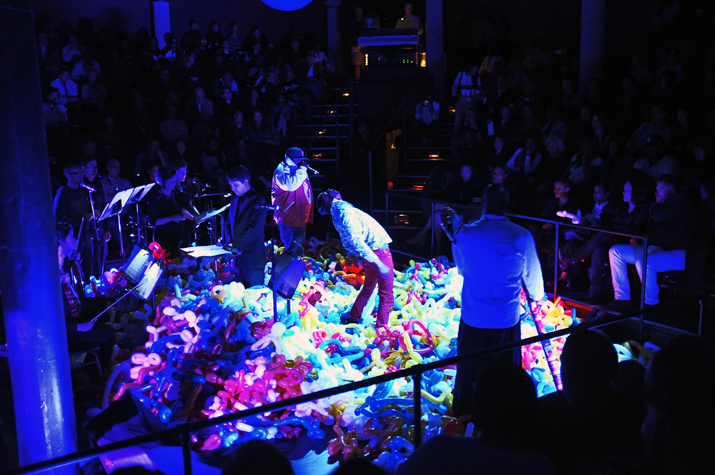
The Roots performing live among some balloon animals. Photo by Mel D. Cole taken with respect from Okayplayer.
Filed under art, communication, dance, hip hop, music, race, representation, resistance
Bun B, hip hop and changing culture

Photo by Jacob Moore. Bun B and Mayor Parker declaring Bun B Day in Houston. August 2011
Bun B is an absolute boss, a fact reasserted in the Texas Monthly article on his influence. I find it interesting how much cultural change Bun B has been involved in. UGK were crucial in convincing the world to appreciate southern hip hop. Bun B is a great example of community minded hip hop leader, as Katy Vine explains:
Bun B’s life these days is so deeply intertwined with Houston’s that he is often referred to as the city’s unofficial mayor. He has been featured in anti-texting public service announcements. He helps publicize drives for the Houston Food Bank. He hosts a twice-weekly segment on the TV station CW39 called Bun’s Beat (recent installments include “Bun B’s Thoughts on the NFL Banning the N-Word” and “Bun B’s Advice for Returning College Students”). He has been a regular guest on networks such as Comcast SportsNet Houston to discuss the Astros and the Rockets. He attends nearly every major concert. He promotes the city’s food and culture actively on his Twitter feed, where he can seem, at times, like a one-man chamber of commerce. “If you want to find out the best sushi spot, barbershop, or club, he would probably be the person with the widest Rolodex,” Houston rapper Chamillionaire told me. “You could ask him something crazy, like where to find left-handed scissors in Houston, and he could probably point you in three different directions.”
via Man About Town: Page 2 of 8 | Texas Monthly.
Let us note that place has been one of the most significant parts of hip hop culture (where are you from?). What if there are creative hip hop intellectuals in every town in the world, who love where they are from so passionately that they will become positive leaders in their own places? It’s going to take some forward thinking municipalities to get the benefits of including hip hop intellectuals.
Thanks to thehairpin for the linque.
Filed under hip hop, kindness, music, representation
Harm reduction, EDM & ‘Molly’
Longreads suggested the tell-all essay on so-called molly and Electronic Dance Music festivals written by Shane Morris. It is a good read with snappy prose and a strong argument that the EDM festivals are locations where lots of people seek drugs from one-time drug dealers who may sell them almost anything.
But I’m more taken with his follow up essay where he not only answers many of the criticisms and also suggests a series of solutions.
Much of what he suggests is harm reduction – trying to make risky behavior (of almost any stripe) less likely to result in damage. But it is also a sincere plea for bystander accountability and a change in the culture of drug-users and those promoters who make money on festivals.
I’m only saying that it’s time the EDM community starts acting like the family it espouses itself to be. No more secrets. No more “turning around and pretending you didn’t see that happen.” No more fearing what might happen if you ask for help. No more pretending people aren’t getting hooked on Molly. If everyone in the EDM community collectively decides to help themselves, rather than bending to legislation, we can fix this. If we advocate a culture of safety, health, and honesty, we can correct the course of this ship before it maroons itself on the rocks.
Part I. We need a return of safe, “cool down” areas to EDM events. If we all acknowledge that people are going to do drugs, and it’s just something that happens, then we should also be able to acknowledge that every person deserves to be safe, healthy, and well. If you’re not feeling OK, there needs to be a place you can go and sit down, chill out, drink water, maybe even get a bag of ice and put it on your head.
via Finding Molly: Reconstructing Dreamland | Bro Jackson.
Morris also suggests people “call out the idiots promoting overconsumption,” and for transparency (including drug testing kits for prospective users). He also commits to making his own music events more safe and offers up “safe word” as the catchphrase for a campaign of communication:

Here is his explanation:
In BDSM circles, using a safeword means things have gotten too much for you to handle, and you need to stop, without judgement. In that regard, I feel its purpose is well served here as well. If you’re at an event, and things have spun out of control for you, a friend, or perhaps a stranger you’re just looking out for–you should be able to remove yourself from the situation and know your safety is the primary concern, without fear of repercussions or judgement.
via Finding Molly: Reconstructing Dreamland | Bro Jackson.
Filed under communication, dance, do-it-yourself, drugs, health, music, punishment, vulnerability
 Life of refinement
Cannibal Capitalism the Birdman edition
Photo of Birdman’s RG (perhapsRich Gang) and YMCMYSL (perhaps Young Money Cash Money Young Stoner Life) tattoos. Thanks to The Smoking Section for the photo, I assume taken from Birdman’s social media.
Birdman is trying to sign Young Thug to his record label. To prove his sincerity he tattooed several Young Thug associated tattoos on his hands and face.
Cannibal capitalism is the mediated experiences of human suffering projected for human entertainment and profit. It is obvious that the bodily impact of Birdman’s tattoos is a particular kind of communication. Tattoos have often been the indication of long-term committment for gangs, military units and fans of musical artists. Birdman’s tattoo is amplified on social media and through dozens of rap blogs. It is a public communication of his commitment intentionally articulated to bring his company more profit (by signing a strong young artist).
In some ways the suffusion of cannibal capitalism into many so-called reality television shows (cooking shows, real estate flippers) is an indication of the desperation of many people. But Birdman isn’t desperate (not in the poverty sense) — he can give expensive cars and jewelry to friends and label-mates. I heard on NPR he just gave a Bugatti to Justin Beiber.
Fleeting fame and the potential for profit have encouraged more than one reality TV contestant to become a public exercise in morality and exclusion. (Did you hear about Stephanie on Top Chef when she cut herself and she went to the hospital?!?! How about that Survivor episode where that guy broke his leg? What a wimp!)
Cannibal capitalism can be mapped whenever a human is harmed and it is filmed and amplified for other people’s pleasure. When this happens a particular morality of self-sacrifice is usually articulated. Announcers and other contestants express just how someone should take the suffering. In some ways the harm done to the body gives access to comment on the body.
In the case of Birdman’s new tattoo’s the morality expressed isn’t how tough Birdman was for getting the ink, but rather how idiotic it is to tattoo to something as fleeting as a new potential corporate rap alliance. Here is the Smoking Section‘s Gotty mocking the social costs of multiple face tattoos.
We recognize that the fact that Birdman will never have to go to a job interview ever in his life. The Cash Money CEO’s so loaded his kids kids most likely will never have to worry about working either. With that said, his continuing effort to ink his whole body with scribblings dedicated to Cash Money subsidiaries is a little odd.
Actually, the “RG,” presumably for his Rich Gang management company, added to his right cheek isn’t that bad because what the hell would two more letters do to a face littered in tats? It’s the “YMCMYSL” scripted on his fingers that doesn’t make sense. Assuming the letters rep Young Money Cash Money Stoner Life as in Young Thug’s movement, that’s more confusing.
via Birdman Permanently Pays Homage To Young Thug | The Smoking Section.
Leave a comment
Filed under capitalism, communication, hip hop, music, representation
Tagged as Birdman, Birdman and cannibal capitalism, Birdman tattoo, Birdman tattoos alliance, cannibal capitalism, cannibal capitalism and hip hop, face tattoos and morality, moral commentary mediated harm, suffering and hip hop morality, tattoo, tattoos to communicate commitment, The Smoking Section, Young Thug