Category Archives: race

Thinking about racist fraternities who love Waka Flocka Flame

Yesterday the noxious video of Oklahoma frat guys chanting racist stuff on a bus hit the interwebs.  The chant not only bragged about preventing “niggers” from joining the fraternity, but also threatened lynching.

The fraternity was dismantled and student members told to move out of their house (and two members were kicked out of school).  I think it is worth thinking about this moment in time not only for the accountability for racist insults (which I support) but also the redemptive narratives of those-kids-weren’t-that-bad (which I think is worth examination).

One redemption thread was that the closure of the house was going to mean that the long-time chef of the fraternity house Howard Dixon would lose his job.  Fundraisers quickly raised tens of thousands of dollars for Mr. Dixon.  In addition to brightening the reputation of the fraternity members, this also points toward the nasty preference to imagine that a ‘few bad apples’ are what spoiled the bunch.

Having attended several fraternity-rich universities, my take is that the whole system is a nostalgic white supremacist dream.  To select your friends and cloister is an invitation for toxic entitlement to blossom.   (Thinkprogress has some good context for this particular fraternity.)

My initial thought about SAE was that the interwebs were enraged because this example is such old-school bigotry that its an easy critique.  The language about gamergate or sexualized violence at college campuses seldom gets this kind of swift action.  I think we doth protest too much.   It’s easy to point as SAE as racists while ignoring larger structural injustices.

Waka Flocka Flame, an unlikely political advocate, rushed in with a quick cancellation of a show.  Initially I was wondering how many of the racist chanting frat guys on the bus ALSO had tickets to go see Waka Flocka Flame?   Quite a few it turns out.

Racism doesn’t mean that you aren’t into black culture or hip hop.  The poisonous element of this racist chant was the proud exclusionary bragging of a (mostly white) frat in keeping out black people.   Checking in with the Reddit thread on this discussion, a number of people made the same observations.  That they had known white-identified people who were into rap music and also prejudiced.   As one commenter put it: “It’s sad… they can be performers, servers or the nannies. They could be their life-saving doctor, their pastor, their therapist, their mailman, and pretty much everything else in the world. Except simply a person.”

The double consciousness of racists.  To objectify and divide marking difference to ensure that white supremacy continues.   I wasn’t surprised when someone mentioned that Waka Flocka had been hired by this very fraternity to perform at a show.   Thus the video of Waka Flocka Flame shotgunning beers and performing for what seems like a mostly white Oklahoma SAE crowd last year.

It puts Waka Flocka’s cancellation of the show in a slightly less charitable light.  We might read it as solidarity against racist injustice.  We might also call it covering your public relations.

Turns out Waka Flocka has a ton of fraternity shows on youtube. Check the Baylor video where he explains that he doesn’t like a woman in the crowd grabbing his ass.  Note his justifications at 2:05.

http://https://www.youtube.com/watch?v=FaczdDExNl4&html5=1

Let’s note that the Baylor Waka Flocka show has some visibility  of the entitled audience members who are consuming Waka Flocka Flame.  When Waka is grabbed he explains that he “feels like a bitch.”  It is dumb sexist stuff, but we can also note his refusal to be grabbed and the part about “in my community.”  I think Waka Flocka Flame probably has crazy stuff happen during his live shows (including being grabbed), but something about this rebuttal suggests that this moment is ‘beyond the pale.’

The normalcy of partying to Waka Flocka and then having a racist admission policy (and chanting about it) seems like the interesting part of this SAE duality.  Challenging racism in our day and age needs to be more rigorous and intersectional than this one example, but its a good thread to get access to some key arguments.

Leave a comment

Filed under academics, hip hop, juxtaposition, race, representation

Mimi Thi Nguyen: punk and resistance

There are a lot of smart insights in this Bluestockings interview with Mimi Thi Nguyen.  Feministing shared the link and gave me the heads up that there was some discussion of guilt and professional expectations in the essay.  Nguyen seems persuasive to this punk professor when she writes:

The disjuncture then comes when I consider how we are encouraged to carry ourselves in the academy. I feel a lot of pressure to professionalize, and the prescriptions for professionalization often run counter to my way of being in the world. I also struggle with the directive that I am supposed to professionalize my students. I don’t hold with the idea that I should train students to be better workers, because the content of “better” — more obedient, more efficient, whatever — runs counter to what I want to teach. In my feminist theories courses, I say, “Yeah, I just gave you assignments with deadlines! But I also want to say to you, what’s so great about work? Why do we believe work is supposed to be edifying? Should we always have to be productive? Why do we imagine work as something that gives us dignity? What if it’s just wearing us down?” My history in punk totally informs these attempts to practice other ways of being in a classroom, and other ways of being a professor.

via (Un)productivity in the Digital Age — A Conversation with Mimi Thi Nguyen | Bluestockings Magazine.

Like Nguyen I was a reader of Maximum Rock and Roll since my teens.  I was deeply informed by the DIY spirit and raw love of music and counterculture that ran through MRR.  Along with that inspiring freedom were some toxic interview discussions and columns that also were a big part of MRR.  I remember a particularly racist / sexist sex column, perhaps from Mykel Board?  Nguyen as a young punk writes MRR and challenges the columnist for MRR and gets a hateful column in reply.  The scrap with MRR inspires her to create her own zine Race Riot.

The impetus for Race Riot came when a columnist at Maximum Rockandroll wrote about his Asian fetish, suggesting that Asian women’s eyelids look like vulva, and that their vulva might be also horizontal. It is an old imperial joke — there are all kinds of imperial jokes about how racial, colonial women’s bodies are so inhuman that their genitalia might reflect this alien state. I wrote a letter to Maximum, cussing and citing postcolonial feminist theory. He then wrote a lengthy column in response about how though I’m Asian, because I’m an ugly feminist, he wouldn’t want to fuck me anyway. There was a discussion at the magazine about whether or not to publish this column because the magazine had a policy — no racism, no sexism, no homophobia. But the coordinator and founder of the magazine decided that this column qualified as satire, and so it was acceptable.

It was really infuriating for me to be 19 years old, totally invested in punk and politics, to be attacked under the guise of racist cool in the punk magazine. I was like, “Fuck it, I’m quitting punk.” But I figured I should do something, to leave something behind as a practice and as a document, to reach other punks of color who might feel as isolated as I did in the aftermath.

via (Un)productivity in the Digital Age — A Conversation with Mimi Thi Nguyen | Bluestockings Magazine.

I know a lot of punks who saw the academy as a reasonable place to continue thinking about punk praxis.  Or more particularly, many of us go to an academic job and are reasonably punk in that and other parts of our lives.  Many of the punks I knew are still working with intentional collectives, creating media, hosting shows, playing music, creating alternative spaces and doing-it-themselves.  I’ll give a shout out to my friend Zack Furness and his book Punkademics.  I think you can read the whole book at Minor Compositions.

I’ll note my appreciation and agreement with Nguyen’s analysis of internet communications and the need for pauses for reflection.   She argues:

New technologies have produced expectations that we now have more democratic access to more knowledge, and that we must accommodate ourselves to an accelerated sense of time. But I am wary of this internalization of capital’s rhythms for continuous consumption and open-ended production. I hate feeling obliged to produce a post or tweet on a timetable. It makes me anxious. There is value in being about to respond quickly to an object or event, of course, but I also want to hold out for other forms of temporal consciousness, including untimeliness and contemplation of deep structures, sitting with an object over time to consider how it changes you, how the encounter with it changes the nature of your inquiry.

via (Un)productivity in the Digital Age — A Conversation with Mimi Thi Nguyen | Bluestockings Magazine.

Good interview and strong arguments.

Leave a comment

Filed under academics, capitalism, communication, do-it-yourself, feminism, media, music, punk, race, representation, resistance, sexism, technology

Americans are vampires: Ebola edition

I ran across a Boing Boing post where they point out that two American missionaries who contracted Ebola appear to have saved by an experimental treatment.  CNN describes the situation:

Its a story that could have come from a cinematic medical thriller: Two American missionary workers contract Ebola. Their situation is dire. Three vials containing a highly experimental drug are flown into Liberia in a last-ditch effort to save them. And the drug flown in last week appears to have worked, according to a source familiar with details of the treatment.Dr. Kent Brantlys and Nancy Writebols conditions significantly improved after receiving the medication, sources say. Brantly was able to walk into Emory University Hospital in Atlanta after being evacuated to the United States last week, and Writebol is expected to arrive in Atlanta on Tuesday.

via Ebola drug likely saved American patients – CNN.com.

1.   Starting in March 2014, Ebola started to be seen in West Africa.  More than 1600 Africans have shown up sick with more than half of those infected dying.  None of these people got a last-minute salvation.

2.  Everyone in the world has to be terrified of Ebola.  It is one of the most scary diseases I’ve ever heard about.  The notion that a pharmaceutical company in San Diego had a treatment that seems to have worked that was never shared with dying African people is offensive.

3.  I can only imagine what this looks like to people in Guinea, Sierra Leone and Liberia.

4.  The cure had to be pried out of the hands of a for-profit pharmaceutical corporation.  Turns out the months of Africans dying wasn’t sufficient incentive to release the treatment.   So how did these two white American missionaries find out about this miracle treatment?  CNN explains that the missionary charity (Samaritans Purse) made the connection:

As the Americans conditions worsened, Samaritans Purse reached out to a National Institutes of Health scientist who was on the ground in West Africa, according to the National Institute of Allergy and Infectious Diseases.”The scientist was able to informally answer some questions and referred them to appropriate company contacts to pursue their interest in obtaining the experimental product,” NIAID said.The experimental drug, known as ZMapp, was developed by the biotech firm Mapp Biopharmaceutical Inc., which is based in San Diego. The patients were told that the treatment had never been tried before in a human being but had shown promise in small experiments with monkeys.

via Ebola drug likely saved American patients – CNN.com.

5.  You might call these Americans vampires.  Back from the dead saved by the magical blood of the sacrifices of those who came before them:

The medicine is a three-mouse monoclonal antibody, meaning that mice were exposed to fragments of the Ebola virus and then the antibodies generated within the mices blood were harvested to create the medicine. It works by preventing the virus from entering and infecting new cells.

via Ebola drug likely saved American patients – CNN.com.

The rush of resources and last-minute miracle part of this narrative is worth talking more about.  But also the sacrifices of the mice, monkeys and the dead Africans have to be considered when thinking about these two saved missionaries.

I think this makes visible the hierarchy of human bodies — the idea that some people count more than others.

Worth noting that the Wall Street Journal reports that one of the Americans was also given a blood transfusion from an African Ebola survivor.

Dr. Brantly and Ms. Writebol began receiving supportive care as soon as they were diagnosed, according to their respective charities. Dr. Brantly also got a blood transfusion from a 14-year-old boy who survived Ebola under Dr. Brantlys care, in the hope that antibodies would help him, too, fight off the virus. Both Dr. Brantly and Ms. Writebol received an experimental serum, the charities said, though they didnt specify what the treatment was.

via U.S. Ebola Virus Patient Being Treated in Atlanta Faces Crucial Days – WSJ.

6.  Some people might ask: ‘don’t you think it’s worth it? Having a potential cure for Ebola is more important than any of these complaints about how the drug got made or released?

I would respond that the harm is done.  Any attempt to justify this kind of hierarchical violence is probably worth noting in itself as evidence of a pernicious desire in the questioner to defend the pharmaceutical company.

Of course I wish for a cure for Ebola and am glad that a treatment seems to be in the works.  I hope for an immediate and full distribution of this new treatment to everyone who has Ebola.

I haven’t seen any leader or press report advocating that the drug should be shared with other dying people.

It is always worth thinking about how we do things.   Few would deny that injustices are done in the name of best intentions.   And we should examine how CNN and the Wall Street Journal write about a phenomenon.

The Wall Street Journal  reports that the death rate of those who get Ebola is one reason why researching a cure isn’t a priority:

There are several vaccines and drug treatments in development and testing for Ebola, but none have been approved by regulators. Commercializing them is a challenge given that Ebola is a rare disease, said Thomas Geisbert, who works on potential Ebola vaccine platforms as a researcher at the University of Texas Medical Branch at Galveston.”Ebola is very rare—there is not a financial incentive for large pharmaceutical companies to make vaccines for Ebola,” he said. “Its really going to require government agencies or a foundation.”

via U.S. Ebola Virus Patient Being Treated in Atlanta Faces Crucial Days – WSJ.

7.  I’m glad that someone helped to save these two people’s lives.  Here is hoping that same impulse counts for everyone else in the world.

Leave a comment

Filed under Animals, capitalism, colonialism, communication, disaster, drugs, health, media, race, representation, rhetoric, technology

Dave Chappelle and detournement

Jimmy Fallon interviews Chappelle and he let’s loose a number of wonderful funny gems.  Salute to Fallon, The Roots Prince and Dave Chappelle.  A few key moments worth observing:

2:00 “the lost Root” and racial stereotyping.

2: 30 Chappelle’s explanation of the Roots and all their musical buddies in “shelves” at Electric Ladyland is beautiful.

3:10 Prince and detournement (to turn around against itself).  “That is a Prince Judo move right there.” “That’s checkmate right there!”  To use the humorous image of Dave Chappelle as Prince to sell records — situationist genius.  Here is the cover from Prince’s actual song: breakfast can wait.”  Thanks to Okayplayer

Thanks to Okayplayer for the image

I actually went and bought the song.  You can go to 3rdeyegirl and spend eighty-eight cents to buy a snare and slap-bass Prince tune about . . . well helium-inclusive erotic love.  Perhaps another level of detournement is making a great song about a decade-old Chappelle skit.

4:30 Jay-Z, the Black Album and Kanye’s confident rewind. I also love Chappelle’s imitation of Common’s face when he hears the Common-referential lyric.

5:40 Kanye and the punchline: “my life is dope and I do dope shit!” while getting a sneak peak at not-yet-released Chappelle Show skits. 110%.

Leave a comment

Filed under communication, hip hop, humor, media, music, race, representation

No Malice & Pusha T on CNN

Several casual observations:

– Bill Weir, CNN reporter seems manipulative, disrespectful and really entitled.

– Both spend some time trying to not incriminate themselves.  It is Pusha who makes the most blatantly inconsistent statement when he refuses acknowledge drug profits in part 2.  “No, I’m a really good rapper.”

Probably worth juxtaposing with “King Push” first track from his most recent album:

– I have a little more clarity about the difficulties of No Malice.  I think he makes some of the most explicit justifications for why he refuses to perform violent drug rap music any more.  I appreciate that he gives up obvious financial gain to be real to his family and his beliefs.

– Pusha T’s segments are basically Pusha T advertisements.   The exchange where he tells Weir how much publicity he’ll get from being on CNN is awesome.  Pusha is phenomenally media savvy and makes it clear that he wouldn’t be on CNN if it didn’t benefit him.

– No Malice’s argument about white consumption of violent black-performed drug rap is pretty compelling.

– When asked by Weir why he doesn’t take the money to perform Clipse songs, No Malice gives the best exchange of the series:

“Brother, that money, that money at one time, was out for my life.  They can’t invent a dollar amount to get me out there to tell . . . look at what’s at stake? I can’t tell anybody about selling drugs any more, I can’t even make it look cool anymore.  There are people that are dying, look at what is going on in Chicago.   And I like I said earlier, your race can enjoy it!  And laugh and joke and enjoy it . . . and then get back to business.  I have a message and I have to share it.  Then I have to let you do what you want with it.  You know, you do what you want with it.  But, I’ve got enough blood on my hands.  Enough.”

– No Malice, CNN.

Leave a comment

Filed under capitalism, communication, cultural appropriation, drugs, hip hop, juxtaposition, media, music, race, representation, vulnerability

Performing arguments: The Roots . . . And then you shoot your cousin

Okayplayer has a slightly obtuse review of the live performance of The Roots new album.  The album is called . . . And then you shoot your cousin.  Here is a snippet from the review by Eddie “Stats” which highlights the use of performance to make some interesting arguments:

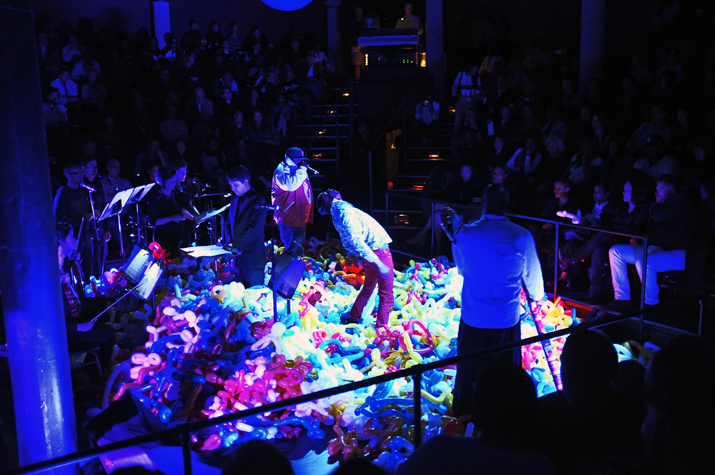
Questlove is at the decks now and as the lights strobe a massive avalanche of balloon animals suddenly falls on the stage, a Jeff Koons flood of meaningless forms, falling in the framedrop slo-mo created by the flash of the strobe. A doo-ragged character enters the stage, humming, holding a gigantic red balloon like a kite. There’s something clownish in his dancerly movements, he has his mouth absurdly open, recalling at once a mime, Flavor Flav in wop-mode, the broom-wielding enforcer of the Apollo as he sweeps balloons away in the wake of his feet. In silence his dance picks up in intensity and his movements resemble Flav less than legendary b-boy choreographer Pee Wee Danz. As he steps and swims through balloons, the pop of dying inflatables echo like gunshots. We are fully in Fluxus territory now, improvisation colliding with a wickeder kind of randomness to create an ‘anything could happen’ tension in the room.

via The Roots chop up their new LP into art live (photos + recap) Okayplayer.

The Roots performing live among some balloon animals.  Photo by Mel D. Cole taken with respect from Okayplayer.

The Roots performing live among some balloon animals. Photo by Mel D. Cole taken with respect from Okayplayer.

Leave a comment

Filed under art, communication, dance, hip hop, music, race, representation, resistance

Positionality: Ebony on Leslie Jones, humor and slavery

Photo from Ebony Magazine, via Saturday Night Live

I appreciated that Leslie Jones wrote an extended riff on slave sexuality and the African American experience on Saturday Night Live.  I recognized the controversial elements, but it was also a crash course on hierarchy for a few SNL viewers.

Slavery was an institution built on rape.  Angela Davis notes that the representation of Africans as animals also meant a notorious breeding/rape part of the economy.  Driven by profit, slave masters would rape in order to make more slaves.

It also necessitated a whole hundred years of representations of black women’s sexuality as somehow complicit in this sexuality.  Hierarchies of white sexuality as pure and desired versus black sexuality often articulated as lusty and despised (bogus).

So when Leslie Jones turned her criticism of the subject to her own body she skipped the rape part of of slave economy.  Of course the humorous part of the skit was imagining that a slave would be empowered as  . . .  perhaps a number one draft pick.  Jamilah Lemieux, editor at Ebony was quick to notice this and argue that it’s a little 2014 for representations of happy slaves:

What about the producers, directors, cast members who watched this play out? No one said, “You know this is going to upset a lot of people, right?” SNL now has at least five Black actors and writers…one would hope that that would have been enough to stop this train. That is why we wanted Black women in the writers’ room in the first place, to prevent exactly this.  Because I am willing to bet that had a Jewish writer conceived an ‘Anne Frank meets Justin Bieber’ skit after the singer made his regrettable comments about the young Holocaust victim, someone would have had the good sense to shut it DOWN.

(When does someone shut down jokes about slavery? And how bad are the racist jokes that don’t make it past the drawing board?)

via Once Again, No One Is Laughing at ‘SNL’ – Entertainment & Culture – EBONY.

No doubt SNL is a racist institution and much of their humor hinges on toxic sexist and racist tropes. Jamilah Lemieux makes clear the positionality of Jones in the ways she lampooned her own desirousness.

I don’t know if she’s just doubling down and committing to defending a completely indefensible (IT WASN’T REALLY WASN’T FUNNY, MA) skit, or if she really just doesn’t grasp what was wrong with it. But it’s depressing that Jones would play out her own issues with feeling undesirable  in a way that not only made her, in that moment, perhaps as unattractive as humanly possible, but also mocked other Black women who may be taller, larger or outside the ‘norm’ in the process. Comedy can be cathartic, dark, subversive…but that takes skill that wasn’t displayed here. She didn’t call to question why women like her are, by her accounts, less wanted than the Lupitas and Beyonces of the world; she talked about fighting Crips for a White dude and popping out NBA-worthy babies on demand.

via Once Again, No One Is Laughing at ‘SNL’ – Entertainment & Culture – EBONY.

Leave a comment

Filed under media, protest, race, representation, rhetoric, sexual assault

Power, autonomy, body and twerking: Kimari Brand

Brilliant breakdown of twerking and bodily representation.  Smart insights from Kimari Brand about power and the significance of the dance form (film by Irma L. Garcia).  Brought to me by the ever-on-point Feministing.  Good preview of the video by Sesali Bowen in Feministing:

Utilizing multiple experiences — including a course on performance, feminism and social justice, a trip abroad to study Afro-Caribbean culture and politics, and her experiences as a Black girl at an institution of higher education that prioritizes white supremacist “credibility and status” — Brand has reframed the dialogue about twerking.

via “Twerk It Girl” examines twerking for autonomy and resistance.

I think twerking is at the heart of a lot of the moral panics about young women’s sexuality.  More particularly the moral panic attached to twerking is represented along racial and/or sexual and/or class lines depending on the expected audience (Miley Cyrus).  Worth discussion and re-presenting which Brand and the filmmaker Garcia do really well.

Leave a comment

Filed under academics, art, class, cultural appropriation, dance, documentary, feminism, hip hop, race, representation, resistance, rhetoric

Accountability for trolls: Jeopardy edition

Arthur Chu has won a couple of Jeopardy episodes with an eye for strategy.  Along the way he has received a ton of abuse from the inter webs.  He reports in a interview with Slate that his wife encouraged him to engage with the trolls.

I have to give my wife credit for this because she’s a strong believer that dragging trolls into the sunlight to name and shame them is better than ignoring them, and the way she was kind of goading me by retweeting all the offensive tweets and getting me to reply to them got me to see that there were two choices—retreat behind a rock and wait for the trolling to blow over, or consciously engage the trolls, take control of the conversation and own my image as a nerdy rumpled “Jeopardy! jerk” and embrace it. And the latter has turned out to be a lot of fun—and in the end generated a lot more positivity than negativity, though it would’ve been hard to believe that’s how it would’ve ended up that first night of angry people calling me out.

via Arthur Chu, Jeopardy!’s reigning champion, talks to Ken Jennings about the strategy of a quiz show master..

I tend to think that likeliness of success with trolls increases with social status, but this is a good snapshot of the ‘feed the trolls’ argument.

Leave a comment

Filed under communication, intersectionality, race, representation

Juxtaposition from death row: Ray Jasper

Ray Jasper is scheduled to be executed by the state of Texas.  From death row, he wrote a strong piece on his impending death and the practice of state killing.   I appreciate the juxtaposition he paints about race.  Referencing a passage by Lisa Maxwell, Jasper explains:

Imagine you’re a young white guy facing capital murder charges where you can receive the death penalty… the victim in the case is a black man… when you go to trial and step into the courtroom… the judge is a black man… the two State prosecutors seeking the death penalty on you… are also black men… you couldn’t afford an attorney, so the Judge appointed you two defense lawyers who are also black men… you look in the jury box… there’s 8 more black people and 4 hispanics… the only white person in the courtroom is you… How would you feel facing the death penalty? Do you believe you’ll receive justice?

As outside of the box as that scene is, those were the exact circumstances of my trial. I was the only black person in the courtroom.

Again, I’m not playing the race card, but empathy is putting the shoe on the other foot.

via A Letter From Ray Jasper, Who Is About to Be Executed.

If the people in Texas is going to kill this dude, the least I can do is read his letter.

Leave a comment

Filed under communication, juxtaposition, race, representation, rhetoric