Category Archives: representation

Law and Order: rape and culture

Salute to the well-argued piece about Law and Order: SVU from the perspective of a survivor of sexual assault.  From Stacey Mae Fowles:

Any rape survivor who has watched her rapist live out his life in relative bliss, while hers is a wreckage of fear and mistrust, will tell you that justice is a fiction we all consent to. While she struggles through the slow tedium of recovery others live in willful ignorance, believing that some sort of redemption is possible. The survivor lives a life redefined by the actions of another—every victory against him, every loss endured in his shadow.

via “The Truth Is Embarrassing”: Olivia Benson and the Timeline of Trauma.

Leave a comment

Filed under media, representation, sexual assault

Waka Flocka Flame mean girls scene

In the Waka / Gucci contrast I’ve noted before that Waka holds the Snoop Dogg path of long-term success. Despite releasing albums like Flockavelli where he is splattered with blood.

Waka simultaneously seems to be welcome in the pop culture sphere.  In some ways because of his bloody rhyme content and choice of representation and his willingness to play a role in the phone scene from mean girls.

http://www.mtv.com/videos/misc/997405/throwback-theater-mean-girls.jhtml#id=1721274


Leave a comment

Filed under communication, hip hop, juxtaposition, representation

Graffiti deterrence: SABE KST

Vice has a cool interview with SABE KST. about is perspective on the evolution of bombing.  I like the graphic stories from old graffiti writers.  SABE has an epic story about graffiti beef going bad:

Aside from commodification, how has the game changed since?

A lot of the writers I grew up with gave it up for different reasons. Either they can’t get up in the middle of the night to go bombing, or they have a boss and a wife, or can’t afford to get locked up. I think it’s a privilege that I’m able to keep writing, so I exercise that liberty whenever I can. Probably the most notable change is the drastic drop in violence. Looking back, I was involved in some pretty serious beefs back then.

How serious?

A friend of mine cut this other kid’s ear off with hatchet over some graffiti nonsense. I was 17 at the time and we lived together in a two-story house in the Bronx. He was one of those kids who didn’t really think about the consequences of his actions and didn’t make a big deal about it. But, I knew for a fact that this kid would come around eventually, so I went out and came back with an M16 assault rifle.

How’d you manage that?

A mutual friend put me in touch with a guy who I guess you can call a good Samaritan. He let me borrow the rifle which he apparently stole from a military base. The guy literally had an empty apartment full of guns and grenades. This was in 1995.

This doesn’t seem so far-fetched. This kid ever come looking for closure?

Yeah, sure enough. And the kid came with his crew. I went outside to talk to them since my friend wanted a fair fight with the kid, but they kept insisting on jumping him. So he grabbed the rifle and lit up the whole block from the top of our stoop. It was like a movie. Everybody started hitting the corner and I ran down the block until I felt this cold heat.

So you caught a stray?

Yeah… Once everyone scattered and I saw the blood, I knew I was shot. And once my friend realized he just ran—he threw the gun in the backyard and took off. When the police discovered the weapon, his prints were all over it and he ended up doing two years. Like I said, he never really thought anything through. Luckily the bullet missed my heart and got lodged in my solar plexus.

via Conceptual Vandalism with Sabe Kst | VICE United States.

A few thoughts:

– this is the quintessential moral panic about graffiti, including the friend who just doesn’t think about the consequences of his actions.  “cut a kid’s ear off with a hatchet . . .”  whoa.

– It is exactly the kind of tantalizing story told in graffiti magazines and books.

– I wonder why the public service announcements in our health education are focused so heavily on the negative consequences of the actions they are trying to prevent, when that seems to be the kind of war story used the most often for authenticity within the subculture?

Leave a comment

Filed under forbidden fruit, graffiti, prisons, representation

Changing hateful language in hip hop

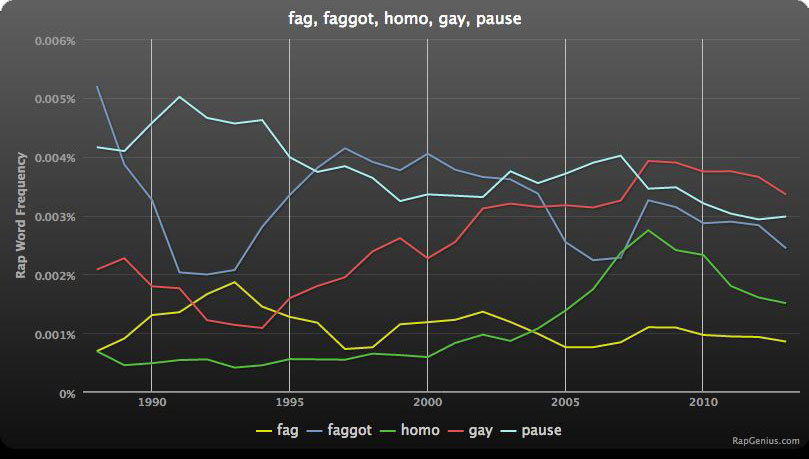
decline in language

I like this article on anti-gay language in hip hop (although the title seems unnecessary).  The above graphic is from the much hated rapgenius.com (not affiliated with the GZA).   But the graphic was included in a nice long write up on Gawker by Rich Juzwiak where he does some lyrical analysis.  While discussing a Frank Ocean lyric Juzwiak writes:

“This is a conversation that hasn’t made its way to mainstream hip-hop before now. It’s probably not as tidy as the most sensitive listeners would prefer. There’s ambiguity there as to whether Ocean’s proposed gunplay is a reaction to homophobia (because saying “faggot” is wrong) or an insult (because being “faggot” is wrong). Ocean is typically terse and selective on these identity matters—it’s possible that he’s still working out this question himself.”

When talking about the number of hit records that seemed to have made it without needing verbal violence toward gay people, Juzwiak explains:

“Hip-hop doesn’t hate gay people. Not all of it, at least. Even when it stumbles in these attempts, even when rappers don’t exhibit the full enlightenment that we’d want from them (Too $hort: “Just go with it, it’s just a lifestyle, you know, so whatever“), it’s still making attempts at engagement, which is more than it was doing even last year and far more than it was doing two years ago.

Still, we’re talking about a vast, varied pool of points of view and opinions. There’s still plenty of homophobic language.”

Here is the link to the article.

Leave a comment

Filed under communication, Gay, hip hop, music, representation

Challenging the idea of the selfish gene

I enjoyed an essay by David Dobbs in Aeon Magazine about genes.  Key to the argument is a call for  more complex understanding of the relationship between genes and evolutionary change.

The gene-centric view is thus ‘an artefact of history’, says Michael Eisen, an evolutionary biologist who researches fruit flies at the University of California, Berkeley. ‘It rose simply because it was easier to identify individual genes as something that shaped evolution. But that’s about opportunity and convenience rather than accuracy. People confuse the fact that we can more easily study it with the idea that it’s more important.’

The gene’s power to create traits, says Eisen, is just one of many evolutionary mechanisms. ‘Evolution is not even that simple. Anyone who’s worked on systems sees that natural selection takes advantage of the most bizarre aspects of biology. When something has so many parts, evolution will act on all of them.

‘It’s not that genes don’t sometimes drive evolutionary change. It’s that this mutational model — a gene changes, therefore the organism changes — is just one way to get the job done. Other ways may actually do more.’

via Why it’s time to lay the selfish gene to rest – David Dobbs – Aeon.

It seems to me that the arguments that the genetic code are read in different ways most challenges the notions about predictable genetic modification.

Describing Mary Jane West-Eberhard’s arguments about genes, Dobbs notes:

She does have her pithy moments. ‘The gene does not lead,’ she says. ‘It follows.’

There lies the quick beating heart of her argument: the gene follows. And one of the ways the gene follows is through this process called genetic accommodation.

I appreciate that it comes down to a battle of articulation — simple vs. complex.  Communication, it always comes back to communication.  Some ideas corrode against others and in this case the gene-centric model pushes out the ability to explain that ideas like the selfish gene . . . might be a little more complex than we think.

Yet West-Eberhard understands why many biologists stick to the gene-centric model. ‘It makes it easier to explain evolution,’ she says. ‘I’ve seen people who work in gene expression who understand all of this. But when they get asked about evolution, they go straight to Mendel. Because people understand it more easily.’ It’s easy to see why: even though life is a zillion bits of biology repeatedly rearranging themselves in a webwork of constantly modulated feedback loops, the selfish-gene model offers a step-by-step account as neat as a three-step flow chart. Gene, trait, phenotype, done.

via Why it’s time to lay the selfish gene to rest – David Dobbs – Aeon.

Leave a comment

Filed under academics, communication, media, nature, representation, science

The Brain Scoop on bullying

Science video blogger Emily Graslie has a crisp response to the nasty emails she receives.  Graslie hosts her show the Brain Scoop.  I like the performative readings of the emails themselves.

Thanks Feministing for the link.

Leave a comment

Filed under academics, communication, feminism, human rights, media, representation, science

Consuming Natives: Kevin Durant Nike edition

I came across this Kevin Durant shoe that seems to scream cultural appropriation to me.

Thanks to the sportingnews.com for the image of Nike Kevin Durant shoe.

The shoe raises money for Nike, Kevin Durant and some Native American athletic programs (I assume in that order).  But the description is a toxic collection of generalizations and stereotypes mashed together.


The bold Nike N7 KD VI features the repeating pattern of arrows that first launched on the Pendleton Woolen Mills Nike N7 blanket last month. The arrow print  symbolizes energy and forward motion and has reflective built in for a surprise effect when worn in the elements.  The bold colors used on the KD VI have significant meaning in Native communities. Turquoise is used often as a color symbolic of friendship, and red is one of four colors—yellow, red, black and white—featured on the traditional Native America medicine wheel, representing movement and the four directions. The KD logo appears on the heel and the N7 logo is on the tongue.

via NIKE, Inc. – Nike N7 and Kevin Durant Collaborate to Support Native American Youth.

That is amazing!  Red is a color significant for Native Americans!  Whoa!  It is good to know where that stuff comes from (sarcasm).   How about vague ambiguity when it comes to so-called native symbols and precise articulation of the Kevin Durant logo?

Nike has also developed a wide shoe, the Air Native N7, for Native North American’s supposedly wider feet (they measured 224 indians feet to justify this claim!)  While criticizing the marketing of this shoe, we can lay some of the News from Indian Country analysis against this Kevin Durant shoe press release.

Some vocal opponents of the Air Native N7 believe the shoe line indeed fosters stereotypes because, along with the company’s trademark swoosh, the footwear features feathers, arrowheads, sunset designs and circle of life motifs. Nike officials have said the product is designed to “deliver sustainable innovation,” and the “N7” portion of its name is meant to encourage “a seventh generation ethos.”

“In my opinion, the whole idea is racist,” says Eugene Johnson, a member of the Confederated Tribes of Siletz Indians, who’s paid close attention to the development of the shoe line. “This is a branding scheme of advertising that Nike is known for… I have no doubt that the sales folks are hoping that Indian sympathizers and the general public will be thinking of how Nike is so charitable in thinking of the Indians, thus, increasing sales through the usual brand of Nike branding advertising.”

via Does the Shoe Fit? Native Nike footwear raises concerns – Indian Country News.

I happen to agree that the dual marketing benefit of being seen as charitable  to anonymous poor indians helps to sell the shoe as does the appropriation of cultural symbols.  I think the same might be said about this Kevin Durant shoe.

Leave a comment

Filed under cultural appropriation, fashion, health, Native, race, representation, sport

Chelsea Manning on direct action and risk

Time Magazine gave Chelsea Manning some space and she makes some good arguments.  A political prisoner who uses her access to media to talk about complicated ideas.  Complicated ideas like direct action, accountability, violence to native nations, class, risks associated with solidarity, killing activists, and the movement. Here is the whole thing.  Stay real america.

I’m usually hesitant to celebrate Thanksgiving Day. After all, the Puritans of the Massachusetts Bay Colony systematically terrorized and slaughtered the very same Pequot tribe that assisted the first English refugees to arrive at Plymouth Rock. So, perhaps ironically, I’m thankful that I know that, and I’m also thankful that there are people who seek out, and usually find, such truths.  I’m thankful for people who, even surrounded by millions of Americans eating turkey during regularly scheduled commercial breaks in the Green Bay and Detroit football game; who, despite having been taught, often as early as five and six years old, that the “helpful natives” selflessly assisted the “poor helpless Pilgrims” and lived happily ever after, dare to ask probing, even dangerous, questions.

Such people are often nameless and humble, yet no less courageous. Whether carpenters of welders; retail clerks or bank managers; artists or lawyers, they dare to ask tough questions, and seek out the truth, even when the answers they find might not be easy to live with.

I’m also grateful for having social and human justice pioneers who lead through action, and by example, as opposed to directing or commanding other people to take action. Often, the achievements of such people transcend political, cultural, and generational boundaries. Unfortunately, such remarkable people often risk their reputations, their livelihood, and, all too often, even their lives.

For instance, the man commonly known as Malcolm X began to openly embrace the idea, after an awakening during his travels to the Middle East and Africa, of an international and unifying effort to achieve equality, and was murdered after a tough, yearlong defection from the Nation of Islam. Martin Luther King Jr., after choosing to embrace the struggles of striking sanitation workers in Memphis over lobbying in Washington, D.C., was murdered by an escaped convict seeking fame and respect from white Southerners. Harvey Milk, the first openly gay politician in the U.S., was murdered by a jealous former colleague. These are only examples; I wouldn’t dare to make a claim that they represent an exhaustive list of remarkable pioneers of social justice and equality—certainly many if not the vast majority are unsung and, sadly, forgotten.

So, this year, and every year, I’m thankful for such people, and I’m thankful that one day—perhaps not tomorrow—because of the accomplishments of such truth-seekers and human rights pioneers, we can live together on this tiny “pale blue dot” of a planet and stop looking inward, at each other, but rather outward, into the space beyond this planet and the future of all of humanity.

Chelsea Manning, formerly named Bradley, is serving a 35-year prison sentence at Fort Leavenworth for leaking hundreds of thousands of classified documents to the anti-secrecy group WikiLeaks.

via Chelsea Manning | Thanksgiving Gratitude With Michelle Obama, Rick Warren and More | TIME.com.

Leave a comment

Filed under colonialism, human rights, intersectionality, media, Native, prisons, propaganda, representation, resistance

Kid president and corn dogs

Kid president for president.

Make my corn dog vegetarian please.

Leave a comment

Filed under communication, kindness, representation

Otherizing culture through food

Soleil Ho has a nice critique in Bitch Magazine of some trends of cultural simplification and racism in food culture.  I like her salty tone.  She kicks off the discussion with the one directional consumption/service relationship of immigrant cultures reduced to food.  Wondering what to reply when someone mentions to the author ‘Oh you’re Vietnamese, I love pho’:

What can one say in response? “Oh, you’re white? I love tuna salad!” It sounds ridiculous, mostly because no one cares if a second-generation immigrant likes American food. Rather, the burden of fluency with American culture puts a unique pressure on the immigrant kid. I paid attention during playdates with my childhood friends, when parents would serve pulled-pork sandwiches and coleslaw for lunch. (It took me a long time to understand the appeal of mayonnaise, which, as a non-cream, non-cheese, non-sauce, perplexed the hell out of me.) From watching my friends, I learned to put the coleslaw in the sandwich and sop the bread in the stray puddles of sauce in between bites. There’s a similar kind of self-checking that occurs when I take people out to Vietnamese restaurants: Through unsubtle side glances, they watch me for behavioral cues, noting how and if I use various condiments and garnishes so they can report back to their friends and family that they learned how to eat this food the “real way” from their real, live Vietnamese friend. Their desire to be true global citizens, eaters without borders, lies behind their studious gazes.

via Craving the Other | Bitch Media.

Ho seems insulted by the notion that you might be able to get at something essential or authentic in the culture by eating take-out food.  She makes a strong argument here.

Like a plague of culture locusts, foodies, Chowhounders, and food writers flit from bibimbap to roti canai, fetishizing each dish as some adventure-in-a-bowl and using it as a springboard to make gross generalizations about a given culture’s “sense of family and community,” “lack of pretense,” “passion,” and “spirituality.” Eventually, a hole-in-the-wall reaches critical white-Instagrammer mass, and the swarm moves on to its next discovery, decrying the former fixation’s loss of authenticity. The foodies’ cultural cachet depends on being the only white American person in the room, braving inhumane spice levels and possible food poisoning in order to share with you the proper way to handle Ethiopian injera bread. But they can’t cash in on it unless they share their discoveries with someone else, thereby jeopardizing that sense of exclusivity. Thus, happiness tends to elude the cultural foodie.

via Craving the Other | Bitch Media.

She is particularly good at pointing out the harms of reducing a culture to food.

Over time, you grow to associate nationalities with the quaint little restaurants that you used to frequent, before they were demolished and replaced with soulless, Americanized joints. You look at a map of the world and point a finger to Mongolia. “Really good barbecue.” El Salvador. “Mmm, pupusas.” Vietnam. “I love pho!\” When you divorce a food from its place and time, you can ignore global civil unrest and natural disasters (see: Zagat declaring Pinoy cuisine the “next great Asian food trend” this past fall as deadly floods swept through the Philippines), knowing as you do that the world’s cultural products will always find safe harbor in your precious, precious mouth.

via Craving the Other | Bitch Media.

Leave a comment

Filed under colonialism, cultural appropriation, food, representation