
Check out the colors of change campaign for Trayvon.
There is an interesting campaign to mail a package of skittles the police chief who chose not to arrest Zimmerman. I’m thinking about mailing some skittles to US Attorney General Eric Holder.
Check out the colors of change campaign for Trayvon.
There is an interesting campaign to mail a package of skittles the police chief who chose not to arrest Zimmerman. I’m thinking about mailing some skittles to US Attorney General Eric Holder.
Filed under colonialism, hip hop, human rights, juxtaposition, media, memorial, protest, representation, resistance

Thanks to kicksonfire for the image.
Nike’s new shoe, the Black and Tan, has been released presumably to take advantage of St. Patrick’s day drinking/marketing opportunities. Whoops. Turns out that the Black and Tan is a sour brand in Ireland because of the hated military/police group which murdered and terrorized civilians during the early twenties.
The Black and Tans were a colonial army recruited from England ostensibly to police the people of Ireland. The lack of oversight and genuine racism in the face of a guerrilla uprising led to a terrible disdain for civilians. The roughshod police force (their name is a reference to the haphazard uniforms of the unit) was almost 7-10,000 strong and recruited from former World War I veterans.
In retaliation for attacks on police forces, the Black and Tans attacked civilians, burned homes and businesses and in one case refused an entire village food. Consider the documentary The Burning of Cork.
The Nike marketing error is evidence of the smooth appropriation transforming actual Irish history into a bizarre tourist narrative emphasizing drinking, leprechauns, and Irish-affiliated brands. These tourist realities corrode against the actual history of Sinn Fein, Home Rule, and the bodily struggles associated with Irish Nationalism.
The assumption of Nike, that their party, party, party language was the universal meaning points to a kind of linguistic arrogance. NPR’s Melissa Block and Robert Siegel interviewed Brian Boyd of the Irish Times on the Nike apology.
BLOCK: Now, Nike has released a statement saying: We apologize, no offense was intended. At the same time, Nike says the sneaker has been, quote, unofficially named by some as the Black and Tan.
SIEGEL: That said, if you look inside the shoe – as we have done with online photos – you see an image of a pint of beer with two colors, black and tan.
BLOCK: Brian Boyd of The Irish Times has reported on some outrage over the shoe. But really, he says, it’s not about a shoe. It’s about a holiday.
BOYD: It’s how the Americans view Saint Patrick’s Day and view Irish culture and history. And it’s the very fact that some people are saying that these are beer-themed sneakers, that the only way to celebrate a national holiday of a country with a very rich culture and a very rich history and literature, et cetera, is to pour massive amounts of alcohol down your body.
It’s how the American treat St. Patrick’s Day. So we’re using this story to say, look, it’s the silly Americans, stupid Americans, look what they’re doing again. They’ve got it all wrong.
via Nike Kicks Up Controversy With ‘Black And Tan’ Shoes : NPR.
Filed under capitalism, colonialism, communication, human rights, juxtaposition, learning, police, propaganda, protest, representation, resistance
A$$holes By Nature is the name of the duo. The roots go deep. Here are the pair as part of the Guerilla Maab.
Filed under communication, hip hop, resistance
The Greek economic crisis showcases how quickly a nation’s assets can be broken down and sold. The New York Times gives scary insight into the plans to make Greece the retirement community of continental Europe among other big changes under foot. Russell Shorto’s essay gives some time to those with and without money to describe the impact the economic changes have on their life.
Not only are the national assets being traded off for debt reduction (or deferment) deals, but the citizens are being squeezed for more tolls and tariffs. What I appreciate is the circumvention of even rich citizens, who can view the whole scheme for what it is. Ripping off impoverished citizens to pay the interest on old national debt.
“Watch it! Watch out!” Paul Evmorfidis was driving up to a toll plaza on the main road from Athens to Thebes. He slowed down as he came to the toll arm blocking the road, but he was not paying the toll and, to my alarm, was not stopping. “I’m showing you something,” he said. He reached out his window, shoved the toll arm up out of the way and drove off as an alarm shrieked behind us. “This is what we do here — everybody who lives around here.” As the Greek government adds new taxes and surcharges onto its citizens, they respond with protest or evasion. After the government announced that there would be an additional 2010 income tax — in effect, retaxing that year’s income — people refused to pay, whereupon the government tacked a new property tax onto electricity bills, which you could elude only at the cost of having the power cut. Likewise, the toll plaza was installed to raise money. The toll was about $3. “The problem is if you live around here, you have to go down this road maybe five times a day,” Evmorfidis said. “Crazy! What kind of planning is that? So we protest.”
Filed under capitalism, colonialism, protest, resistance, Surveillance
Artifact 1. The editor-in-chief of the Bay Citizen was gassed in the #occupy oakland actions.
I looked down and my hand was black, my four fingers covered in toxic chemicals. I couldn’t feel my hand much but could clench it and unclench it and assumed I was okay. My blue flannel shirt also was black, stained where the canister had struck me and discharged. I was soaked in tear gas, but for some reason it was having less of an effect than the burning on my hand.
Another strange but not entirely unexpected thought popped into my head: 6 inches lower and it would have hit me in the crotch.
Artifact 2. South Korean debate involves MPs using tear gas in the parliament building.
An opposition MP set off a teargas canister in the South Korean parliament in a failed attempt to prevent the ruling party passing a free trade deal with the US.
Proponents said the deal, the largest US trade pact since the 1994 North America Free Trade Agreement (Nafta), could increase commerce between the two countries by up to a quarter. But the opposition claims it will harm South Korean interests, putting jobs at risk.
via South Korean MP lets off teargas in parliament | World news | guardian.co.uk.
Filed under colonialism, documentary, human rights, juxtaposition, resistance
Thanks to Democracy Now! and MSNBC for unveiling the corporate lobbying group that has offered to the American Banking Association to undermine #occupy wallstreet.
According to MSNBC, the lobbying firm Clark Lytle Geduldig & Cranford sent the memo to the American Bankers Association and offered to conduct “opposition research” on Occupy Wall Street in order to construct “negative narratives” for a fee of $850,000. The memo advises the ABA to take the movement seriously, writing: “It may be easy to dismiss OWS as a ragtag group of protesters but they have demonstrated that they should be treated more like an organized competitor who is very nimble and capable of working the media, coordinating third party support and engaging office holders to do their bidding. To counter that, we have to do the same.” The memo goes on to warn the ABA that Democratic victories in 2012 would be detrimental for Wall Street and suggests the financial industry focus its energy on specific races that would lead to Republican elections.
via Washington Lobbying Firm Offers to Undermine Occupy Movement on Behalf of Wall Street.
In times of crisis, arguments about power become more visible. In this case, we get to see the generation of propaganda at the stage of inception and amplification.
Filed under capitalism, communication, media, propaganda, resistance

Let us praise Kamala Harris, California’s Attorney General for her pressure on the big five banks who exploited the mortgage crisis for profit. The banks, state governors and Obama administration folks have been negotiating a pay-out deal for the states. Of course the deal would protect these mortgage lenders from future lawsuits.
But the key player in the battle to make the banks pay is Harris. California’s catastrophic recession is due above all to the unpayable debts with which the banks saddled entire regions of the state. Harris recognized this in September, when she announced that, like Schneiderman and Biden, she was pulling out of the negotiations because the banks remained uninvestigated and the waiver they were being offered for their possible misconduct was way too broad. In her letter to Associate U.S. Atty. Gen. Thomas Perrelli and Miller announcing her decision, Harris said the agreement “would allow too few California homeowners to stay in their homes…. After much consideration, I have concluded that this is not the deal California homeowners have been looking for.”
Without California’s participation, of course, the banks would never assent to a deal.
via Kamala Harris is key in mortgage settlement with banks – latimes.com.
Filed under capitalism, propaganda, resistance
Thanks to Glen E. Friedman, we have a little write up and video from Chris Hedges and Cornel West prosecuting a corporation in the #occupy wallstreet park.
This is the kind of street theater we need to see in cities all across America. In addition to marching and occupying public places, we need to explore creative and provocative ways to capture the attention of the media. In our ADD culture, we’ve got to keep things interesting. West and Hedges are taking a page from the Abbie Hoffman play book.
via WHAT THE FUCK HAVE YOU DONE?: THE PEOPLE VS.GOLDMAN SACHS: CORNEL WEST AND CHRIS HEDGES PRESIDING.
Filed under capitalism, communication, documentary, juxtaposition, media, protest, resistance
Premise number one: automobile culture as we know it in North America is unsustainable.
Ken Bensinger’s three-part series in the L.A. Times about exploitative auto dealers and the poor underscores just how much automobile-centered living has cost America. The series is pretty clear: working poor are screwed without cars and the industries which prey on those needs are evil. Not to mention the ecological damage, strip mall culture, distance between humans, high-speed culture, and consumer identity that are entwined with the lifestyle of the car.
Premise number two: the transition away from automobiles is going to be very hard for people, particularly in the U.S..
We set up this nation to be focused on individual-based car transit. We can’t be too surprised that people hold onto their perceived right to drive a car with surprising firmness. I was teaching a social movements class and showed a short video of activists in the United Kingdom protesting a church celebration of the automobile. One woman on the film seemed particularly eloquent to me. She spoke of losing her child to a speeding car. When the class started discussing the video, I was surprised to find that most of the students wanted to blame this woman for “letting” her child go near a road.
Suddenly I realized that they were feeling judged and they wanted to undercut this tragic voice because they didn’t want to think about their participation in automobile culture.
The need to change car culture in the United States will be met with shallow innovation rather than actual change. I suspect that we’ll just tweak things in the era of declining oil returns. We’ll have more electric cars reliant on natural gas and nuclear power plants to make energy. We’ll have many more bio-diesel vehicles and probably new farm subsidies for vegetable oil producers.
Even though the gas-guzzler is fundamentally offensive, we won’t challenge the right to guzzle gas, we’ll just provide new “clean” justifications. People who drive electric cars drive more. That’s right! When people buy a new energy-efficient vehicle they tend to use it more. When we have the moral problems cleaned up (in our minds) we revert to unbridled consumer desire. “Oh, lets take the Prius on the road trip — it’s so efficient.”
Alternative: thinking about the closed loop, Ecotopia and transportation
Ernst Callenbach’s Ecotopia books are interesting day-dreams on what a future might look like. One reason the book is useful is the visioning component involved in future-fiction thinking — every reader is invited to disagree or re-envision.
In my Humboldt bioregion we have the Kinetic Sculpture Race where dozens of bicyle-driven human powered sculptures must prove themselves capable of traveling over sand, water and many miles of roads. It isn’t hard to imagine this fleet of bike vehicles shared, rehabilitated and helping to move goods and people around the North Coast.
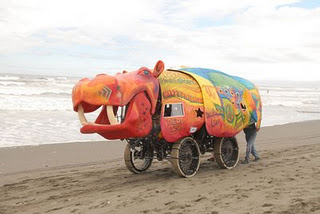
Catch a ride to the market on the giant hippo.
This suggests to me that the collapse of oil-based transportation might not be all that terrible in this place. My daydream is that the transition isn’t just about keeping gas pump-dependent, individuality-centered, automobile culture alive, but about being open to something else growing in it’s place.
Remember when you were a kid and you just rode your bike? Meandered? Wandered? Crossed a parking lot and then rode in circles? Have you actually done that lately?
I’m not trying to be a smart-ass. I think this is part of the loss of car-dependent culture. Most of us are so stressed out paying for cars, or paying for gas, or dealing with the extra hidden charges in our automobile insurance this month that we don’t get around to fun bike rides. Or to imagine that the problems of transportation aren’t unique.
I bet you can think of a time in the last few weeks where you were stymied by a lack of transportation. I think this is what most of us have in common. We want mobility, freedom to move. The chance to just go and get where we need.
Rep. Gwen Moore (D-Wis.) has tried for years to get the government to help the poor buy cars. In 2005 and again in 2007, she sponsored legislation to provide $50 million a year for low-income car ownership programs. Both bills died in committee.
She said she has faced resistance from, among others, environmental organizations that insist mass transit is a better solution.
“Public transit is not practical in Milwaukee where the wind chill can be 45 below and you have to drop three kids off at day care,” Moore said. “We really have a crisis with respect to getting people to their jobs.”
via The poor have few options for seeking help in buying a car – Page 2 – latimes.com.
This is probably what underlies the vicious defensiveness about personal car ownership — this desire for freedom and escape. Solidarity in modern capitalism can be seen in the unfulfilled invitation to freedom. And the daily needs of living in the world that in fact seem to necessitate a car of one’s own.
So how do you challenge the cultural norm while still supporting the need of the poor to have safe and reliable transportation? I guess the daydream is that we could actually start talking not only about the costs of automobile culture, but also the threads of other ways of living that are visible slightly below the surface. Mix a little utopianism with newspaper reports. Encourage people to talk about the impossible and pretty soon it isn’t impossible.
Cuba has endured a U.S. embargo for a couple of decades. The mutual antagonism between the governments of Cuba and the United States has created a fascinating window into an alternative way of being. I’m not oblivious to Cuba’s poverty and problems. In terms of organic agriculture and in this case, automobiles, the resilient Cuban people (different than the government) have shown what is possible.
But since Cubans couldn’t legally sell their vehicles, they learned to do everything possible to keep them on the road.
Nelson Ramos, a car enthusiast and former economist in Havana, says cars in Cuba are “like members of the family.”
“Cars stay in the family forever. And you take care of the car, you fix the engine, and we probably have the best mechanics in the world,” Ramos says. “This is probably the only country in the world where you don’t have a junkyard for cars. We simply get the wreckage and put it on wheels and drive it again.”
via In Cuba, A Used Car Is No Bargain : NPR.
I try not to be a purist. In my ideal world all transportation would be bicycles, but I know that isn’t realistic for most people. So instead, I would put forward a dream of a transition inspired by justice. The needs of a community being organized around those who needed help first. I envision a few electric cars, or biodiesel vehicles that might operate as ambulances or as transit for those who have need. We don’t need any new cars if what Cuba shows us is possible. People will be hand-carving door handles out of wood for the bicycle-powered buggies of the future.
Filed under bicycle, capitalism, Eureka, Humboldt, resistance
Thank you colorlines. You kick ass.
In August, I completed a two-year long joint investigation for Colorlines.com and the Investigative Fund of the Nation Institute that identified 16 officers still on duty who were responsible for more than half of the department’s officer-involved shooting incidents in the past decade. These repeat shooters operate behind a wall of secrecy, built over decades and sealed with a 2006 California Supreme Court decision blocking public access to personnel records.
Among the worst of them is Sgt. Patrick Gonzales. Over the course of his career, Gonzales has shot four people, three fatally, and been accused of repeated beatings and public strip searches of suspects. In the predominantly black neighborhoods he has policed for 13 years, Gonzales has long been widely known as a loose cannon. Despite Gonzales’ history of questionable uses of force and the $3.6 million paid out by Oakland to settle lawsuits involving him, he is also deployed repeatedly for crowd control. He was videotaped firing projectiles at anti-war protesters in 2003, he was at the November 2010 protest of Mehserle’s verdict and a photograph of him at the Oct. 25 Occupy Oakland raid (above) shows him wearing a gas mask and riot gear, with a tear-gas canister clutched in his hand.
via The Police Raid on Occupy Oakland Was Nothing New for This City – COLORLINES.
Filed under human rights, police, protest, resistance
 Life of refinement