Rick-rolling your teacher

I’ve gotten papers with little comments or song lyrics embedded in the prose.  I assumed they were little tests to see if I was actually reading the paper.  I note it as a technique of surveillance or accountability.

Thanks to openculture.org for the image.

This is a whole extra level of thoughtfulness.  Rick-rolling without really altering the content of your paper.

I wonder if this was really a paper for this class or was it made as a gag?  

Shout out to openculture.org for the story.

Leave a comment

Filed under academics, communication, hacking, media, music

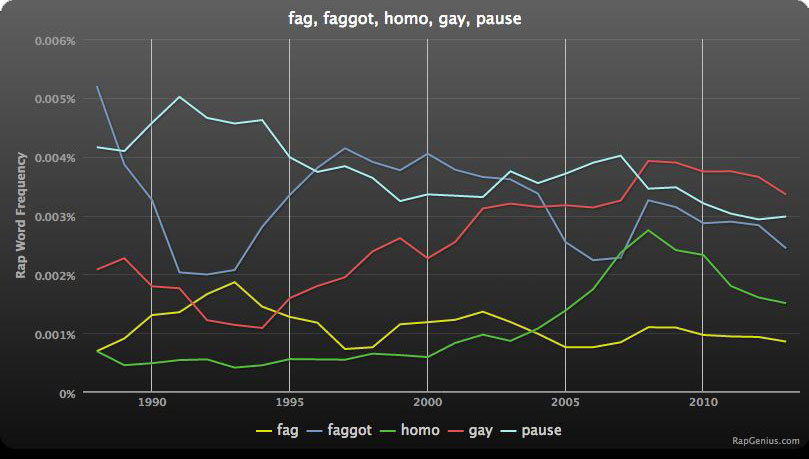
Changing hateful language in hip hop

decline in language

I like this article on anti-gay language in hip hop (although the title seems unnecessary).  The above graphic is from the much hated rapgenius.com (not affiliated with the GZA).   But the graphic was included in a nice long write up on Gawker by Rich Juzwiak where he does some lyrical analysis.  While discussing a Frank Ocean lyric Juzwiak writes:

“This is a conversation that hasn’t made its way to mainstream hip-hop before now. It’s probably not as tidy as the most sensitive listeners would prefer. There’s ambiguity there as to whether Ocean’s proposed gunplay is a reaction to homophobia (because saying “faggot” is wrong) or an insult (because being “faggot” is wrong). Ocean is typically terse and selective on these identity matters—it’s possible that he’s still working out this question himself.”

When talking about the number of hit records that seemed to have made it without needing verbal violence toward gay people, Juzwiak explains:

“Hip-hop doesn’t hate gay people. Not all of it, at least. Even when it stumbles in these attempts, even when rappers don’t exhibit the full enlightenment that we’d want from them (Too $hort: “Just go with it, it’s just a lifestyle, you know, so whatever“), it’s still making attempts at engagement, which is more than it was doing even last year and far more than it was doing two years ago.

Still, we’re talking about a vast, varied pool of points of view and opinions. There’s still plenty of homophobic language.”

Here is the link to the article.

Leave a comment

Filed under communication, Gay, hip hop, music, representation

Merry Ghostfacemas 2013

December 26.  Listen to every Ghostface Killah song, preferably in a robe with  a magnum of champagne.

Leave a comment

Filed under hip hop, music

Twist on tagging

I woke up thinking about the fame/anonymity line that successful artists/graffiti practitioners have to navigate.  Made me think about SF’s Barry McGee/Twist.

From a cool interview by Samuel Borkson where Barry McGee emphasizes living, eating kale and going surfing.  When asked what he’d do with a lot of money Twist replies:

BMG: I’m more interested in less than more. Our society has become obsessed with having more, having it all. To what end? Excess, while fascinating to watch, is not the answer to me. Most over budgeted art projects I have seen are terrible.

via BARRY MCGEE AND SAMUEL BORKSON: A CONVERSATION | Dirty Magazine.


Leave a comment

Filed under art, communication, graffiti, health, media

Run the Jewels: Christmas f*cking miracle

Bonus!  The sweaters, the wig on Killer Mike, El-P’s combover, and some of the best lines of 2013.

Leave a comment

Filed under hip hop, music

Eating, ecosystems, settlers and loss

From an Orion essay by J. B. MacKinnon

The wild plants and animals that used to feed us are akin to keystone species, which give structure to entire ecological communities. Wild foods were the tethers that tied us to whole habitats. Forget the taste of acorns and it becomes reasonable to fragment the unbroken oak forests that, besides people, fed tens of millions of passenger pigeons. Fish the shad into obscurity and there is less of a case to be made against damming the rivers of the Eastern Seaboard, or using them as dumping grounds for industrial pollution. Stop gathering the edible flower bulbs of the Rocky Mountains, and abandon the clearest argument against grazing those meadows to nubs. To stand in for such distinct foods of place, there will be, wherever you may roam, broiler chickens from Georgia, Texas beef, Idaho’s famous potatoes.

via Appetite of Abundance: On the Benefits of Being Eaten | Longreads.

Despite the nostalgic tone, I think MacKinnon has a strong argument about the loss from changing ecosystems to support settler food habits.

The most dramatic example is surely the Great Plains, where tens of millions of plains bison have been replaced by 45 million cattle—a straight swap of buffalo steaks for beef burgers. Yet so much more had to change as well. Ninety percent of the tallgrass and shortgrass prairies, fueled by sunshine and watered by rainfall, was ultimately replaced by hard-grazed cattle range and farm-raised crops—often for livestock feed—that require fifty gallons of oil per acre and the irrigation of more than 20 million acres of land. With the vanishing of the bison began the slow fade of an estimated 100 million wallows that the pawing, rolling animals eroded into the grasslands, creating ephemeral water pools in the wet seasons and dust basins in the dry. As the wallows declined, so did the spadefoot and Great Plains toads that gathered to breed in them; so did the grasslands song of the western chorus frog; so did birds like the McCown’s longspur and mountain plover, the latter so fond of prairie balds that they’re now known to nest, with predictable risk, on farmers’ bare fields.

Without bison calves and carcasses to feed on, the plains grizzly faded not only from the landscape but also from memory. Gone, too, is the strange reciprocal relationship between bison and prairie dogs, with the bison mowing down the grass to make way for prairie dog colonies, which in turn improve the quality of forage for bison. The two animals’ fates were joined: wild bison now roam just 1 percent of their former range; prairie dogs number 2 percent of their former population. The buffalo bird, which once fed on insects spooked into the air by bison herds, simply came up for a name change. Today, it’s the cowbird.

via Appetite of Abundance: On the Benefits of Being Eaten | Longreads.

Leave a comment

Filed under Animals, colonialism, food, memorial, Native, nature

Joni Mitchell and her feline costar

Jody Rosen writes:

And, well, there’s a cat. It’s a nice-looking cat, of the gray-and-black tabby variety, and while I assume it’s Joni Mitchell’s pet, I hope it was a Hollywood stunt cat, because Mitchell subjects the poor thing to a series of spine-wrenching contortions not seen since Ferdinand II of Aragon sent my converso forbears packing off to the strappado. She dances a kind of pas de deux with the cat, see, which sounds cute, but in practice involves stretching and distending the feline’s extremities, twirling it in circles, lifting it overhead, etc. I can’t decide whether to contact the ASPCA about the statute of limitations on animal torture, or to make a bunch of GIFs and ROTFLMAO. In any case, I think we all can agree that “Dancin’ Clown” is the worst song ever, and the greatest video ever made. And that Joni Mitchell has no business owning a cat.

via Rosen on Joni Mitchell’s Worst Song — Vulture.

Thanks to Soul-sides for the link.

Leave a comment

Filed under Animals, dance, music

Elton John in Russia

I appreciate Elton John speaking loudly about his opposition to the Russian  anti-gay legislation in Russia.  I also think this is an elegant justification for Elton John to circumvent a boycott.

It also happens to be a justification that probably makes Elton John a whole lot of money.

Don’t get me wrong, it is excellent to see pop stars expressing their politics.  And I think Elton John is a super bad-ass.  (Remember that he stood up to some heavy bullying and blackmail from a newspaper in the UK).  And I think that he has credibility and status for his opinion to be widely amplified.

Leave a comment

Filed under capitalism, communication, Gay, human rights, protest

Challenging the idea of the selfish gene

I enjoyed an essay by David Dobbs in Aeon Magazine about genes.  Key to the argument is a call for  more complex understanding of the relationship between genes and evolutionary change.

The gene-centric view is thus ‘an artefact of history’, says Michael Eisen, an evolutionary biologist who researches fruit flies at the University of California, Berkeley. ‘It rose simply because it was easier to identify individual genes as something that shaped evolution. But that’s about opportunity and convenience rather than accuracy. People confuse the fact that we can more easily study it with the idea that it’s more important.’

The gene’s power to create traits, says Eisen, is just one of many evolutionary mechanisms. ‘Evolution is not even that simple. Anyone who’s worked on systems sees that natural selection takes advantage of the most bizarre aspects of biology. When something has so many parts, evolution will act on all of them.

‘It’s not that genes don’t sometimes drive evolutionary change. It’s that this mutational model — a gene changes, therefore the organism changes — is just one way to get the job done. Other ways may actually do more.’

via Why it’s time to lay the selfish gene to rest – David Dobbs – Aeon.

It seems to me that the arguments that the genetic code are read in different ways most challenges the notions about predictable genetic modification.

Describing Mary Jane West-Eberhard’s arguments about genes, Dobbs notes:

She does have her pithy moments. ‘The gene does not lead,’ she says. ‘It follows.’

There lies the quick beating heart of her argument: the gene follows. And one of the ways the gene follows is through this process called genetic accommodation.

I appreciate that it comes down to a battle of articulation — simple vs. complex.  Communication, it always comes back to communication.  Some ideas corrode against others and in this case the gene-centric model pushes out the ability to explain that ideas like the selfish gene . . . might be a little more complex than we think.

Yet West-Eberhard understands why many biologists stick to the gene-centric model. ‘It makes it easier to explain evolution,’ she says. ‘I’ve seen people who work in gene expression who understand all of this. But when they get asked about evolution, they go straight to Mendel. Because people understand it more easily.’ It’s easy to see why: even though life is a zillion bits of biology repeatedly rearranging themselves in a webwork of constantly modulated feedback loops, the selfish-gene model offers a step-by-step account as neat as a three-step flow chart. Gene, trait, phenotype, done.

via Why it’s time to lay the selfish gene to rest – David Dobbs – Aeon.

Leave a comment

Filed under academics, communication, media, nature, representation, science

The Brain Scoop on bullying

Science video blogger Emily Graslie has a crisp response to the nasty emails she receives.  Graslie hosts her show the Brain Scoop.  I like the performative readings of the emails themselves.

Thanks Feministing for the link.

Leave a comment

Filed under academics, communication, feminism, human rights, media, representation, science