Category Archives: art

Dance for a chicken: Cajun Mardi Gras

Folkstreams.net offer an intriguing collection of documentary films, mostly centering on rural knowledge, folk traditions, and music.   Reflecting on the 1993 sixteen mm film “Dance for a chicken: Cajun Mardi Gras:”

–> Good articulation of Mardi Gras in rural communities.  I enjoyed the lens on different towns and their radically distinct traditions.

—> Documentary filmmaking includes a certain voice, and it is interesting to observe the frame-makers who constitute the narrative structure of the documentary through the representations they choose.   I think the of the narration and visibility of the film creators increases over time (this footage is at least eighteen years old).  The discussions about blackface, cultural appropriation (the film includes a fragmented scene of rural white-identified Mardi Gras celebrants dressed up as indians driving through a Native American reservation), and gender provide valuable time-contextual artifacts vis-a-vis the film itself.

–> There is a dialogue about Mardi Gras, and this film is an attempt to broaden the image of drunken costumed revelry.  It is quite good on the historic traditions, unpacking the coded imagery, and iconography.

–> I feel bad for the chickens.

–> At the end of the film they discuss the impact of rural Mardi Gras traditions evolving as fewer people engage in actual farming life.  It’s a good place to start thinking about the impact of economic changes on ritual experience.

Leave a comment

Filed under art, documentary

videos that kick ass

Here is batgirl arguing for equal pay.  Thanks to feministing for the cool link.

And Big K.R.I.T. with the remix of Country shit featuring Ludachris and Bun B.  Yowza.

Leave a comment

Filed under art, feminism, hip hop

Pharoahe Monch: Renegade

Ain’t no conscious hip hop left.  Those that were conscious, now are just working to eat.

Pharoahe Monch never pretended to be simple and clean.  His work with Organized Confusion was lyrical, dense, and complex.  I think Monch is an intellectual roughneck — capable of pushing some thin ideas to the point of breaking. Hold no rapper to the ethical standards of a priest or a politician.  Monch shares ideas — you don’t have to like them.

In fact, I didn’t like his video of “Black hand side.”  It’s a good tune, and it encourages peaceful resolution of conflict among African Americans.  But it also includes a domestic violence scene which seems to get the same treatment.  Sweep violence under the rug.  I’m not feeling that.  So I’m certainly not gonna post a video with some ideas I feel need to be challenged.

But Pharoahe’s We Are Renegades (W.A.R.) is dang good as an album.  And I don’t have any need for Pharoahe Monch to match my politics.  Just to keep making good music.   I’ll decide what fits me.

Witness “Clap.”  The first single from the album that gets a relatively lush 10 minute short movie.  Winter in America indeed.  Ice cold and not getting any warmer.  The only spark of warmth comes from gun barrel.  110%.

Leave a comment

Filed under art, hip hop, human rights

Anthropomorphism and maps

Donna Seger has a lovely blog Streets of Salem.  She has recently collected a nice gathering of maps represented via living creatures.   Kicks ass.

Leave a comment

Filed under academics, art, colonialism

graffiti in Libya: mocking a dictator

photo by Rory Mulholland, The Guardian

Rory Mulholland writes of the new graffiti critiques of Libyan dictator Qaddafi in The Guardian.  Smooth documentation of some cool art.  I liked this paragraph:

The revolution has lifted the lid on a repressed society and the people of Benghazi are making up for the lost years. They have quickly set up newspapers, radio stations and rap bands to say things that just a few months earlier would have got them locked up or worse. But the Gaddafi caricatures are the most striking manifestation of the new-found freedom of expression.

via The Libyan artists driving Gaddafi to the wall | World news | The Observer.

I’ll also note that this graffiti proves the inability of the dictatorship to control the image and the word.  The people can now circumvent state controls, and graffiti is one of the modes of communication which is most likely to allow for anonymity.  Vital for earnest criticism, especially when the subject of critique is likely to shoot you.  I suspect that a fair number of westerners who have been inculcated into the moral panic associated with graffiti read the heavily painted walls of various Arab spring uprisings with anxiety.

It strikes me as a deeply authentic medium of expression which emerges in the context of necessity.  Egypt, Tunisia, Syria, and China have all used internet blockades to prevent people from communicating with each other during community mobilizations.  Painting in the street became part of internal communication and collective articulation.

Look again at the painting above.  This image communicates something about the area in which it is painted.  It might mean relative safety from repression, it might be a meeting point, it might even allow non-involved citizens to avoid areas where there might be fighting.   Speaking nothing of the ability of such an image to crack through the conditioning of decades of unquestioning obedience to a terrifying force.

Remember Timisoara?  It’s a small Romanian town, where in 1989, a few citizens rallied around a pastor being bullied by the dictatorship.  After troops were used to put down the protests, a few more people started to make some noise and the town was put under martial law.  To rally the citizens the wretched dictator Nicholau Ceausescu gave a live TV broadcast.  When the crowd started to chant Timisoara and push against security forces, Ceausecu’s face went blank, and seventy six percent of the citizens who were watching got an image they had never seen before — evil on it’s heels.

And a few hours later, Ceausescu was dead.

Leave a comment

Filed under art, human rights, propaganda

Geronimo was not killed in Pakistan . . .

I didn’t know that the Navy SEAL codename for the operation to kill Osama Bin Laden was called Geronimo.  Thanks to Colorlines and the 1491s, we get a nice video response, with emphasis on current native north America.

1 Comment

Filed under art, human rights, Native

Thought harpoon

Rammellzee’s Cerembric neutron harpoon.  One  of the best explanations for communications which corrode against other discourse.  As Rammellzee writes:

CEREMBRIC NEUTRON HARPOON (Thought Lance) holds complete thought-processes to constructions and launches outline that can construct any shape energy it wants to construct in any dimension of physical magnetics. Several remanipulators such as dimensional doors, dimension cracks.

via GOTHIC FUTURISM.

Layer this idea against Walter Benjamin writing about Dada:

“Dadaist manifestations actually guarateed a quite vehement distraction by making artworks the center of scandal.  One requirement was paramount: to outrage the public.  From an alluring visual composition or an enchanting fabric of sound, the Dadaists turned the artwork into a missile.  it jolted the viewer, taking on a tactile [taktisch] quality (Walter Benjamin, The work of art in the age of its technological reproducibility. 39.)

Despite having read chunks of Benjamin in gradual school, I’m finding the re-read to be really insightful.  Crucial to my recent reflection about Walter Benjamin was a lovely 1993 film about Walter Benjamin that helped to located his thought in the context of some recent ideas about fragmentation and power. Here is the link to John Hughes film One way street: fragments for Walter Benjamin.  Thanks to Ubuweb.com for the brilliant resource!


Leave a comment

Filed under art, capitalism, learning

Gil Scott-Heron

Cooking soul tribute mixtape here.

Leave a comment

Filed under art, funk & soul

Profit, fear and forming the pack: Hunter S. Thompson

I finished Hunter S. Thompson’s Hell’s Angels yesterday.   The epic piece of journalism in which he is ’embedded’ in the motorcycle gang for a few months holds up well, although I’m astounded to see how much casual racism is in his writing.

Two nice quotes need to be archived here for discussion.  One about profit and fear.  The Bass Lake section of the book describes an Angel run to a tiny lake resort.  One store proprietor refuses to sell the Hell’s Angels beer, while another makes a big profit not only from beer sales, but also from the spectacle of Angels.  Thompson writes:

So it must have been a giddy revelation for the Bass Lake Chamber of Commerce to discover that the Hell’s Angels’ presence — far from being a plague — was in fact a great boon to the tourist trade.  It is eerie to consider the meaning of it.  If the Hells Angels draw standing room only any half-hip chamber-of-commerce entertainment chairman should see the logical follow-up; next year, bring in two fighting gangs from Watts and pit them against each other on one of the main beaches . . . with fireworks overhead while the local high school band plays Bolero and “They Call the Wind Maria” (147).

I thought I owned a copy of this book, but couldn’t find it, so I stopped by the library to get a copy.  The librarian reminded me that Hunter S. Thompson books tend to get boosted from the library.  Now that is a legacy.

The other quote that struck me was about the Marlon Brando movie The Wild One which was an fictionalized antecedent to the moral panic of motorcycle gangs running amok.  Thompson makes the case that the film itself helped to create rebel identity — solidifying a previously misty image of themselves.

The truth is that The Wild One — despite an admitted fictional treatment–was an inspired piece of film journalism.  Instead of institutionalizing common knowledge, in the style of Time, it told a story that was only beginning to happen and which was inevitably influenced by the film.  It gave the outlaws a lasting romance-glazed image of themselves, a coherent reflection that only a few had been able to find in a mirror, and it quickly became the bike rider’s answer to the The Sun Also Rises (66).

In the field of communication this process of identity formation might be called ‘constitutive rhetoric.’  To create an audience by virtue of their description in media.  From Mountain Dew consumers, to the folks who tattoo themselves with the Nike logo, this is a valued space for inquiry.

It is worth noting that the previous person who took out his book was inspired to capture a small pixie or bat in between two of the pages.  The way people will store old leaves in a book, this lunatic stored old dead critters.  I discovered this when a few pages before the creature a sinister stain began to emerge in the middle of each page.  Engaged I simply turned the pages, avoiding the funky stain.  And then  in the middle of chapter two, two pages stuck together cradling a dead being.

Selah.

1 Comment

Filed under art, disaster, media

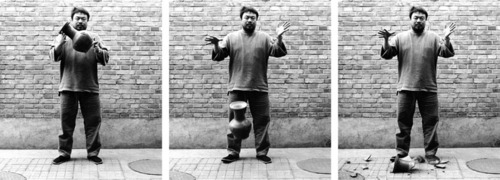
Why so valuable? Ai Weiwei can not be replaced

Ai Weiwei dropping a han dynasty urn

Thirty seven days.  Artist Ai Weiwei has been locked up by Chinese authorities for thirty seven days.  Rumor is that he is being tortured and beginning to admit to his ‘crimes.’

Weiwei is priceless.  Artistic installations and performances that point to a better world than one without him.

Adrien Serle writes about Weiwei’s blog writings in a recent Guardian.

I can think of no equivalent recent writing by an artist in the west, none that confronts political and social realities so eloquently or with such passion and controlled rage. Thoughtful, acerbic, angry, increasingly outspoken, the blogs cover innumerable subjects, from attempts to rescue the cats rounded up and left to starve in warehouses in the clean-up campaign before the 2008 Beijing Olympics, to architecture and design. He writes about Andy Warhol, about the destruction of China’s heritage and the unthinking cynicism and idiocies of city planners and cultural officialdom. He documents the Chinese government’s handling of the 2003 Sars epidemic, the contaminated milk scandal, the “tofu-dregs” construction of the schools that collapsed during the 2008 Wenchuan earthquake. He damns the mendacity of the Chinese media (“To call them whores would be to degrade sex workers. To call them beasts of burden would humiliate the animal kingdom”), and the hypocrisy of some Chinese public intellectuals. But there are also lighter essays on haircuts, humour, creativity and much more besides. After the closure of his blog, Ai turned to Twitter, saying that in Chinese the 140-character brevity of the form almost amounted to a novella.

via Where is Ai Weiwei? | Art and design | The Guardian.

1 Comment

Filed under art, human rights