
Artifact one: Camping before the Twilight premier

Photo by Mario Anzuoni/Reuters/Landov
Artifact 2: Camping at #occupy oakland

Thanks to #occupy contra costa for the photo
Artifact one: Camping before the Twilight premier
Photo by Mario Anzuoni/Reuters/Landov
Artifact 2: Camping at #occupy oakland
Thanks to #occupy contra costa for the photo
Filed under capitalism, communication, juxtaposition, protest, representation
Thank you Marion Nestle. I saw this yesterday but was too disgusted to write it up. Dr. Nestle is on point here:
I’m always saying that food company donations and partnerships to health and environmental Good Causes end up doing more for the companies than the recipients. Money always talks. Accepting corporate donations comes with strings that create conflicts of interest.
The latest evidence for these assertions comes from the Grand Canyon’s efforts to get plastic water and soda bottles out of the park. These account for a whopping 30% of its waste.
According to the account in today’s New York Times, Coca-Cola, one of the park’s big donors, convinced the National Park Service to block the bottle ban.
Stephen P. Martin, the architect of the plan and the top parks official at the Grand Canyon, said his superiors told him two weeks before its Jan. 1 start date that Coca-Cola, which distributes water under the Dasani brand and has donated more than $13 million to the parks, had registered its concerns about the bottle ban through the foundation, and that the project was being tabled.
via Food Politics » Coca-Cola v. Grand Canyon: donations come with short strings.
Filed under capitalism, nature, propaganda
The process of objectification — to take a living, complex 3-dimensional person and render them into two-dimensions – is a significant part of modern communication. Advertising and television helping to constitute our very desires. Reflecting on previous invitations of objectification can help us to understand how we are being organized.
Fray magazine has twenty images of playboy playmate lips juxtaposed with the causes of their deaths. The artist is Jennifer Daniel.
There are some obvious problems with this project. Using previously objectified people runs the risk that the reader will simply re-create the old pattern of knowledge. But something about this obscuring of the sexy bodies and the bringing forward of the deaths gets at the realness of humans who have been pushed aside for their body images.
For instance Miss November 1969 who’s turnoffs include: “people who are always late,” dies in an auto accident. Was she rushing to an appointment? Was she killed by someone drunk driving? Was she driving?
I find the piece sad and lonely. Perhaps in that way it can be a restorative to help respond to the relentless pressures of bodily discipline.
Filed under capitalism, communication, feminism, health, juxtaposition, representation
Thanks to Glen E. Friedman, we have a little write up and video from Chris Hedges and Cornel West prosecuting a corporation in the #occupy wallstreet park.
This is the kind of street theater we need to see in cities all across America. In addition to marching and occupying public places, we need to explore creative and provocative ways to capture the attention of the media. In our ADD culture, we’ve got to keep things interesting. West and Hedges are taking a page from the Abbie Hoffman play book.
via WHAT THE FUCK HAVE YOU DONE?: THE PEOPLE VS.GOLDMAN SACHS: CORNEL WEST AND CHRIS HEDGES PRESIDING.
Filed under capitalism, communication, documentary, juxtaposition, media, protest, resistance
Premise number one: automobile culture as we know it in North America is unsustainable.
Ken Bensinger’s three-part series in the L.A. Times about exploitative auto dealers and the poor underscores just how much automobile-centered living has cost America. The series is pretty clear: working poor are screwed without cars and the industries which prey on those needs are evil. Not to mention the ecological damage, strip mall culture, distance between humans, high-speed culture, and consumer identity that are entwined with the lifestyle of the car.
Premise number two: the transition away from automobiles is going to be very hard for people, particularly in the U.S..
We set up this nation to be focused on individual-based car transit. We can’t be too surprised that people hold onto their perceived right to drive a car with surprising firmness. I was teaching a social movements class and showed a short video of activists in the United Kingdom protesting a church celebration of the automobile. One woman on the film seemed particularly eloquent to me. She spoke of losing her child to a speeding car. When the class started discussing the video, I was surprised to find that most of the students wanted to blame this woman for “letting” her child go near a road.
Suddenly I realized that they were feeling judged and they wanted to undercut this tragic voice because they didn’t want to think about their participation in automobile culture.
The need to change car culture in the United States will be met with shallow innovation rather than actual change. I suspect that we’ll just tweak things in the era of declining oil returns. We’ll have more electric cars reliant on natural gas and nuclear power plants to make energy. We’ll have many more bio-diesel vehicles and probably new farm subsidies for vegetable oil producers.
Even though the gas-guzzler is fundamentally offensive, we won’t challenge the right to guzzle gas, we’ll just provide new “clean” justifications. People who drive electric cars drive more. That’s right! When people buy a new energy-efficient vehicle they tend to use it more. When we have the moral problems cleaned up (in our minds) we revert to unbridled consumer desire. “Oh, lets take the Prius on the road trip — it’s so efficient.”
Alternative: thinking about the closed loop, Ecotopia and transportation
Ernst Callenbach’s Ecotopia books are interesting day-dreams on what a future might look like. One reason the book is useful is the visioning component involved in future-fiction thinking — every reader is invited to disagree or re-envision.
In my Humboldt bioregion we have the Kinetic Sculpture Race where dozens of bicyle-driven human powered sculptures must prove themselves capable of traveling over sand, water and many miles of roads. It isn’t hard to imagine this fleet of bike vehicles shared, rehabilitated and helping to move goods and people around the North Coast.
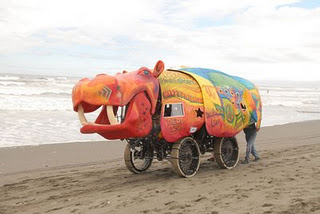
Catch a ride to the market on the giant hippo.
This suggests to me that the collapse of oil-based transportation might not be all that terrible in this place. My daydream is that the transition isn’t just about keeping gas pump-dependent, individuality-centered, automobile culture alive, but about being open to something else growing in it’s place.
Remember when you were a kid and you just rode your bike? Meandered? Wandered? Crossed a parking lot and then rode in circles? Have you actually done that lately?
I’m not trying to be a smart-ass. I think this is part of the loss of car-dependent culture. Most of us are so stressed out paying for cars, or paying for gas, or dealing with the extra hidden charges in our automobile insurance this month that we don’t get around to fun bike rides. Or to imagine that the problems of transportation aren’t unique.
I bet you can think of a time in the last few weeks where you were stymied by a lack of transportation. I think this is what most of us have in common. We want mobility, freedom to move. The chance to just go and get where we need.
Rep. Gwen Moore (D-Wis.) has tried for years to get the government to help the poor buy cars. In 2005 and again in 2007, she sponsored legislation to provide $50 million a year for low-income car ownership programs. Both bills died in committee.
She said she has faced resistance from, among others, environmental organizations that insist mass transit is a better solution.
“Public transit is not practical in Milwaukee where the wind chill can be 45 below and you have to drop three kids off at day care,” Moore said. “We really have a crisis with respect to getting people to their jobs.”
via The poor have few options for seeking help in buying a car – Page 2 – latimes.com.
This is probably what underlies the vicious defensiveness about personal car ownership — this desire for freedom and escape. Solidarity in modern capitalism can be seen in the unfulfilled invitation to freedom. And the daily needs of living in the world that in fact seem to necessitate a car of one’s own.
So how do you challenge the cultural norm while still supporting the need of the poor to have safe and reliable transportation? I guess the daydream is that we could actually start talking not only about the costs of automobile culture, but also the threads of other ways of living that are visible slightly below the surface. Mix a little utopianism with newspaper reports. Encourage people to talk about the impossible and pretty soon it isn’t impossible.
Cuba has endured a U.S. embargo for a couple of decades. The mutual antagonism between the governments of Cuba and the United States has created a fascinating window into an alternative way of being. I’m not oblivious to Cuba’s poverty and problems. In terms of organic agriculture and in this case, automobiles, the resilient Cuban people (different than the government) have shown what is possible.
But since Cubans couldn’t legally sell their vehicles, they learned to do everything possible to keep them on the road.
Nelson Ramos, a car enthusiast and former economist in Havana, says cars in Cuba are “like members of the family.”
“Cars stay in the family forever. And you take care of the car, you fix the engine, and we probably have the best mechanics in the world,” Ramos says. “This is probably the only country in the world where you don’t have a junkyard for cars. We simply get the wreckage and put it on wheels and drive it again.”
via In Cuba, A Used Car Is No Bargain : NPR.
I try not to be a purist. In my ideal world all transportation would be bicycles, but I know that isn’t realistic for most people. So instead, I would put forward a dream of a transition inspired by justice. The needs of a community being organized around those who needed help first. I envision a few electric cars, or biodiesel vehicles that might operate as ambulances or as transit for those who have need. We don’t need any new cars if what Cuba shows us is possible. People will be hand-carving door handles out of wood for the bicycle-powered buggies of the future.
Filed under bicycle, capitalism, Eureka, Humboldt, resistance
Check out the three-part L.A. Times series on buy here pay here automobile sellers. The second of the series came out today and is pretty intense. It is about the financial vultures who have seen the profit in extorting the poor and are investing heavily in these rip off car businesses.
These dealerships focus on people who need cars to get to work, but can’t qualify for conventional loans. They sell aging, high-mileage vehicles at prices well above Kelley Blue Book value and provide their own financing. As lenders of last resort, they can charge interest at three times or more the going rate for regular used-car loans.
Many require customers to return to the lot to make their loan payments — that’s why they’re called Buy Here Pay Here dealerships.
If buyers default, as about 1 in 4 do, the dealer repossesses the cars and in many cases sells them again.
The dealerships make an average profit of 38% on each sale, according to the National Alliance of Buy Here Pay Here Dealers. That’s more than double the profit margin of conventional retail car chains like AutoNation Inc.
“The amount of return from these loans you can’t get on Wall Street. You can’t get it anywhere,” said Michael Diaz, national sales manager for Small Dealers Assistance Inc. in Atlanta, which buys loans originated by Buy Here Pay Here dealers. “It’s the gift that keeps giving.”
Investor money is pouring into the industry from several sources, helping Buy Here Pay Here dealers expand their reach and raise their profile.
via Investors place big bets on Buy Here Pay Here used-car dealers – latimes.com.
And who are those investors?
Subprime auto loan issues now represent a larger percentage of all auto-loan securitizations than at any time since 2006, according to Moody’s.
That means people who have never set foot on a Buy Here Pay Here lot, including retirement savers, own a small piece of the business.
via Investors place big bets on Buy Here Pay Here used-car dealers – Page 3 – latimes.com.
Filed under capitalism
Ah yes, the overly-simplistic logic of overpopulation fanatics. Seven billion people . . . ooooh, what a scary Halloween.
Lets take dumb-ass of the month (only one day left . . . who will win in November?) Dr. Eric Tayag:
Dr. Eric Tayag of the Philippines’ Department of Health said in the AFP report: “Seven billion is a number we should think about deeply. We should really focus on the question of whether there will be food, clean water, shelter, education and a decent life for every child. If the answer is no, it would be better for people to look at easing this population explosion.”
via 7 billionth baby: Congratulations are mixed with dire words – latimes.com.
1. If you use the term “explosion” or “population bomb” to describe actual humans, you should immediate be sent back to health class. Dehumanization by comparison to an inanimate killer is 180 degrees opposite from making a baby. It is the easiest cue that you are reading or listening to an idiot if they use this language.
2. Human beings make babies, some of them make many babies because they might want several babies. Some parents may have kids because they want to love them. If you don’t like that you shouldn’t have babies.
3. If you are terrified about the new babies of the world using up your resources, get over yourself. The lack of ” food, clean water, shelter, education and a decent life for every child” is about poverty and justice. Work to make sure that every person in the world get’s access to these things. It’s about politics not about penises. To imagine that the solution is to reduce population or as Dr. Tayag says “easing” population is part of the racist day-dream that too often leads to sterilization abuses and eugenics.
4. If you are really concerned with the ecology and sustainability of the earth then STOP USING SO MANY RESOURCES. No I don’t mean babies, but you — the person wiping their ass with clean paper and pissing in clean drinking water.
Filed under capitalism, colonialism, communication, human rights
Here is the ice-cold footage of US Marine Scott Olson getting shot by the Oakland police department. Feel free to watch with a cynical eye, but check out when the flash bomb explodes in the midst of people trying to help an injured person.
This is intended to anger you.
Filed under capitalism, colonialism, documentary, human rights, resistance

Photo ran in the Guardian, taken by Kimihiro Hoshino/AFP/Getty Images

Photo credit Daryl Bush, AP, ran in the Guardian

photo byStephen Lam, Reuters, ran in the Guardian
This collection of images is pretty disturbing. No good photos of the police/protester scraps from yesterday in US media, but the British journal has the images. I found the same thing when I went to look for images of the crackdown on Chicago #operation wallstreet. Lets note protesters helping each other and excessive police violence intended to communicate threats to the supportive public. Lets also note courage, generosity and the elements of a new world being articulated. The kind of world which disturbs corporate heads and their cop subordinates.
Filed under capitalism, communication, human rights, propaganda, protest
 Life of refinement