Category Archives: communication

Electoral politics in Iceland: anarchist performance art

I appreciated Constantin Seibt’s article on the anarchists playing with the Icelandic electoral system.  The Best party had a wonderful list of campaign promises:

A glance at the most important campaign promises of the Best Party is more than enough to highlight the audacity of Reykjavik’s voters. They were promised free towels at swimming pools, a polar bear for the zoo, the import of Jews, «so that someone who understands something about economics finally comes to Iceland», a drug-free parliament by 2020, inaction «we’ve worked hard all our lives and want to take a well-paid four-year break now», Disneyland with free weekly passes for the unemployed «where they can have themselves photographed with Goofy», greater understanding for the rural population «every Icelandic farmer should be able to take a sheep to a hotel for free», free bus tickets. And all this with the caveat: «We can promise more than any other party because we will break every campaign promise.»The Best Party emerged from an idea for a sketch show.

via More punk, less hell! – News Ausland: Europa – tagesanzeiger.ch.

You know how it goes, they win the election, form a coalition government, fix the budget, and suggest that humorous performance art may be more effective than traditional governance.

An assessment of four years of anarchist rule yields a rather surprising conclusion: the punks put the city’s financial house in order. They can also look back on some very successful speeches, a few dozen kilometers of bike paths, a zoning plan, a new school organization that no one complains about any more and a relaxed, booming city – tourism is growing by 20% a year and some say that is the new bubble. In speeches, president Grímsson no longer praises Icelanders’ killer instinct, but their creativity. Real estate prices are again on the rise and the Range Rovers are back too. In polls last October, the Best Party hit its high-water mark of 38%. Shortly thereafter, Gnarr announced he would retire and dissolve the Best Party. His reason: «I’m a comedian, not a politician.» He added: «I was a cab driver for four years, a really good one even, and I quit doing that as well.»«My question was always: ‹How do we fuck the system?›» says Örn. «And the answer was, we show that non-politicians can do the job as well. But quitting with a certain election victory within reach, that’s truly fucking the system!»

via More punk, less hell! – News Ausland: Europa – tagesanzeiger.ch.

Thanks to longreads for the suggestion.

Leave a comment

Filed under art, capitalism, communication, do-it-yourself, humor, media, protest, punk, representation, resistance

Dave Chappelle and detournement

Jimmy Fallon interviews Chappelle and he let’s loose a number of wonderful funny gems.  Salute to Fallon, The Roots Prince and Dave Chappelle.  A few key moments worth observing:

2:00 “the lost Root” and racial stereotyping.

2: 30 Chappelle’s explanation of the Roots and all their musical buddies in “shelves” at Electric Ladyland is beautiful.

3:10 Prince and detournement (to turn around against itself).  “That is a Prince Judo move right there.” “That’s checkmate right there!”  To use the humorous image of Dave Chappelle as Prince to sell records — situationist genius.  Here is the cover from Prince’s actual song: breakfast can wait.”  Thanks to Okayplayer

Thanks to Okayplayer for the image

I actually went and bought the song.  You can go to 3rdeyegirl and spend eighty-eight cents to buy a snare and slap-bass Prince tune about . . . well helium-inclusive erotic love.  Perhaps another level of detournement is making a great song about a decade-old Chappelle skit.

4:30 Jay-Z, the Black Album and Kanye’s confident rewind. I also love Chappelle’s imitation of Common’s face when he hears the Common-referential lyric.

5:40 Kanye and the punchline: “my life is dope and I do dope shit!” while getting a sneak peak at not-yet-released Chappelle Show skits. 110%.

Leave a comment

Filed under communication, hip hop, humor, media, music, race, representation

Gendered tropes in video games: Anita Sarkeesian

Leave a comment

Filed under communication, feminism, gender, media, representation, technology

No Malice & Pusha T on CNN

Several casual observations:

– Bill Weir, CNN reporter seems manipulative, disrespectful and really entitled.

– Both spend some time trying to not incriminate themselves.  It is Pusha who makes the most blatantly inconsistent statement when he refuses acknowledge drug profits in part 2.  “No, I’m a really good rapper.”

Probably worth juxtaposing with “King Push” first track from his most recent album:

– I have a little more clarity about the difficulties of No Malice.  I think he makes some of the most explicit justifications for why he refuses to perform violent drug rap music any more.  I appreciate that he gives up obvious financial gain to be real to his family and his beliefs.

– Pusha T’s segments are basically Pusha T advertisements.   The exchange where he tells Weir how much publicity he’ll get from being on CNN is awesome.  Pusha is phenomenally media savvy and makes it clear that he wouldn’t be on CNN if it didn’t benefit him.

– No Malice’s argument about white consumption of violent black-performed drug rap is pretty compelling.

– When asked by Weir why he doesn’t take the money to perform Clipse songs, No Malice gives the best exchange of the series:

“Brother, that money, that money at one time, was out for my life.  They can’t invent a dollar amount to get me out there to tell . . . look at what’s at stake? I can’t tell anybody about selling drugs any more, I can’t even make it look cool anymore.  There are people that are dying, look at what is going on in Chicago.   And I like I said earlier, your race can enjoy it!  And laugh and joke and enjoy it . . . and then get back to business.  I have a message and I have to share it.  Then I have to let you do what you want with it.  You know, you do what you want with it.  But, I’ve got enough blood on my hands.  Enough.”

– No Malice, CNN.

Leave a comment

Filed under capitalism, communication, cultural appropriation, drugs, hip hop, juxtaposition, media, music, race, representation, vulnerability

Inspired by ‘Who gets to graduate’

Paul Tough has a very strong essay in the New York Times called “Who gets to graduate.”  It is a snapshot of the strategies used by caring teachers and administrators at the University of Texas at Austin to help students succeed.  I appreciated the emphasis on successful strategies.  Here are a few of my favorite points.   Chemistry professor David Laude gets props for his initial approach:

In 1999, at the beginning of the fall semester, Laude combed through the records of every student in his freshman chemistry class and identified about 50 who possessed at least two of the “adversity indicators” common among students who failed the course in the past: low SATs, low family income, less-educated parents. He invited them all to apply to a new program, which he would later give the august-sounding name the Texas Interdisciplinary Plan, or TIP. Students in TIP were placed in their own, smaller section of Chemistry 301, taught by Laude. But rather than dumb down the curriculum for them, Laude insisted that they master exactly the same challenging material as the students in his larger section. In fact, he scheduled his two sections back to back. “I taught my 500-student chemistry class, and then I walked upstairs and I taught this 50-student chemistry class,” Laude explained. “Identical material, identical lectures, identical tests — but a 200-point difference in average SAT scores between the two sections.”

Laude was hopeful that the small classes would make a difference, but he recognized that small classes alone wouldn’t overcome that 200-point SAT gap. “We weren’t naïve enough to think they were just going to show up and start getting A’s, unless we overwhelmed them with the kind of support that would make it possible for them to be successful,” he said. So he supplemented his lectures with a variety of strategies: He offered TIP students two hours each week of extra instruction; he assigned them advisers who kept in close contact with them and intervened if the students ran into trouble or fell behind; he found upperclassmen to work with the TIP students one on one, as peer mentors. And he did everything he could, both in his lectures and outside the classroom, to convey to the TIP students a new sense of identity: They weren’t subpar students who needed help; they were part of a community of high-achieving scholars.

via Who Gets to Graduate? – NYTimes.com.

Laude’s interventions have been successful with many students.  Inspired by Laude, UT has developed a research tool which helps them discover which incoming first year students are likely to need some help.

I have a pang of concern about privacy and labeling.  There is something terrible about telling a student from a poor family who has worked really hard that they are “unlikely to succeed” because of some algorithm. This notion of a computer assessing students seems particularly soul crushing.   I appreciate that the folks at UT have something similar in mind in their communication strategy about their interventions.  Paul Tough again:

Perhaps the most striking fact about the success programs is that the selection criteria are never disclosed to students. “From a numbers perspective, the students in these programs are all in the bottom quartile,” Laude explained. “But here’s the key — none of them know that they’re in the bottom quartile.” The first rule of the Dashboard, in other words, is that you never talk about the Dashboard. Laude says he assumes that most U.L.N. students understand on some level that they were chosen in part because of their financial need, but he says it is important for the university to play down that fact when dealing directly with students. It is an extension of the basic psychological strategy that he has used ever since that first TIP program: Select the students who are least likely to do well, but in all your communications with them, convey the idea that you have selected them for this special program not because you fear they will fail, but because you are confident they can succeed.

via Who Gets to Graduate? – NYTimes.com.

UT has turned to psychologists to help figure out how to best communicate to at-risk incoming students that they belong.  How do you best re-articulate the fears and doubts to make them manageable?  Here is Paul Tough explaining UT professor David Yeager and his insights about persuasion and argument:

Yeager began working with a professor of social psychology named Greg Walton, who had identified principles that seemed to govern which messages, and which methods of delivering those messages, were most persuasive to students. For instance, messages worked better if they appealed to social norms; when college students are informed that most students don’t take part in binge drinking, they’re less likely to binge-drink themselves. Messages were also more effective if they were delivered in a way that allowed the recipients a sense of autonomy. If you march all the high-school juniors into the auditorium and force them to watch a play about tolerance and inclusion, they’re less likely to take the message to heart than if they feel as if they are independently seeking it out. And positive messages are more effectively absorbed when they are experienced through what Walton called “self-persuasion”: if students watch a video or read an essay with a particular message and then write their own essay or make their own video to persuade future students, they internalize the message more deeply.

In one experiment after another, Yeager and Walton’s methods produced remarkable results. At an elite Northeastern college, Walton, along with another Stanford researcher named Geoffrey Cohen, conducted an experiment in which first-year students read brief essays by upperclassmen recalling their own experiences as freshmen. The upperclassmen conveyed in their own words a simple message about belonging: “When I got here, I thought I was the only one who felt left out. But then I found out that everyone feels that way at first, and everyone gets over it. I got over it, too.” After reading the essays, the students in the experiment then wrote their own essays and made videos for future students, echoing the same message. The whole intervention took no more than an hour. It had no apparent effect on the white students who took part in the experiment. But it had a transformative effect on the college careers of the African-American students in the study: Compared with a control group, the experiment tripled the percentage of black students who earned G.P.A.s in the top quarter of their class, and it cut in half the black-white achievement gap in G.P.A. It even had an impact on the students’ health — the black students who received the belonging message had significantly fewer doctor visits three years after the intervention.

via Who Gets to Graduate? – NYTimes.com.

As a communication professor I’d like to claim some particular insight into these persuasive pathways.  Communication and Rhetoric teachers tend to think about exactly this kind of strategic approach to making messages, but it is also kind of common sense.   I bet English, Ethnic Studies Women’s Studies and Social Work professors all recognized some of our core principles in our fields in these insights.

I don’t think it is about credit.  There is certainly work to go around.  Part of the story is the structural support of administrators and the other part of the story are the good teachers primed  to implement these ideas.   You’d need administrators and informed teachers working in cooperation for a while to get results.   And you’d need all those teachers from all those fields who already know this to implement change successfully at a university.

Much of the ‘ah-ha’ arguments of the article are about a communication practice known as inoculation — that you pre-warn someone about a coming moment of persuasion in order to steer the person’s understanding of that moment when it happens.

Often used by political candidates to warn about an argument about to be spoken by an opponent in a debate, the tactic works equally well when thinking about education.   Here is Paul Tough analyzing UT’s online messaging module which helps to intellectually-inoculate first year students about belonging and doubt:

Our first instinct, when we read about these experiments, is that what the interventions must be doing is changing students’ minds — replacing one deeply held belief with another. And it is hard to imagine that reading words on a computer screen for 25 minutes could possibly do that. People just aren’t that easy to persuade. But Yeager believes that the interventions are not in fact changing students’ minds — they are simply keeping them from overinterpreting discouraging events that might happen in the future. “We don’t prevent you from experiencing those bad things,” Yeager explains. “Instead, we try to change the meaning of them, so that they don’t mean to you that things are never going to get better.”

via Who Gets to Graduate? – NYTimes.com.

Nice essay and more to think about as we do the important work of hustling to make change.

Leave a comment

Filed under academics, capitalism, class, communication, intersectionality, kindness, learning, representation, Surveillance

Performing arguments: The Roots . . . And then you shoot your cousin

Okayplayer has a slightly obtuse review of the live performance of The Roots new album.  The album is called . . . And then you shoot your cousin.  Here is a snippet from the review by Eddie “Stats” which highlights the use of performance to make some interesting arguments:

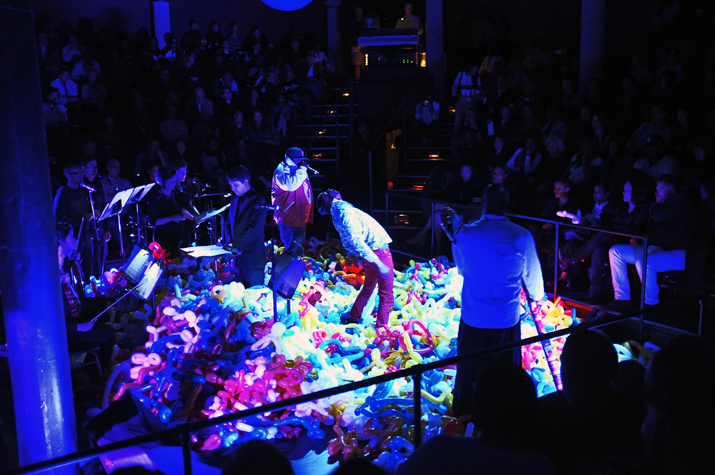
Questlove is at the decks now and as the lights strobe a massive avalanche of balloon animals suddenly falls on the stage, a Jeff Koons flood of meaningless forms, falling in the framedrop slo-mo created by the flash of the strobe. A doo-ragged character enters the stage, humming, holding a gigantic red balloon like a kite. There’s something clownish in his dancerly movements, he has his mouth absurdly open, recalling at once a mime, Flavor Flav in wop-mode, the broom-wielding enforcer of the Apollo as he sweeps balloons away in the wake of his feet. In silence his dance picks up in intensity and his movements resemble Flav less than legendary b-boy choreographer Pee Wee Danz. As he steps and swims through balloons, the pop of dying inflatables echo like gunshots. We are fully in Fluxus territory now, improvisation colliding with a wickeder kind of randomness to create an ‘anything could happen’ tension in the room.

via The Roots chop up their new LP into art live (photos + recap) Okayplayer.

The Roots performing live among some balloon animals.  Photo by Mel D. Cole taken with respect from Okayplayer.

The Roots performing live among some balloon animals. Photo by Mel D. Cole taken with respect from Okayplayer.

Leave a comment

Filed under art, communication, dance, hip hop, music, race, representation, resistance

Harm reduction, EDM & ‘Molly’

Longreads suggested the tell-all essay on so-called molly and Electronic Dance Music festivals written by Shane Morris.  It is a good read with snappy prose and a strong argument that the EDM festivals are locations where lots of people seek drugs from one-time drug dealers who may sell them almost anything.

But I’m more taken with his follow up essay where he not only answers many of the criticisms and also suggests a series of solutions.

Much of what he suggests is harm reduction – trying to make risky behavior (of almost any stripe) less likely to result in damage.  But it is also a sincere plea for bystander accountability and a change in the culture of drug-users and those promoters who make money on festivals.

I’m only saying that it’s time the EDM community starts acting like the family it espouses itself to be. No more secrets. No more “turning around and pretending you didn’t see that happen.” No more fearing what might happen if you ask for help. No more pretending people aren’t getting hooked on Molly. If everyone in the EDM community collectively decides to help themselves, rather than bending to legislation, we can fix this. If we advocate a culture of safety, health, and honesty, we can correct the course of this ship before it maroons itself on the rocks.

Part I. We need a return of safe, “cool down” areas to EDM events. If we all acknowledge that people are going to do drugs, and it’s just something that happens, then we should also be able to acknowledge that every person deserves to be safe, healthy, and well. If you’re not feeling OK, there needs to be a place you can go and sit down, chill out, drink water, maybe even get a bag of ice and put it on your head.

via Finding Molly: Reconstructing Dreamland | Bro Jackson.

Morris also suggests people “call out the idiots promoting overconsumption,” and for transparency (including drug testing kits for prospective users).   He also commits to making his own music events more safe and offers up “safe word” as the catchphrase for a campaign of communication:

Here is his explanation:

In BDSM circles, using a safeword means things have gotten too much for you to handle, and you need to stop, without judgement. In that regard, I feel its purpose is well served here as well. If you’re at an event, and things have spun out of control for you, a friend, or perhaps a stranger you’re just looking out for–you should be able to remove yourself from the situation and know your safety is the primary concern, without fear of repercussions or judgement.

via Finding Molly: Reconstructing Dreamland | Bro Jackson.

Leave a comment

Filed under communication, dance, do-it-yourself, drugs, health, music, punishment, vulnerability

Cannibal Capitalism the Birdman edition

Photo of Birdman’s RG (perhapsRich Gang) and YMCMYSL (perhaps Young Money Cash Money Young Stoner Life) tattoos. Thanks to The Smoking Section for the photo, I assume taken from Birdman’s social media.

Birdman is trying to sign Young Thug to his record label.  To prove his sincerity he tattooed several Young Thug associated tattoos on his hands and face.

Cannibal capitalism is the mediated experiences of human suffering projected for human entertainment and profit.   It is obvious that the bodily impact of Birdman’s tattoos is a particular kind of communication.  Tattoos have often been the indication of long-term committment for gangs, military units and fans of musical artists.  Birdman’s tattoo is amplified on social media and through dozens of rap blogs.  It is a public communication of his commitment intentionally articulated to bring his company more profit (by signing a strong young artist).

In some ways the suffusion of cannibal capitalism into many so-called reality television shows (cooking shows, real estate flippers) is an indication of the desperation of many people.   But Birdman isn’t desperate (not in the poverty sense) — he can give expensive cars and jewelry to friends and label-mates.  I heard on NPR he just gave a Bugatti to Justin Beiber.

Fleeting fame and the potential for profit have encouraged more than one reality TV contestant to become a public exercise in morality and exclusion. (Did you hear about Stephanie on Top Chef when she cut herself and she went to the hospital?!?! How about that Survivor episode where that guy broke his leg? What a wimp!)

Cannibal capitalism can be mapped whenever a human is harmed and it is filmed and amplified for other people’s pleasure.  When this happens a particular morality of self-sacrifice is usually articulated.  Announcers and other contestants express just how someone should take the suffering.  In some ways the harm done to the body gives access to comment on the body.

In the case of Birdman’s new tattoo’s the morality expressed isn’t how tough Birdman was for getting the ink, but rather how idiotic it is to tattoo to something as fleeting as a new potential corporate rap alliance.   Here is the Smoking Section‘s Gotty mocking the social costs of multiple face tattoos.

We recognize that the fact that Birdman will never have to go to a job interview ever in his life. The Cash Money CEO’s so loaded his kids kids most likely will never have to worry about working either. With that said, his continuing effort to ink his whole body with scribblings dedicated to Cash Money subsidiaries is a little odd.

Actually, the “RG,” presumably for his Rich Gang management company, added to his right cheek isn’t that bad because what the hell would two more letters do to a face littered in tats? It’s the “YMCMYSL” scripted on his fingers that doesn’t make sense. Assuming the letters rep Young Money Cash Money Stoner Life as in Young Thug’s movement, that’s more confusing.

via Birdman Permanently Pays Homage To Young Thug | The Smoking Section.

Leave a comment

Filed under capitalism, communication, hip hop, music, representation

Social movements changing journalism and law: Canadian press against Rob Ford

Like most people who spend time on the internets I’m fascinated by Toronto Mayor Rob Ford.  I watched his interview with Jimmy Kimmel and thought: this guy is invulnerable.  He has that teflon acumen to look the audience in the face and (according to many accounts) lie.

The Walrus has a cool accounting of the legal changes in Canada which led to the press freedoms to write about the bad-boy mayor.  Including training the next generation of journalists!  That is social movement work.

Rogers and his colleagues were already monitoring defamation cases in other common law countries, such as the US and Britain, looking for effective defences beyond truth and fair comment. A pair of landmark decisions in Britain’s House of Lords in 1999 and 2006 gave them what they needed. “Responsible journalism,” as the Lords called their new defence, posited that if a journalist has taken reasonable steps to verify that a story is true, and has given the subject an opportunity to respond, he or she cannot be found liable for defamation, even if the story contains untruths. Responsible journalism revolutionized British defamation law.

ADIDEM’s task was to persuade Canadian judges to follow suit, but how do you persuade a judge to rewrite the law at your behest? “You start,” says Rogers, “by using defences that are not yet part of the common law of Canada but that you think should be.” First, however, the group had to make sure Canadian journalists were writing stories that hewed to the spirit of responsible journalism, so they began preaching the gospel in their daily interactions with clients and in seminars at journalism schools. At the Ryerson School of Journalism in Toronto, Rogers and the Star’s Bert Bruser, considered the dean of Canadian media law, recruited reporters like Doolittle to the cause.

via The Story behind the Rob Ford Story · thewalrus.ca.

Thanks to Longreads.com for the recommendation.

Leave a comment

Filed under communication, learning, resistance

Moral pressure for food choices

Illustration by Laura Jones Martinez from Bitch Magazine.

Nice paragraph on food trends, privilege, corporate health food, and the price of kale in Bitch Magazine.  Worth talking about guilt, stress and ethics involved in shopping for food.   Salute to Soleil Ho (and graphics by Laura Jones Martinez) explains the moral dilemma presented to shoppers:

I need to buy this if I want to be good, if I really want to take care of myself and my family As it turns out, this moralistic way of framing choice is extremely profitable for food processors, restaurants, and produce retailers: we’ve been effectively held captive by our own consciences.

via The Cost of Kale: How Foodie Trends Can Hurt Low-Income Families | Bitch Media.


Leave a comment

Filed under communication, food, health