Category Archives: feminism

Colorlines on Django – can we critique a fiction?

Colorlines have the *science* on Django Unchained and slavery.  Among their “Top ten things you should know about slavery but won’t learn at ‘Django’ are the following crucial insights:

3) Africans possessed unique expertise which Europeans required to make their colonial ventures successful. Africans knew how to grow and cultivate crops in tropical and semi-tropical climates. African rice growers, for instance, were captured in order to bring their agricultural knowledge to America’s sea islands and those of the Caribbean. Many West African civilizations possessed goldsmiths and expert metal workers on a grand scale. These slaves were snatched to work in Spanish and Portuguese gold and silver mines throughout Central and South America. Contrary to the myth of unskilled labor, large numbers of Africans were anything but.

via 10 Things You Should Know About Slavery and Won’t Learn at ‘Django’ – COLORLINES.

And this nice reminder about the violent disciplinary work of slavery economics:

6) The brutalization and psychological torture of slaves was designed to ensure that plantations stayed in the black financially.

Slave revolts and acts of sabotage were relatively common on Southern plantations. As economic enterprises, the disruption in production was bad for business. Over time a system of oppression emerged to keep things humming along. This centered on singling out slaves for public torture who had either participated in acts of defiance or who tended towards noncompliance. In fact, the most recalcitrant slaves were sent to institutions, such as the “Sugar House” in Charleston, S.C., where cruelty was used to elicit cooperation. Slavery’s most inhumane aspects were just another tool to guarantee the bottom line.

via 10 Things You Should Know About Slavery and Won’t Learn at ‘Django’ – COLORLINES.

And key to remember that many of those who made profits from slavery continue to be the global elite:

9) Many firms on Wall Street made fortunes from funding the slave trade.

Investment in slavery was one of the most profitable economic activities throughout most of New York’s 350 year history. Much of the financing for the slave economy flowed through New York banks. Marquis names such as JP Morgan Chase and New York Life all profited greatly from slavery. Lehman Brothers, one of Wall Street’s largest firms until 2008, got its start in the slave economy of Alabama. Slavery was so important to the city that New York was one the most pro-slavery urban municipalities in the North.

via 10 Things You Should Know About Slavery and Won’t Learn at ‘Django’ – COLORLINES.

I like this list and would only add an eleventh argument – fleshing out some discussion of gender.  I agree with Angela Davis that a lot of the violent responses by white folks during reconstruction was mobilized around the representation of the threat of black men raping white women.  I think we can track some of current American tensions about sexuality to this decade of image/cultural construction: white male supremacy, female purity and implications of criminality associated with black skin.  Despite being incorrect and made up, these ideas stuck around.

In the comments section of the Colorlines article, one person asks:

‘Django Unchained’ was FICTION why does everyone want to hold it up to fact-checking? These 10 points are correct but had nothing to do with the film. I know so many people that have been discouraged from seeing a great film because the net is flooded with articles about how historically inaccurate the film is. It’s a cowboy styled revenge film where the hero is a black man…

via 10 Things You Should Know About Slavery and Won’t Learn at ‘Django’ – COLORLINES.

I wouldn’t speak for the Colorlines author, Imara Jones, but in my opinion the importance of Django is precisely that it is a popular fictional representation about slavery.  I don’t think it’s real, but Django, along with a long-line of films (Gone with the wind) about slavery can be probed for shared themes, threads, preferred representations.  The fictional liberties are worth examining not for historical accuracy, but for current political implications.

Leave a comment

Filed under art, feminism, media, race, representation, slavery

NASA beauty pageant/Organizational communication of sexism

Image from Artifacting.

For a few years in the late sixties and early seventies NASA ran beauty pageants.  There isn’t much information about the contests but the internet has generated a handful of pictures of the winners set next to a series of space artifacts.  The images stuck with me and a few ideas are worth probing, perhaps not focusing on the beauty pageants, but instead turning the lens toward NASA.

–> At what point does an organization focused ostensibly on the investigation of outer space find itself running an earthly beauty contest?  One answer is that lots of organizations do charity or events to raise their public profile.  I can imagine a car dealer having a book drive for a local library.  But obviously a car dealer probably wouldn’t raise funds for a bicycle learning center.  The choice of secondary advocacy/charity/public relations campaigns speaks (in a slightly obscured way) about the priorities of the organization.
–>Considering the context of the time, these images are generated a few years after the 1969 human landing on the moon.  The space race between the United States the Soviet Union is in motion.  The recruitment of scientists and engineers is presumably a government priority.  Reading the NASA history chapter on social and cultural legacies gives some incredible insights into the very serious struggles to challegne institutional sexism and racism at NASA.  In 1973, when the beauty pageant photo was taken, there was no women’s bathroom at the Kennedy Space Center.  Apparently women could be objectified at the space command, but they couldn’t take a piss.

–> A quote from the above mentioned NASA History:

Admitting women into the Astronaut Corps did require some change in the NASA culture, recalled Carolyn Huntoon, a member of the 1978 astronaut selection board and mentor to the first six female astronauts. “Attitude was the biggest thing we had to [work on],” she said. Astronaut Richard Mullane, who was selected as an astronaut candidate in 1978, had never worked with professional women before coming to NASA. Looking back on those first few years, he remembered that “the women had to endure a lot because” so many of the astronauts came from military backgrounds and “had never worked with women and were kind of struggling to come to grips on working professionally with women.”

http://www.nasa.gov/centers/johnson/pdf/584743main_Wings-ch6a-pgs459-469.pdf

Although I like the inclusion of the topic of sexism in the NASA workplace, I have to question the choice of the editors of this piece to focus on a male astronaut to explain the problem of sexism.  Particularly beneficial to the institution of NASA is the suggestion that the problem of discrimination comes down to the attitudes of a few astronauts.  Compare this with the actual history of NASA in which the first director of Equal Employment Opportunity for NASA (Ruth Bates Harris) declares the attempt to recruit women and people of color “a near total failure.”  Harris was fired by the director of NASA and congress had to force NASA to reinstate her under threat.  It seems like the attitude problem wasn’t limited to a few astronaut candidates.  (Admittedly this information came from the same NASA produced text).

–> Mary Daly includes some discussion about the 2-dimensional representation of women who sustain the men of the space race in Gyn/Ecology.  She describes wives and mothers who are captures in photographic (and video-graphic representation) in order to enable men to fly into space.  There is something amazing about the choice of these NASA pageant images — of beautiful women who have competed for the approval of obscure NASA officials — the winners placed awkwardly into scientific scenes.  As if to suggest their intrusion and difference.  Consider the woman above who is dressed precisely to be as un-astronaut as possible.  As if to suggest that the only way a woman would get into NASA is on the arm of a person who legitimately was welcomed there — as a wife or girlfriend.

–> It is logical to note that these particular representations proliferate the moments when women are asking to get access to equal employment.  We could describe them as a targeted responses intended to resist cultural changes.

Leave a comment

Filed under communication, feminism, human rights, juxtaposition, learning, representation

Michael Kimmel and ‘No Homo’

I spent some time last semester talking about the phrase “no homo” as gender policing.  My argument is that it verbalized patterns of behavior that were not generally sexualized.  Quite often bringing sexual attention to something that was previously mundane. Consider rap intellectual Dallas Penn’s use of “no homo” to ensure heterosexuality is mapped when getting a compliment about his Polo scarf.

He didn’t introduce himself as a rapper, a graff artist or anything spectacular. All he did was compliment me on the ‘Lo scarf I was rocking. No homo, of course.

via dallaspenn.com » Blog Archive » MEYHEM LAUREN IS REALITY….

I have traditionally argued that “no homo” is simply gender policing.  Making sure that people around you know that it is not acceptable for your version of a man to compliment another man on a scarf for instance.  It seems like this is an extension of pathological homophobia.  Not just fear of gay sex, but fear that non-sexual acts would be read as the precursor for gay attraction.

It seems like an interesting subject because it makes an easy map to see the boundary lines for modern masculinity.  The rules for men-to-be-real-men are seldom as explicitly verbalized as with “no homo.”

I’m a fan of Michael Kimmel.  I think he is a smart man who gets a lot of the power dynamics of gender. In the case of “no homo” he argues that this is a kind of linguistic development which marks a loosening of the boundaries of new heterosexual masculinity.

I think we’re a little less homophobic. There’s good evidence that young men are less homophobic than older men are. And I illustrate this often by the difference between “that’s so gay” and “no homo.” Because “that’s so gay” is a way of policing other guys, saying don’t do that, that’s gay. But “no homo” says “you can do it, no homo.” Or “I love you, no homo.” It gives us permission to say something but then back away from it. That’s really different than not being able to do it at all. It’s a small step. The next step is to be able to say it and then not back away from it at all. I think it’s a little bit progressive, not a lot bit progressive.

via An Interview with Michael Kimmel | fbomb.

I think this is quite interesting.  It seems as though the “permission-with-commentary” may come with substantial linguistic homophobic baggage.


Leave a comment

Filed under communication, feminism, homophobia, representation

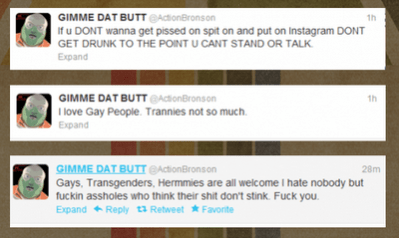
Juxtaposition on transgender discrimination: Action Bronson and Feministing

Artifact one:

Recent wins don’t undermine these tragedies in any way. In fact, it’s all that much harder to see the most marginalized in our community facing violence at the same time that we’re winning victories. Changes in our laws don’t mean people automatically stop hating us. Sometimes increased visibility can mean increased violence. We have to continue working to change people’s minds while we also work to change the laws. Trans women of color continue to face the worst transphobic violence. So we have to continue working deliberately to lift up the voices of trans women of color, to make sure the community most impacted can speak for themselves and humanize themselves.

via A sea change in transgender rights.

Artifact two:


Leave a comment

Filed under communication, feminism, hip hop, homophobia, human rights, juxtaposition, representation

Audre Lorde in Germany

What a nice clip.  Thanks A.L..  You inspire and motivate!

Get up and get ’em!

Leave a comment

Filed under art, documentary, feminism, learning, race, representation

Gender visible in lego heads

I’m getting ready to run a workshop on microaggressions this afternoon and I run across a nice graphic about lego toys.

Thanks to Boing Boing for the link & annals of spacetime for the research.

Really, though, sets have become the norm, so unless you shop through a specialty Web store like BrickLink, you’ll get whichever figs come in a set—and the reality is that those remain predominantly male-focused. To be sure, not everything LEGO’s done in this area is bad. For example, the City Community Minifigure Set features images of a female construction worker, a female EMT, and a female police officer, all careers that play against stereotype. I saw at least one space set in stores recently with a female astronaut. But here’s another big problem: Whenever there’s only one minifig included in a set, it’s invariably a male. Would it be so hard to include one extra part, a female head, and show the female version clearly on the box of every set? Or, if one extra part would break the bank, why not include a dual head, with a female face on one side and a male face on the other?

via annals of spacetime: my dear lego, you are part of the problem.

A dual head with one male-ish face on one side and a female-ish face on the other!  What a cool notion.  Argentina style!


Leave a comment

Filed under feminism, representation

Carol Adams and the New York Times justifications for meat eating

The New York Times invited only prominent white men to discuss the ethics of eating meat.  Blisstree remedy this by inviting Carol J. Adams, the preeminent feminist vegetarian ethical thinker writing today to respond.  She begins by noting the invisibility of identity in the New York Times choices:

Let’s remember the insight about who is “marked” and who is not marked in our culture. Until Black Liberation and Women’s Liberation began to change consciousness in the late 60s and early 70s, white men were unmarked, that is, their whiteness and maleness were untheorized and unremarkable. We all have to resist a kind of “colonization of consciousness” in which we participate in maintaining what is normative because that is what we are used to seeing. The irony here is that the Times helps to create what is normative and who the experts are. Whoever is quoted in interviews and is invited to be a guest writer in the Magazine section, becomes more well known.

via Author Carol J. Adams Weighs In On The Ethicist’s All-Male Meat Panel.

And of course, the delicious core of the argument: that gendered representation is tied to how comfortable Americans are with meat eating.  Adam’s continues:

Does it speak to the gendered politics of meat-eating? How much time do we have?

First, it begins with the presumption that meat eating as a normative practice can be defended, especially here in the United States. I don’t believe in general that it can be, not here in the United States.

Our culture is heavily invested in the identification of meat eating with manliness: The idea that meat protein is better for you; the notion that men need to eat meat to be strong (the countless vegan athletes who disprove this notwithstanding); the identification of veganism with women or with gay men (i.e., it is okay for those “kinds” of people to give up eating meat)! The fixation on hunting as being an important part of our evolutionary heritage is part of the sexual politics of meat, (and interestingly one of the panelists, Michael Pollan describes his very masculine experience of hunting wild animals).

Then there is the philosophical tradition from which much animal theory is written that emphasizes the rational and distrusts the emotional. I am part of a group of feminist writers arguing that a feminist care ethic helps us to see the important of choosing to be vegan. But if caring is disdained, then those kinds of arguments get drowned out in favor of the “rational.”

There is also the status of the other animals in a patriarchal world, one in which they are feminized and sexualized. (I argue in The sexual politics of meat that all animals are made female in image or language through meat eating.)

via Author Carol J. Adams Weighs In On The Ethicist’s All-Male Meat Panel Page 2 |.

Leave a comment

Filed under Animals, capitalism, feminism, food, health, representation, vegetarian

Women behind the wheel: Saudi drivers and M.I.A.

When we amplify cultural appropriation with glossy mediated representations trimmed from context we often get something spectacular. Witness M.I.A.’s new video.   Is it a sensationalist exploitation of vague Arab identity?  Is it a mediocre song with a snazzy video? Is it an anthem for Arab women’s power and emancipation at a particular moment when Saudi Arabian women are fighting for the right to drive?

Saudi Arabia is the only country that bars women from driving. But the topic remains a highly emotional issue in the kingdom, where women are also not allowed to vote, or even work without their husbands’, or fathers’, permission. For religious puritans, the ban on women driving is a sign that the government remains steadfast in the face of a Western onslaught on Saudi traditions. A political cartoon here once depicted car keys attached to a hand grenade.

via Saudis Arrest Woman Leading Right-to-Drive Campaign – NYTimes.com.

Maybe these sultry hooded women are representations of the terrifying hand grenade of women’s emancipation? M.I.A. is certainly in charge — note that she and the other women are suggested as the stunt drivers in her video.  Not quite the dis-empowered sultry video vixen.

Let’s also note the Saudi stunt driving tradition which has provided some of the visual antecedents for M.I.A.’s video.

I think it is a smart way to make the argument.  It’s a savvy juxtaposition — to connect the stunt driving (socially acceptable youth rebellion) with women driving (absolute moral panic).  But the construction of the argument relies on some of the most blunt images of Arab and Muslim cultures.

Cultural appropriation has a couple of dimensions.  One is  the absorption of specific cultural traditions into a generic western culture (German sausages become hot dogs which then become America’s national food).  A second dimension is the insistence that citizens hide their specific culture: language, food, sexuality in order to gain the benefits of citizenship.

In this case, I think the risk is the other-izing jump to rescue Arab women from their oppressive men.  In the buildup to the US-Afghanistan war, the Taliban’s treatment of women was a central theme used to drum up support for military intervention.  I think this is an insincere secondary objectification of women’s struggles, a hijack of liberation and autonomy.    The American invasion of Afghanistan has not helped the women of Afghanistan and the emotional concern that made ‘Afghan women‘ a news cycle trope seems to have dissipated.

We tend to represent the Arab-other in murky abstractions of difference and this video is a slight variation of an Orientalist theme.

1 Comment

Filed under capitalism, colonialism, communication, feminism, human rights, juxtaposition, music, protest, representation

Margaret Cho on accountability and fat jokes

Things I could say should be left unheard and unsaid because I am not willing to be the bigger person. I do not take the high road. I take the low road and blows below the belt are my absolute favorite. The best revenge is not living well. The best revenge is revenge. My mouth and mind and typing fingers are weapons of mass destruction and I pity those ignorant idiots who would leave insults about mine or any women’s bodies in comment boxes because there’s ways of hunting people down. Lots and lots of ways. It’s not as anonymous as they think, as stupid as they are.

via Margaret Cho Rightfully Loses Her Shit.

Thanks Jezebel for the linque!

Leave a comment

Filed under communication, feminism, media, representation

Juxtapostion: gendered LEGO

Artifact one:

Artifact 2:

Image from Sociological Images.

Lisa Wade has the brilliant exposition on this shift over at Sociological Images. 

(And how awesome is that first ad?)

Leave a comment

Filed under communication, feminism, representation