
Sims, Mass & Alan the G created this wonderful video montage of MF DOOM samples and snippets. Well constructed and inspirational (I’m trying to find a copy of Altered States right now!)
Category Archives: hip hop
Clipse Studies 102: No Malice is good
It is worth noting the 2009 Clipse album “Til the casket Drops” as a marker of a few key moments in hip hop.
–> excessive consumerism refined.
–> objectifying sexism as inevitable hip hop video “wallpaper”.
–> Pharrell’s production genius.
–> the last time No Malice rhymed as Malice.
Despite buying the CD in the store, I didn’t know there was a video for this song until today. In retrospect No Malice seems to be showing his discomfort with the lifestyle embodied in the video. “Mama lookin’ right, and I don’t even want her.”
Entitled masculinity as means of riding the fence.
Filed under hip hop, music, representation, sexism
Birdman, consumption and representation
I launch the new video by Young Thug and Rich Homie Quan and the first image is . . . Birdman?
A month a go, Birdman splashed out in an effort to sign Young Thug. While you are being courted by Birdman and Young Money why not shoot a video with a few of the symbols of conspicuous consumption?
Birdman, Birdman Birdman. It is astounding how much space he takes up in this video. Father figure, founder of the feast, center of the party, exceptionally wealthy and entitled. The symbols are all there. Lighting up a cigar in the middle of a boutique sneaker store, bored yacht face, neck yoke of control over attractive women, mansion hallway vignette with Young Money/Cash Money plaques, comforting stacks of cash to sooth weary fingers . . .
(What would it cost to create this video out of rented artifice? Not actually that much real money . . . rent a mansion, boat, cars, shoot the plane scene with a landed dummy plane . . . )
Birdman doesn’t rhyme in the video — he just stars in it. (He does give the exiting dialogue — a shout out to his deceased mother Miss Gladys). I guess Birdman is the price you pay for entry into Young Thug and Rich Homie Quan’s video.
I appreciate that this opening verse gives Thug a chance to rhyme what to him is a kind of normal accelerated pace. His lyrics are distorted by his own voice and he plays with the sounds in a pretty creative way. I don’t know why I like the natural caterwauling squawks that emit from Young Thug more than the digital ones, but I do.
Quan always has a quality flow, and I like his subtly shifting styles through this verse. His deep voice growling does good riding the bass line. It seems like his references and similes could step up a notch . . . but he certainly sounds good.
What to make of the brief scene where Young Thug gives a stack of money to an old woman? Young thug is arguing in the song that he does all this to bring money home to his family — a little consciousness break in a snowstorm of sexism and consumption. Hold on, Quan suggests that his motivation is his mom and dad. And Birdman concludes the video with a sponsored vodka shout out and tribute to his deceased mom.
One of the early critical arguments about hip hop was that the representations of hip hop quickly became images constituted by the artists in order to sell an image to an audience. That hip hop involved performers going to work and creating something intended to meet an audiences expectations (usually male and privileged). One way to read hip hop was to imagine what kind of audience might enjoy and buy this kind of performance. (I’ll note the writings of Eric Watts, Tricia Rose and Robin D. G. Kelley have mostly influenced my perspective on this subject).
To a degree this crass consumerism vs. I’m-just-doing-this-to-feed-my-family debate is played out in the video. I would say that the dominant visual narrative of consumption clashes with any other message. In some ways the class consciousness (dropping off a couple of stacks for mom) is part of the representation of excessive wealth. (Gza: “Who promised his mom a mansion with mad rooms /She died, he still put a hundred grand in her tomb” Gold).
Filed under capitalism, class, communication, gender, hip hop, media, representation, rhetoric
Janelle Monae & 500th post
This is the 500th post on life of refinement. I’m proud of the non-linear series of artifacts gathered here that point toward new understandings. I use this web site to archive interesting things. Meaningful things. This is a curation of the rambling series of artifacts and patterns of representation I find significant enough to be marked and analyzed in a free open public space. This is as close to learning as we’ll ever get.
Thanks to all who read the website.
***
I knew of Janelle Monae and appreciated her music but only had singles in my library. Inspired by a Wax Poetics write up, I bought a copy of “The Electric Lady” last night. With two full listens into the album (barely enough to comprehend what is going on) I’m sold.
This project is wonderful dance music and a really good concept album (or an extension of a concept album to multiple projects — Monae plays an alter ego pretty consistently). The record is an extended riff on technology, cyborg/human interactions, civil rights and living life with dual identities. Given that “The Electric Lady” could be a Phillip K. Dick novel, the smooth inviting production and musicianship is what carries the project.
This albums sounds VERY eighties to me. From the sonic structure and choices of beats/samples to the rock opera lyricism of the concepts. At points I was reminded of my nostalgic childhood filled with Styx, Heart, Bon Jovi and Run DMC. The strings sound eighties. The drums sound eighties. Even the vocal harmonies remind me of eighties hits. But the eighties were a point of technological jump off and the slight broadening of pop music.
I like the futuristic world that Monae is painting. And the willingness to build futuristic pop music out of the sonic blocks of the past. Astute Monae names tracks after inspiring pioneers: “Sally Ride” (astronaut) and “Dorothy Dandridge Eye’s” (first black woman to be nominated for an Academy Award).
In the context of the blog, I’ll quote the end of the “Dance Apocalyptic” when Janelle Monae says: “I really really want to thank you for dancing to the end.” Thanks for reading and dancing ’til the end.
Filed under art, communication, funk & soul, hip hop, human rights, music, representation, resistance, rock and roll, technology
E-40 Bamboo
Salute to E-40! Nice dance-heavy video to get things going for the day, but the song is great. The beat has that Bay area clap, snap and slap sound while 40 Water’s flow just disrespects the beat.
Anyone know who made this beat?
Dave Chappelle and detournement
Jimmy Fallon interviews Chappelle and he let’s loose a number of wonderful funny gems. Salute to Fallon, The Roots Prince and Dave Chappelle. A few key moments worth observing:
2:00 “the lost Root” and racial stereotyping.
2: 30 Chappelle’s explanation of the Roots and all their musical buddies in “shelves” at Electric Ladyland is beautiful.
3:10 Prince and detournement (to turn around against itself). “That is a Prince Judo move right there.” “That’s checkmate right there!” To use the humorous image of Dave Chappelle as Prince to sell records — situationist genius. Here is the cover from Prince’s actual song: breakfast can wait.” Thanks to Okayplayer

Thanks to Okayplayer for the image
I actually went and bought the song. You can go to 3rdeyegirl and spend eighty-eight cents to buy a snare and slap-bass Prince tune about . . . well helium-inclusive erotic love. Perhaps another level of detournement is making a great song about a decade-old Chappelle skit.
4:30 Jay-Z, the Black Album and Kanye’s confident rewind. I also love Chappelle’s imitation of Common’s face when he hears the Common-referential lyric.
5:40 Kanye and the punchline: “my life is dope and I do dope shit!” while getting a sneak peak at not-yet-released Chappelle Show skits. 110%.
Filed under communication, hip hop, humor, media, music, race, representation
No Malice & Pusha T on CNN
Several casual observations:
– Bill Weir, CNN reporter seems manipulative, disrespectful and really entitled.
– Both spend some time trying to not incriminate themselves. It is Pusha who makes the most blatantly inconsistent statement when he refuses acknowledge drug profits in part 2. “No, I’m a really good rapper.”
Probably worth juxtaposing with “King Push” first track from his most recent album:
– I have a little more clarity about the difficulties of No Malice. I think he makes some of the most explicit justifications for why he refuses to perform violent drug rap music any more. I appreciate that he gives up obvious financial gain to be real to his family and his beliefs.
– Pusha T’s segments are basically Pusha T advertisements. The exchange where he tells Weir how much publicity he’ll get from being on CNN is awesome. Pusha is phenomenally media savvy and makes it clear that he wouldn’t be on CNN if it didn’t benefit him.
– No Malice’s argument about white consumption of violent black-performed drug rap is pretty compelling.
– When asked by Weir why he doesn’t take the money to perform Clipse songs, No Malice gives the best exchange of the series:
“Brother, that money, that money at one time, was out for my life. They can’t invent a dollar amount to get me out there to tell . . . look at what’s at stake? I can’t tell anybody about selling drugs any more, I can’t even make it look cool anymore. There are people that are dying, look at what is going on in Chicago. And I like I said earlier, your race can enjoy it! And laugh and joke and enjoy it . . . and then get back to business. I have a message and I have to share it. Then I have to let you do what you want with it. You know, you do what you want with it. But, I’ve got enough blood on my hands. Enough.”
– No Malice, CNN.
Filed under capitalism, communication, cultural appropriation, drugs, hip hop, juxtaposition, media, music, race, representation, vulnerability
Tech N9ne and Murs: Hard
Tech N9ne showcases a lot of different styles in those verses. Murs is going to do good things with Strange music. I like that he shows up and gives respect to the other members of the team. I’m in favor of any music video that requires a warning label that it might harm you.
Performing arguments: The Roots . . . And then you shoot your cousin
Okayplayer has a slightly obtuse review of the live performance of The Roots new album. The album is called . . . And then you shoot your cousin. Here is a snippet from the review by Eddie “Stats” which highlights the use of performance to make some interesting arguments:
Questlove is at the decks now and as the lights strobe a massive avalanche of balloon animals suddenly falls on the stage, a Jeff Koons flood of meaningless forms, falling in the framedrop slo-mo created by the flash of the strobe. A doo-ragged character enters the stage, humming, holding a gigantic red balloon like a kite. There’s something clownish in his dancerly movements, he has his mouth absurdly open, recalling at once a mime, Flavor Flav in wop-mode, the broom-wielding enforcer of the Apollo as he sweeps balloons away in the wake of his feet. In silence his dance picks up in intensity and his movements resemble Flav less than legendary b-boy choreographer Pee Wee Danz. As he steps and swims through balloons, the pop of dying inflatables echo like gunshots. We are fully in Fluxus territory now, improvisation colliding with a wickeder kind of randomness to create an ‘anything could happen’ tension in the room.
via The Roots chop up their new LP into art live (photos + recap) Okayplayer.
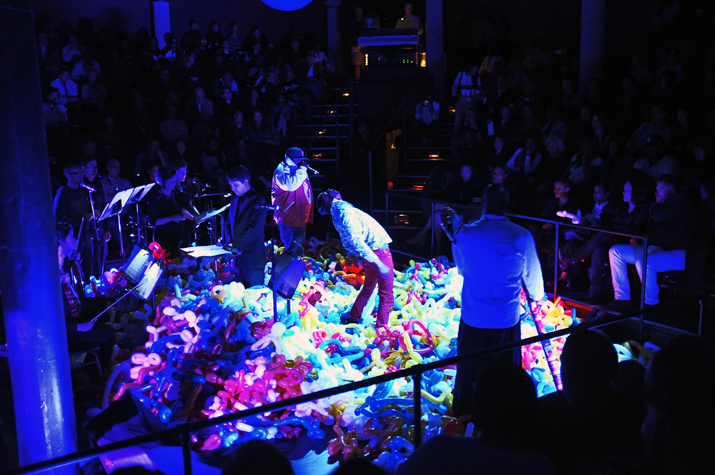
The Roots performing live among some balloon animals. Photo by Mel D. Cole taken with respect from Okayplayer.
Filed under art, communication, dance, hip hop, music, race, representation, resistance
 Life of refinement