Category Archives: hip hop

Bun B, hip hop and changing culture

Photo by Jacob Moore. Bun B and Mayor Parker declaring Bun B Day in Houston. August 2011

Bun B is an absolute boss, a fact reasserted in the Texas Monthly article on his influence.  I find it interesting how much cultural change Bun B has been involved in.  UGK were crucial in convincing the world to appreciate southern hip hop.  Bun B is a great example of community minded hip hop leader, as Katy Vine explains:

Bun B’s life these days is so deeply intertwined with Houston’s that he is often referred to as the city’s unofficial mayor. He has been featured in anti-texting public service announcements. He helps publicize drives for the Houston Food Bank. He hosts a twice-weekly segment on the TV station CW39 called Bun’s Beat (recent installments include “Bun B’s Thoughts on the NFL Banning the N-Word” and “Bun B’s Advice for Returning College Students”). He has been a regular guest on networks such as Comcast SportsNet Houston to discuss the Astros and the Rockets. He attends nearly every major concert. He promotes the city’s food and culture actively on his Twitter feed, where he can seem, at times, like a one-man chamber of commerce. “If you want to find out the best sushi spot, barbershop, or club, he would probably be the person with the widest Rolodex,” Houston rapper Chamillionaire told me. “You could ask him something crazy, like where to find left-handed scissors in Houston, and he could probably point you in three different directions.”

via Man About Town: Page 2 of 8 | Texas Monthly.

Let us note that place has been one of the most significant parts of hip hop culture (where are you from?).   What if there are creative hip hop intellectuals in every town in the world, who love where they are from so passionately that they will become positive leaders in their own places?  It’s going to take some forward thinking municipalities to get the benefits of including hip hop intellectuals.

Thanks to thehairpin for the linque.

Leave a comment

Filed under hip hop, kindness, music, representation

Power, autonomy, body and twerking: Kimari Brand

Brilliant breakdown of twerking and bodily representation.  Smart insights from Kimari Brand about power and the significance of the dance form (film by Irma L. Garcia).  Brought to me by the ever-on-point Feministing.  Good preview of the video by Sesali Bowen in Feministing:

Utilizing multiple experiences — including a course on performance, feminism and social justice, a trip abroad to study Afro-Caribbean culture and politics, and her experiences as a Black girl at an institution of higher education that prioritizes white supremacist “credibility and status” — Brand has reframed the dialogue about twerking.

via “Twerk It Girl” examines twerking for autonomy and resistance.

I think twerking is at the heart of a lot of the moral panics about young women’s sexuality.  More particularly the moral panic attached to twerking is represented along racial and/or sexual and/or class lines depending on the expected audience (Miley Cyrus).  Worth discussion and re-presenting which Brand and the filmmaker Garcia do really well.

Leave a comment

Filed under academics, art, class, cultural appropriation, dance, documentary, feminism, hip hop, race, representation, resistance, rhetoric

Cannibal Capitalism the Birdman edition

Photo of Birdman’s RG (perhapsRich Gang) and YMCMYSL (perhaps Young Money Cash Money Young Stoner Life) tattoos. Thanks to The Smoking Section for the photo, I assume taken from Birdman’s social media.

Birdman is trying to sign Young Thug to his record label.  To prove his sincerity he tattooed several Young Thug associated tattoos on his hands and face.

Cannibal capitalism is the mediated experiences of human suffering projected for human entertainment and profit.   It is obvious that the bodily impact of Birdman’s tattoos is a particular kind of communication.  Tattoos have often been the indication of long-term committment for gangs, military units and fans of musical artists.  Birdman’s tattoo is amplified on social media and through dozens of rap blogs.  It is a public communication of his commitment intentionally articulated to bring his company more profit (by signing a strong young artist).

In some ways the suffusion of cannibal capitalism into many so-called reality television shows (cooking shows, real estate flippers) is an indication of the desperation of many people.   But Birdman isn’t desperate (not in the poverty sense) — he can give expensive cars and jewelry to friends and label-mates.  I heard on NPR he just gave a Bugatti to Justin Beiber.

Fleeting fame and the potential for profit have encouraged more than one reality TV contestant to become a public exercise in morality and exclusion. (Did you hear about Stephanie on Top Chef when she cut herself and she went to the hospital?!?! How about that Survivor episode where that guy broke his leg? What a wimp!)

Cannibal capitalism can be mapped whenever a human is harmed and it is filmed and amplified for other people’s pleasure.  When this happens a particular morality of self-sacrifice is usually articulated.  Announcers and other contestants express just how someone should take the suffering.  In some ways the harm done to the body gives access to comment on the body.

In the case of Birdman’s new tattoo’s the morality expressed isn’t how tough Birdman was for getting the ink, but rather how idiotic it is to tattoo to something as fleeting as a new potential corporate rap alliance.   Here is the Smoking Section‘s Gotty mocking the social costs of multiple face tattoos.

We recognize that the fact that Birdman will never have to go to a job interview ever in his life. The Cash Money CEO’s so loaded his kids kids most likely will never have to worry about working either. With that said, his continuing effort to ink his whole body with scribblings dedicated to Cash Money subsidiaries is a little odd.

Actually, the “RG,” presumably for his Rich Gang management company, added to his right cheek isn’t that bad because what the hell would two more letters do to a face littered in tats? It’s the “YMCMYSL” scripted on his fingers that doesn’t make sense. Assuming the letters rep Young Money Cash Money Stoner Life as in Young Thug’s movement, that’s more confusing.

via Birdman Permanently Pays Homage To Young Thug | The Smoking Section.

Leave a comment

Filed under capitalism, communication, hip hop, music, representation

Sanitizing Waka Flocka Flame

I’ve noted before that Waka Flocka Flame travels a careful orbit between violent drug rhymes and friendly celebrity.  It reminds me of Snoop Dogg and Sean Price — they both sort of make visible the double-consciousness of famous black men. Simultaneously expressing fictional violent anti-social expressions (which are consumed for people’s pleasure) and at the same time in different venues re-representing themselves with a friendly comedic persona (which is consumed for people’s pleasure).

Here is Waka telling a story from his childhood about his grandmother punishing him stylized like a Charles Schultz Peanuts holiday special.

Let’s remember that only the voice is Waka’s the representation is the work of a whole team of experts (sound editors, animators, directors, artists).  And a company makes money on the whole thing.

It would be very interesting to map the choices of animated representations of the recent Trae and Waka videos.

Leave a comment

Filed under hip hop, media, punishment, representation

Curren$y at the drive in

Curren$y has a new mix tape available for download called The Drive in Theatre. I recommend it.  The record is a return to loose jazz loops and picturesque raps set over Godfather samples.   Add in a ton of potent guest verses and The Drive in Theatre went right to the CD player of my automobile.

“Godfather Four” with Action Bronson is pretty strong.  So is “E.T.” (a collaboration with B-Real) that gives Curren$y a chance to talk the lifestyles of the rich and stoned and B-Real a chance to confirm his own Godfather status. “Vintage Vineyard,” “Stolen,” “El Camino,” are all solid portraits of the elite life.

“Grew up in this” matches Spitta with Gary Indiana’s Freddie Gibbs (the hardman’s hardman) and Young Roddy.  The result are three nice verses about struggling.

Check out The Drive in Theatre it’s a strong effort and worth downloading.

Leave a comment

Filed under hip hop, music

Cannibal capitalism: Chief Keef and rehab

I’m interested in the idea that folks would become famous because they harmed themselves or allowed someone else to harm them on camera.  I’ve been calling it cannibal capitalism – as a means of describing this wide scope on popular media.    Cannibal in the sense that viewers consume of the body of another human being who is on camera taking years off of their life

Chief Keef is in rehab for ganja and let’s loose with some great insights about how unpleasant it is.

Nestled inside a nondescript beach house, one of hip-hop’s most controversial rising stars is holed up in court-ordered rehab, and he’s feeling frustrated and alone.

“It’s like being locked up,” Chief Keef, 18, tells Billboard, in his first interview since he entered rehab. “And when I’m locked up, I don’t want anybody to come see me. I won’t let my family come here. I haven’t seen my 2-year-old daughter.”

via Chief Keef Talks Rehab, ‘Bang 3’ Album & Learning How to Surf | Billboard.

Cannibal Capitalism is best thought of as a pattern of mediated communication about morality.  Along with viewing people getting hurt and enjoying it (Jackass, NFL, Ultimate Fighting) we also get the moral commentary from the narrators and participants about that suffering.

Part of the narration of morality that comes with hip hop and cannibal capitalism is a kind of racism+classism+paternalism.  When the articles were popping about Odd Future, the dominant story was just how naughty they were and emphasizing the difficulties they got into.  Very little conversation about music, and heavy emphasis on the disciplining of (usually) young black men.

The quote from the Billboard article is the opening passage.  Do you think it invites a kind of moral judgement?  Do you wonder what this rapper did to get this punishment?  Is it framed in a way to encourage you to read it as an omniscient person who hasn’t had this kind of difficulty, shaking your head in faux-sympathy?

There is no doubt that Chief Keef is at the core of a major moral panic.  One part of the division is the fascinating language used to divide people up.  Richard Sherman and the significance of the representation of thug:

I wonder if the exciting pleasure of the music and imagery of Chief Keef experiencing suffering, particularly mapping up to the discipline and punish strategy of suffering/redemption (recycled) is part of the appeal?

Public consumption of rap stars and their back stories usually includes a kind of nefarious sharing of information.  I went over to my buddies house and we listened to music and also to a 5 minute rant from KRS-ONE threatening some dude over a van robbery.

Hip hop fans are usually fiends for gossip, and interested in the music, culture, language and well, anything of our favorite musicians.

Leave a comment

Filed under capitalism, communication, hip hop, media, prisons, punishment, race, representation

Waka Flocka Flame mean girls scene

In the Waka / Gucci contrast I’ve noted before that Waka holds the Snoop Dogg path of long-term success. Despite releasing albums like Flockavelli where he is splattered with blood.

Waka simultaneously seems to be welcome in the pop culture sphere.  In some ways because of his bloody rhyme content and choice of representation and his willingness to play a role in the phone scene from mean girls.
http://www.mtv.com/videos/misc/997405/throwback-theater-mean-girls.jhtml#id=1721274


Leave a comment

Filed under communication, hip hop, juxtaposition, representation

Changing hateful language in hip hop

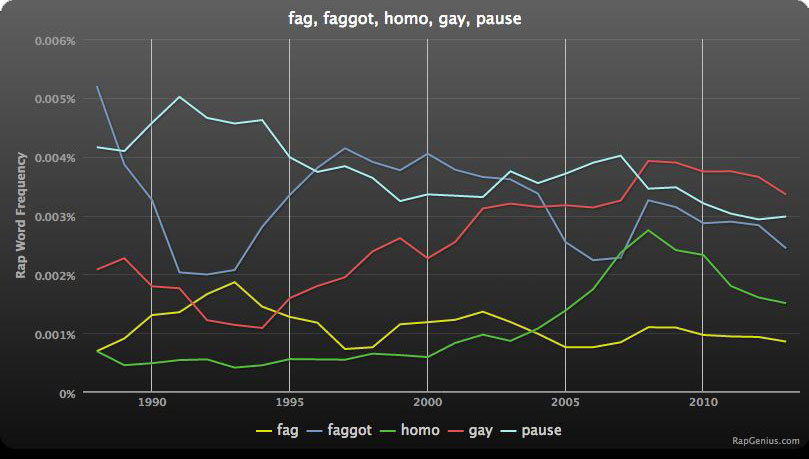
decline in language

I like this article on anti-gay language in hip hop (although the title seems unnecessary).  The above graphic is from the much hated rapgenius.com (not affiliated with the GZA).   But the graphic was included in a nice long write up on Gawker by Rich Juzwiak where he does some lyrical analysis.  While discussing a Frank Ocean lyric Juzwiak writes:

“This is a conversation that hasn’t made its way to mainstream hip-hop before now. It’s probably not as tidy as the most sensitive listeners would prefer. There’s ambiguity there as to whether Ocean’s proposed gunplay is a reaction to homophobia (because saying “faggot” is wrong) or an insult (because being “faggot” is wrong). Ocean is typically terse and selective on these identity matters—it’s possible that he’s still working out this question himself.”

When talking about the number of hit records that seemed to have made it without needing verbal violence toward gay people, Juzwiak explains:

“Hip-hop doesn’t hate gay people. Not all of it, at least. Even when it stumbles in these attempts, even when rappers don’t exhibit the full enlightenment that we’d want from them (Too $hort: “Just go with it, it’s just a lifestyle, you know, so whatever“), it’s still making attempts at engagement, which is more than it was doing even last year and far more than it was doing two years ago.

Still, we’re talking about a vast, varied pool of points of view and opinions. There’s still plenty of homophobic language.”

Here is the link to the article.

Leave a comment

Filed under communication, Gay, hip hop, music, representation

Merry Ghostfacemas 2013

December 26.  Listen to every Ghostface Killah song, preferably in a robe with  a magnum of champagne.

Leave a comment

Filed under hip hop, music

Run the Jewels: Christmas f*cking miracle

Bonus!  The sweaters, the wig on Killer Mike, El-P’s combover, and some of the best lines of 2013.

Leave a comment

Filed under hip hop, music