Category Archives: human rights

Juxtaposition on prostitution

Artifact 1:

Who says a zombie apocalypse has to stop a working girl from making a little cash? Guide Lola past hordes of undead zombie hookers to collect weapons and cash AND guide your still-living Johns back to your trailer for a little “business.” Fulfill the night’s quota, hop in your trailer and do it again the next night.

via Free Online Game – Zombie Hooker Nightmare from Adult Swim.

Artifact 2:

One feeling is that white women are in the club as a side thing: a hobby, for a good workout, to pay for college, etc. While women of color in the business are in it as a long-term career and to support children. Women of color also talk about how difficult it is to get into a strip club in the first place. Pornography already has a reputation for producing films with many racist themes. These are just some basic examples of racism that affect sex workers. It pits workers against each other and makes it nearly impossible to forge a truly cohesive community. I will explore this topic more in the future but for this post I would like to elaborate on how sex workers respond to clients who are men of color and how this directly affects our ability to fight against racism.

via Womanist Musings: The Colour of Money.

Artifact 1:

X – Tempt nearby Johns and make them follow you.

Touching Johns – Makes them follow you.

Guide Johns back to the trailer to turn tricks. Reach the night’s quota and enter the trailer to progress to the next level.

via Free Online Game – Zombie Hooker Nightmare from Adult Swim.

Artifact 2:

One of the most memorable part of working at that club was my experience dancing for white men. I am light-skinned but my features often prompted men to ask if was Latina or Asian. An affirmative answer nearly ALWAYS produced a response of “How exotic” “Ooh I love Latinas, they are so….(insert ridiculous comment here)”. I also noted that white men propositioned me for sex much more often than men of color and were much more persistent about it. Once again, a boring stereotype that is reproduced often in the media and carried out in the club (and online, in the street, etc) which paints women of color as exotic, and excessively sexual. Such bodies are so promiscuous that they are easy to buy – the sale of these bodies is assumed, even.

via Womanist Musings: The Colour of Money.

Artifact 1:

You don’t have to touch Johns to get them to follow you. Pressing X will get almost any John you can see on the screen to follow you as long as zombies aren’t currently attacking them.

via Free Online Game – Zombie Hooker Nightmare from Adult Swim.

Artifact 2:

In order for us to effectively fight racism and racist institutions, we must reach out to sex workers and begin a dialogue. This dialogue is necessary because sex workers encounter so much racism (in such blatant forms) and reproduce these racist behaviors as well. Without a connection to anti-racism efforts, change will not happen in this industry-not for sex workers, not for our clients and not for our community.

via Womanist Musings: The Colour of Money.

Leave a comment

Filed under feminism, human rights

Amnesia, Kenya and the Mau Mau: documentary

The question of national amnesia – the defensive forgetting to avoid traumatic national history — strikes me as central to the condition of humans in this era.

Getting at what you (or someone else) has forgotten is a rough path filled with the potential for hurt feelings and self-defensive justification.

I appreciate the contribution by the National Film Board of Canada who released the documentary: A time there was: stories from the last days of Kenya colony.

British national service and colonialism send a young man (the film’s creator and narrator McWilliams) to Kenya where he photographs the people and the scenery of the land.   It isn’t simple.  He doesn’t simply travel back to get that souvenir connection at the end of his days, instead he layers his own admittedly faulty memory with the films and images of Kenya under colonial rule.  A Mau Mau forest fighter is given healthy space to describe the politics of the time from the militant perspective, and a colonial governor gets screen time.   Both contribute to the sense of deepening — counter forgetting, marking in space and time.

This film helps to get at the process of forgetting/obscuring.  I also points at the potential for uncovering and exposing those pieces missing.

Honestly, I can’t recommend this film enough.  It is up on the National Film Board website in full for a few more days.

Leave a comment

Filed under documentary, human rights, media

Supreme court fear mongering: the California release of prisoners

I just don’t know.

Sam Alito. Thanks to Slate for the photo

Reflecting upon the recent Supreme Court decision which requires California to deal with overcrowded prisons by reducing prisons by 30,000 inmates.   There were two conservative dissenting opinions.  Sam Alito’s writing, as reported in the NYT,  leans toward the military model to describe the incarcerated.

In a second dissent, Justice Alito, joined by Chief Justice John G. Roberts Jr., addressed what he said would be the inevitable impact of the majority decision on public safety in California.

He summarized the decision this way: “The three-judge court ordered the premature release of approximately 46,000 criminals — the equivalent of three Army divisions” (italics in original).

via Supreme Court Upholds Order to Reduce Calif. Prison Population – NYTimes.com.

I think the simplistic scapegoating of prisoners like this is at the core of the California overcrowding problem. They aren’t soldiers, or enemies, they are people who are locked up. Sure they may have been convicted of a crime, but that doesn’t end their humanity — it emphasizes it.  To compare them in size to three Army divisions suggests that a legion of Huns is being released to hold innocent civilians hostage.

It is a choice of language which distracts from the very real problem of prison over crowding.  California currently houses about 140,000 inmates, the requirement to reduce the prisons by 30,000 gives you some sense of conditions.  Of course this new number — 110,000 prisoners, the maximum we are allowed to currently lock up —  is still 137.5% of housing capacity!

And lets be clear, this ruling doesn’t mean we have to release prisoners.  California can also use “new construction, out-of-state transfers and using county facilities,” according to Justice Kennedy.

All three of these alternatives seem pretty grim.   Prison building boondoggles, paying other states to house our inmates when we are so far in debt, and of course the trickle down from prison to county lock up will wreck a number of communities.  And opportunities for circumvention abound. California can also ask for more time after two years. And of course politicians will jump through every hoop to avoid being seen as soft on the incarcerated. Judicial unfunded mandate with a political poison pill makes the mass release of inmates portrayed by the dissenting justices unlikely to happen.

Can we just own up and start seriously diverting non-violent offenders?  And stop labeling people locked in the language of enemy creation?

Leave a comment

Filed under capitalism, human rights, prisons

Documentary: stopover in Dubai

Thanks to the folks at Waxidermy and Gorgomancy, we have the surveillance camera film about the 2010 assassination of Mahmoud al-Mabhouh. Worth a viewing.

Update April 2012.  The Gorgomancy link is down, but the video is available from youtube in three chunks.  Here they are.


Leave a comment

Filed under documentary, human rights

hacktivism: anonymous in Tunisia

Thinking about the struggles to articulate democracy in the era where the very means of expression are owned, the Arab spring gives a chance to see the information strategies of dictatorships on the wane.

In an interesting Al Jazeera article, they note the hacking collective anonymous who helped to provide tools for information sharing during the government clampdown in Tunisia.

As Anons realised the significance of what was taking place in Tunisia – and the fact that it was being ignored by foreign media – they collaborated with Tunisian dissidents to help them share videos with the outside world.

Anonymous quickly created a “care packet”, translated into Arabic and French, offering cyberdissidents advice on how to conceal their identities on the web, in order to avoid detection by the former regime’s cyberpolice.

They used their collective brainpower to develop a greasemonkey script – an extension for the Mozilla Firefox web browser – to help Tunisians evade an extensive phishing campaign carried out by the government.

via Anonymous and the Arab uprisings – Middle East – Al Jazeera English.

Leave a comment

Filed under human rights, media

Valuable documentary: Black in Latin America

Henry Louis Gates has produced a wonderful new documentary series Black in Latin America.  It is a series that looks at the historical representations of the importation of African slaves in Haiti, the Dominican Republic, Mexico, Peru, and Brazil.  Each episode is pretty strong standing alone, but viewing them together really helps to synthesize some of the shared dynamics — the ideas cross over episodes.

Particularly interesting to me is the impact that cane sugar has on European tastes and the relationship sugar has to plantation economies.   When Toussaint L’Ouverture and the Haitian rebellion denied Europe this now vital commodity, Cuba is flooded with slaves to gear up sugar cane production.   This not only allows European flavor access, it also speaks to the compelling desire to never be without refined sugar.  Not to mention enabling France and the United States to isolate and embargo the newly-emancipated Haiti, crushing the economy and facilitating US military take-over.

Also fascinating are the attempts to ‘whiten’ the populations by encouraging immigration from Europe and the impact this has on racial self-identification.  As Gates notes when asked about the racial difference between the nations in the documentaries and the US he notes:

Whereas we have black and white or perhaps black, white, and mulatto as the three categories of race traditionally in America, Brazil has 136 kinds of blackness. Mexico, 16. Haiti, 98. Color categories are on steroids in Latin America. I find that fascinating. It’s very difficult for Americans, particularly African-Americans to understand or sympathize with. But these are very real categories. In America one drop of black ancestry makes you black. In Brazil, it’s almost as if one drop of white ancestry makes you white. Color and race are defined in strikingly different ways in each of these countries, more akin to each other than in the United States. We’re the only country to have the one-drop rule. The only one. And that’s because of the percentage of rape and sexual harassment of black women by white males during slavery and the white owners wanted to guarantee that the children of these liaisons were maintained as property.

via Q&A with Professor Henry Louis Gates, Jr. | Black in Latin America | PBS.

Gates covers the history with a certain quickness.  But he get’s at the cultural impact — in each nation we find some folks whitening, changing the features on statues and in history books, shifting the representation of black leaders to affirm non-blackness.  He also maps the resistance of music, religion, language and the threads of political pan-African identity.

This is a massive topic and I would watch a 12 or 15 part series on the subjects.   It is a shame that Gates only has five episodes to get at the story.  He does an admirable job organizing the ideas and also exposing current themes in each nation that point back to their historical relationship to the slave economy.

The episodes are up for viewing on pbs.  Highly recommended.

Leave a comment

Filed under human rights, media, slavery

Propaganda: facebook vs. google

Propaganda impedes the ability of the viewer/listener to distinguish who is making the message.  Facebook hired a P.R. firm (Burson-Marsteller) to plant semi-bogus stories about privacy concerns in the media.  Here is the Guardian on this trickery:

Suspicions in Silicon Valley were aroused earlier this week when two high-profile media figures – former CNBC tech reporter Jim Goldman, and John Mercurio, a former political reporter – began pitching anti-Google stories on behalf of their new employer, Burson-Marsteller. The pair consistently refused to disclose the identity of their client.

Goldman and Mercurio approached USA Today and other outlets offering to ghost write op-ed columns and other stories that raised privacy concerns about Google Social Circle, a social network feature based on Gmail.

In their pitch to journalists, the pair claimed Social Circle was “designed to scrape private data and build deeply personal dossiers on millions of users – in a direct and flagrant violation of [Google’s] agreement with the FTC [Federal Trade Commission]”.

Facebook’s cover was blown when Burson-Marsteller offered to help write an op-ed for Chris Soghoian, a prominent internet security blogger. Soghoian challenged the company’s assertion that Social Circle was a privacy threat and accused them of “making a mountain out of a molehill”.

Soghoian was stonewalled by Burson-Marsteller when he asked them who their client was. He later published an email exchange between himself and Mercurio.

Cordasco said on Thursday: “Now that Facebook has come forward, we can confirm that we undertook an assignment for that client.

via Facebook paid PR firm to smear Google | Technology | guardian.co.uk.

Offering to ‘ghost-write’ stories is fairly common in P.R. circles.  A casualty of the 24-hour news cycle, many reporters and editors are on constant copy hunts.  The lengthy time given to reporters to fact check has mostly disappeared instead replaced with quick internet searches.  Corporations (and their public relations mouthpieces) can offer to write the whole article in journalistic prose and then offer the article to a well-known pundit (or a beat reporter).

For those reporters on the grind — it is like a sudden snow-day off from school —  you are freed from the responsibilities of actually reporting.  But of course for those of us who still wish that mass media was actually reflecting accurately what someone SAW this is a tragic development.

But of course, the tendrils of internet companies (and google in particular, the medium by which many 0f us do our own ‘fact-checking’) quietly re-adjusting written history is a terrifying possibility.

Internet barriers presented by nations (China for instance) quickly become comfortable to the citizens. Evan Osnos wrote a fascinating essay describing his conversations and observations on a Chinese tour of Europe.  When he asks one of his fellow tourists if they used Facebook, he comes up with this reflection.

I asked Promise if he used Facebook, which is officially blocked in China but reachable with some tinkering. “It’s too much of a hassle to get to it,” he said. Instead, he uses Renren, a Chinese version, which, like other domestic sites, censors any sensitive political discussion. I asked what he knew about Facebook’s being blocked. “It has something to do with politics,” he said, and paused. “But the truth is I don’t really know.” I recognized that kind of remove among other urbane Chinese students. They have unprecedented access to technology and information, but the barriers erected by the state are just large enough to keep many people from bothering to outwit them. The information that filtered through was erratic: Promise could talk to me at length about the latest Sophie Marceau film or the merits of various Swiss race-car drivers, but the news of Facebook’s role in the Arab uprisings had not reached him.

via Chinese Citizens on Tour in Europe : The New Yorker.

It isn’t so much that any citizen of any nation censors themselves to protect the nation, but we swim in so much state-oriented media that it would be impossible to know what we don’t know.  Those elements that are forbidden to us, must be inaccessible for a good reason.

In this context, we should probably argue that corporate media filtration is more dangerous than national media filters.  As Osnos points out, people can circumvent national information barriers, but it is trickier to outwit google or facebook.

Leave a comment

Filed under human rights, media, propaganda

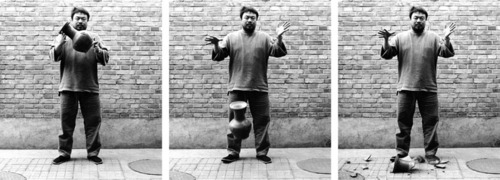
Why so valuable? Ai Weiwei can not be replaced

Ai Weiwei dropping a han dynasty urn

Thirty seven days.  Artist Ai Weiwei has been locked up by Chinese authorities for thirty seven days.  Rumor is that he is being tortured and beginning to admit to his ‘crimes.’

Weiwei is priceless.  Artistic installations and performances that point to a better world than one without him.

Adrien Serle writes about Weiwei’s blog writings in a recent Guardian.

I can think of no equivalent recent writing by an artist in the west, none that confronts political and social realities so eloquently or with such passion and controlled rage. Thoughtful, acerbic, angry, increasingly outspoken, the blogs cover innumerable subjects, from attempts to rescue the cats rounded up and left to starve in warehouses in the clean-up campaign before the 2008 Beijing Olympics, to architecture and design. He writes about Andy Warhol, about the destruction of China’s heritage and the unthinking cynicism and idiocies of city planners and cultural officialdom. He documents the Chinese government’s handling of the 2003 Sars epidemic, the contaminated milk scandal, the “tofu-dregs” construction of the schools that collapsed during the 2008 Wenchuan earthquake. He damns the mendacity of the Chinese media (“To call them whores would be to degrade sex workers. To call them beasts of burden would humiliate the animal kingdom”), and the hypocrisy of some Chinese public intellectuals. But there are also lighter essays on haircuts, humour, creativity and much more besides. After the closure of his blog, Ai turned to Twitter, saying that in Chinese the 140-character brevity of the form almost amounted to a novella.

via Where is Ai Weiwei? | Art and design | The Guardian.

1 Comment

Filed under art, human rights