Category Archives: human rights

Deadpan administrators: Emma Sulkowicz graduates with mattress

Most of you know of the case of Emma Sulkowicz who was raped at Columbia university.  Sulkowicz committed to carry around the mattress where the crime took place until the university expelled her rapist.  Activism, performance art and a compelling articulation of the burdens that survivors of sexualized violence carry.

Sulkowicz graduated and walked across the stage in her gown carrying that mattress.  Worth a moment of reflection to look at the administrators who simply gape at her and her colleagues who help carry the mattress.  If you want to know which administrators to fire, start with the ones that won’t shake Sulkowicz’s hand as she completes her degree.   Please note the crowd volume for Sulkowicz.

Stick around for the short video on the Black Student Union’s die-in at the tree lighting ceremony.

Leave a comment

Filed under academics, feminism, gender, human rights, protest, representation, resistance, sexual assault

Technology extending activism #blacklivesmatter

1.  Thanks to Feministing for the best framing of the uprising in Baltimore.  I appreciate the foregrounding of gender, class, and the juxtaposition of Wholefoods feeding the National Guard and community members organizing (through technology) to feed local kids.

2.  The New York Times seems to think that activism documented through the internet focusing on police violence is a new thing.  It isn’t, but Jay Caspian Kang’s write up of the radicalization of the leaders of this movement is a useful connection point.  Here Kang outlines the articulation of long-standing injustices into first-person experiences of tear-gas saturated outrage in Ferguson.

Mckesson was radicalized that night. “I just couldn’t believe that the police would fire tear gas into what had been a peaceful protest,” he told me. “I was running around, face burning, and nothing I saw looked like America to me.” He also noticed that his account of that night’s tear-gassings, along with a photo he took of the rapper J. Cole, had brought him quite a bit of attention on Twitter. Previously, Mckesson had used the social-media platform to post random news articles that interested him, but now he was realizing its documentary power. He quickly grasped that a protester’s effectiveness came mostly from his ability to be present in as many places as possible: He had to be on West Florissant when the police rolled up in armored vehicles; inside the St. Louis coffee shop MoKaBe’s, a safe haven for the protesters in the city’s Shaw neighborhood, when tear gas started to seep in through the front door; in front of the Ferguson Police Department when shots rang out. He had to keep up a steady stream of tweets and carry around a charger so his phone wouldn’t die.

via ‘Our Demand Is Simple: Stop Killing Us.’ – NYTimes.com.


Leave a comment

Filed under colonialism, communication, do-it-yourself, human rights, juxtaposition, media, memorial, police, protest, representation, resistance, technology

Make this the year YOU discover a new destination!

Excellent visual argument about Palestine.  Compelling visuals, crisp juxtaposition and significant argument about the importance of graffiti.

Leave a comment

Filed under capitalism, colonialism, critique, do-it-yourself, graffiti, human rights, juxtaposition, media, propaganda, protest, representation, resistance, vulnerability

Police violence and mentally ill: firing dissidents

Toshio Meronek has a thoughtful piece about police violence toward mentally ill people.  I appreciated the article, but one part stuck out.  Meronek writes:

Statistics and history show there’s little accountability for cops who use excessive force, like in central New Jersey, where a 2014 study by the Courier News and the Home News Tribune found that 99 percent of police brutality complaints went uninvestigated. Last year, a police officer in Monterey, California was fired not for using too much force, but for using too little. In February of 2014, Corporal Thanh Nguyen a campus officer at California State University Monterey Bay, refused to tase a mentally ill black student when prompted by officers from the nearby Marina, California police force. After the Marina police filed a complaint with the university citing “failure to act,” Nguyen was fired. (In an interview with The Huffington Post, Jeff Solomon, president of the Statewide University Police Association, the officer’s union, explains that Nguyen refused to participate in the tasing because he believed it was unnecessary. Nguyen is now suing his former employer for wrongful termination.)

via Cops shouldn’t be above the Americans with Disabilities Act | Fusion.

There is an interesting groupthink dynamic in the firing of Nguyen.  Seems similar to the Border Patrol firing border agents who humanize people who cross the border.

Leave a comment

Filed under communication, human rights, intersectionality, police, punishment, representation, resistance

Gamergate, autoblocker, anti-trans violence and sea lions: Katherine Cross for the win

One of the most productive commentators about so-called gamergate is Katherine Cross.  Her recent post on Feministing is so on point that it deserves some archival / expansion work.

1.  There is an autoblocking program for twitter that removes most of the posts from gamergate trolls.  For anyone out there interested in civil space, this is a big improvement.  Cross describes it this way:

What offends GamerGaters about the autoblocker, aside from the fact that a woman found a technical solution to a social problem, is that it denies them the ability to impose themselves on targets. The idea that the women, people of colour, and queer folk who’ve comprised the majority of GG’s targets might be able to curate their online spaces and have certain discussions only with those of their choosing is repugnant to many GamerGaters. In the absence of genuine legal recourse, the worst thing you can do to a bully, harasser, or troll is ignore them after all.

via Revenge of the Sealion: GamerGate’s crusade against blocking.

2.   Underscoring much of the gamergate vitriol is a toxic anti-trans politics.  Much of the visibility of the violence seems to have a direction.  Again Katherine Cross gathers enough targeted tweets and message board quotes to rile me up.   For those who are trans-inclusive, trans-positive, or simply kind human beings, it is worth marking gamergate as a particularly anti-trans moment in time.

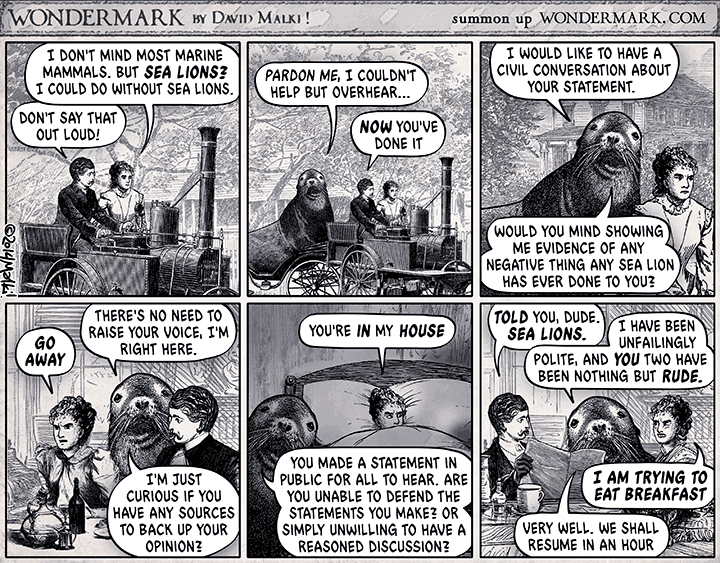
3.  Katherine Cross introduces me to the idea of “sealioning” — a refined bullying tactic.  Cross explains:

“Polite” GGers, defined as those who do not explicitly swear or use slurs, nevertheless harry the people they target because they do not take no for an answer and come in packs. The phenomenon of “sealioning”– barraging a target with politely worded but interrogating questions asked in bad faith– gained a name under GamerGate because of how common the tactic was.

via Revenge of the Sealion: GamerGate’s crusade against blocking.

Also provided is this nice comic!

Sealion-Comic


Leave a comment

Filed under Animals, communication, feminism, Gay, hacking, human rights, intersectionality, protest, representation, resistance, sexism, Surveillance, technology, video games

Online harassment in Massive online classes

Massive Open Online Classes (MOOC) were a big deal a few years ago.  Turns out that one of the most prominent MIT MOOC teachers, Walter Lewin has been  using his MOOC to harass (mostly) international students like French student Faïza Harbi.  Inside Higher Education has the details and a discussion over whether students enrolled in free classes get Title IX protection from gender-based discrimination:

Whether MIT could be held liable for not protecting Harbi and the other women is still an unanswered question. MOOC providers differ on whether learners who are not enrolled at institutions eligible for federal financial aid are covered by the Family Educational Rights and Privacy Act, which some researchers have warned about. But when it comes to discrimination, legal experts said, Title IX of the Education Amendments of 1972 should apply to anyone who registers for a MOOC.

“Title IX talks in terms of ‘no person’ shall experience discrimination — not ‘no student,’ ” Buzuvis said. “That broad language creates the possibility for anyone who’s a victim of discrimination [to] potentially have a claim under Title IX.”

Buzuvis, who runs the Title IX Blog, said that, based on the severity of the Lewin case, a lawsuit against MIT could come down to if the institution knew about the harassment and didn’t act to protect learners.

via Complainant in ‘unprecedented’ Walter Lewin sexual harassment case comes forward @insidehighered.

Buzuvis mentioned is: Erin Buzuvis, director of the Center for Gender and Sexuality Studies at Western New England University.

Thanks for Feministing for the link!

Leave a comment

Filed under academics, capitalism, feminism, gender, human rights, sexism, sexual assault, technology

Justice for Mike Brown: disrupting the symphony

Beautiful music.  A moment of public dialogue interjected into a space for beautiful music.   I don’t know how I missed this  St. Louis symphony showdown.

Elizabeth Vega on the conception of the symphony as a protest space.   Daily KOS reports:

Elizabeth: Two weeks ago, Sarah and I participated in a direct action at Cardinal Stadium. We did a series of banner drops at a baseball game with folks. We are both middle aged I am a grandmother and I am brown and Sarah is white. People were incredibly rude and racist to us at the game. They booed us. Told us “Pants up dont loot” etc.. They clearly saw what they wanted to see. We were escorted out in handcuffs and chanted “No justice! No Peace!” It was a rough night where we didnt feel any love. Sarah suggested that night, jokingly, that perhaps we needed another venue. The next day she said she wanted to do an action at the symphony. I was on board and immediately brought on Derek. When we found out the next performance was a requiem we had to do it.  It took us about two weeks among planning other actions and events for the national mobilization. We are all very busy but carved out about five hours total to recruit, plan and organize.

via Requiem for Mike Brown protest at St. Louis Symphony exposes both white privilege and support.

Thanks to feministing for the suggestion, link and video.

Leave a comment

Filed under art, class, human rights, memorial, music, protest, representation, resistance

Janelle Monae & 500th post

This is the 500th post on life of refinement.  I’m proud of the non-linear series of artifacts gathered here that point toward new understandings.  I use this web site to archive interesting things.  Meaningful things.  This is a curation of the rambling series of artifacts and patterns of representation I find significant enough to be marked and analyzed in a free open public space.  This is as close to learning as we’ll ever get.

Thanks to all who read the website.

***


I knew of Janelle Monae and appreciated her music but only had singles in my library.  Inspired by a Wax Poetics write up, I bought a copy of “The Electric Lady” last night.  With two full listens into the album (barely enough to comprehend what is going on) I’m sold.

This project is wonderful dance music and a really good concept album (or an extension of a concept album to multiple projects — Monae plays an alter ego pretty consistently).   The record is an extended riff on technology, cyborg/human interactions, civil rights and living life with dual identities.  Given that “The Electric Lady” could be a Phillip K. Dick novel, the smooth inviting production and musicianship is what carries the project.

This albums sounds VERY eighties to me.  From the sonic structure and choices of beats/samples to the rock opera lyricism of the concepts.  At points I was reminded of my nostalgic childhood filled with Styx, Heart, Bon Jovi and Run DMC.    The strings sound eighties.  The drums sound eighties.  Even the vocal harmonies remind me of eighties hits.   But the eighties were a point of technological jump off and the slight broadening of pop music.

I like the futuristic world that Monae is painting.  And the willingness to build futuristic pop music out of the sonic blocks of the past.  Astute Monae names tracks after inspiring pioneers: “Sally Ride” (astronaut) and “Dorothy Dandridge Eye’s” (first black woman to be nominated for an Academy Award).

In the context of the blog, I’ll quote the end of the “Dance Apocalyptic” when Janelle Monae says: “I really really want to thank you for dancing to the end.”   Thanks for reading and dancing ’til the end.


Leave a comment

Filed under art, communication, funk & soul, hip hop, human rights, music, representation, resistance, rock and roll, technology

pattrice jones: animals, ecology and injustice

The official title of this stunning talk is: “Animal liberation and social justice.”  But you should watch it, take notes, change your life and donate some cash to the Vine shelter.


Leave a comment

Filed under Animals, capitalism, do-it-yourself, feminism, human rights, intersectionality, kindness, representation, resistance, vegetarian

Elton John in Russia

I appreciate Elton John speaking loudly about his opposition to the Russian  anti-gay legislation in Russia.  I also think this is an elegant justification for Elton John to circumvent a boycott.

It also happens to be a justification that probably makes Elton John a whole lot of money.

Don’t get me wrong, it is excellent to see pop stars expressing their politics.  And I think Elton John is a super bad-ass.  (Remember that he stood up to some heavy bullying and blackmail from a newspaper in the UK).  And I think that he has credibility and status for his opinion to be widely amplified.

Leave a comment

Filed under capitalism, communication, Gay, human rights, protest