Category Archives: learning

Picking a fight out of your division: Bonz Malone

Intellectual giant and cultural wizard Bonz Malone offers a vicious attack on Spike Lee in this interview on the OKAY Player Radio.  The subject is sort of about Django Unchained, but really it should be about Bonz Malone.  It made me think about Spike Lee making an enemy of Indiana Pacer Reggie Miller.

Bonz wrecks spike Lee, but of course, he doesn’t make films.  In the same way, Spike Lee doesn’t actually play competitive basketball and Reggie Miller took the taunts from the film-maker and well . . . just watch.

One possible lesson is stay in your lane.

The other is that it is healthy for us to share insights across experiences.  And you certainly don’t have to be in the NBA to have an opinion on basketball.  Bonz Malone gets at some real and interesting things in this discussion.  Worth a listen.

Leave a comment

Filed under hip hop, learning, media, race, representation, slavery

Cannibal capitalism: diving and the NFL

I’ve been struggling with the idea I call cannibal capitalism — the idea that one would trade of your body, health and well-being in order to get money.  It makes the most sense to help understand some current rappers — Gucci Mane in particular.

But this morning I got two recomendations from Longreads — one on the NFL and the other on deep-sea industrial diving.  Both seem to suggest that there is a popular understanding that in some occupations — the danger and assumption of self-harm is part of the job.  That one trades of their body in order to continue to survive, and occasionally thrive.  I guess one element of surviving in cannibal capitalism is that one often has a limited selection of options and choices.  In my opinion this is driven by the previous discourse one is saturated in — learn, as the NFL players do — that one is expected to endure suffering for pay and success and one is more likely to see this behavior as normal and participate.

The perspective of pain is what this story is about. For fans, injuries are like commercials, the price of watching the game as well as harrowing advertisements for the humanity of the armored giants who play it. For gamblers and fantasy-football enthusiasts, they are data, a reason to vet the arcane shorthand (knee, doubtful) of the injury report the NFL issues every week; for sportswriters they are kernels of reliable narrative. For players, though, injuries are a day-to-day reality, indeed both the central reality of their lives and an alternate reality that turns life into a theater of pain. Experienced in public and endured almost entirely in private, injuries are what players think about and try to put out of their minds; what they talk about to one another and what they make a point to suffer without complaint; what they’re proud of and what they’re ashamed by; what they are never able to count and always able to remember.

via Worst NFL Injuries – Tom Junod on Injury Issue in the NFL – Esquire.

The deeper you dive, the more you get paid. In his second or third year an apprentice may be promoted, or “broken out,” to a full-time diver. His salary will increase to between $60,000 and $75,000. He will start as an “air diver,” diving as deep as 120 feet while breathing regular air. Jobs at this depth might include retrieving tools from the worksite, or cutting and retrieving the polypropylene cord that runs between the surface vessel and the underwater worksite. Next the diver will be assigned to more complex jobs below a hundred feet, for which he must breathe mixed gas in order to avoid suffering the effects of nitrogen narcosis while working with heavy machinery. A full-time mixed-gas diver can earn more than $100,000 a year. He will perform jobs at ever greater depths, with higher degrees of technical difficulty, until his diving supervisor deems him ready to graduate to saturation diving. Sat divers can make $200,000 a year. Sat’s where it’s at.

via Diving Deep into Danger by Nathaniel Rich | The New York Review of Books.

Leave a comment

Filed under communication, health, learning

Anonymity: Richard Marx isn’t shameless, and a dinner party with Bill Ayers

Anonymity ain’t what it used to be.

Used to be you could mouth off in the cheap sheets about a mediocre musician who hasn’t had a hit in twenty years.  Not in 2013. Artists have access to the internet too and they will drive their Lexus to your local dive bar and hold you accountable!

Why would someone who sold 30 million records care what a TV station blogger says? Then on Sunday I got this email:

No explanation for why you write that I’m “shameless?” You act pretty tough sitting alone in your little room behind your laptop.

If you’d written you hated my music, that’s cool. Like I could give a shit. But saying I’m “shameless” calls into question my character and integrity.

This is my hometown…where my kids live…where my mother lives…and this will not stand with me.

Would you say that to my face? Let’s find out. I’ll meet you anywhere in the city, any time. I don’t travel again until the end of the week. Let’s hash this out like men.

Never heard of you in my life before, but between various columnist/radio friends and an array of people at NBC, I now know plenty about you. You don’t know anything about me. But you’re about to.

This isn’t going away.

Richard Marx

I called my editor.

“I’ve been getting emails from some guy who says he’s Richard Marx,” I said. “I think it’s an impostor. The only thing that makes me think it might really be Richard Marx is that it’s from an AOL account.”

My editor had been a waiter at a pizzeria in Lake Bluff, where Richard Marx ate with his family.

“He was a terrible tipper and a real douche,” my editor said. “We used to argue about who had to serve him. His wife is taller than he is.”

via Right Here Waiting – The Morning News.

And of course, what happens if Weather Underground organizers offer to cook a dinner for a local charity?  Conservative bloggers buy the seats:

There was a little “Buy Instantly” button on our dinner item that someone could select for $2,500, which seemed absurdly high. But in early December TV celebrity and conservative bad boy Tucker Carlson clicked his mouse, and we were his.

I loved it immediately. Surely he had some frat boy prank up his sleeve—a kind of smug and superior practical joke or an ad hominem put-down—but so what? We’d just raised more for the Public Square in one bid than anyone thought would be raised from the entire auction. We won!

Well, not so fast—this did mean we had to prepare dinner for Carlson plus five, and that could become messy. But, maybe it wouldn’t, and anyway, we argued, it’s just a couple of distasteful hours at most, and, then bingo! Cash the check.

via Boston Review — Bill Ayers: Breaking Bread with Breitbart.

Leave a comment

Filed under food, learning, media

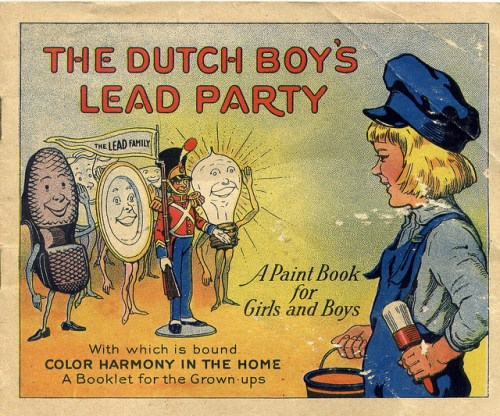
Lead and crime

selling toxins with cute kids

We used to market toxins to little kids with ads like the above.  Seems appropriate to connect up with the new studies that suggest that lead toxicity is a lot more destructive than we thought.

Put all this together and you have an astonishing body of evidence. We now have studies at the international level, the national level, the state level, the city level, and even the individual level. Groups of children have been followed from the womb to adulthood, and higher childhood blood lead levels are consistently associated with higher adult arrest rates for violent crimes. All of these studies tell the same story: Gasoline lead is responsible for a good share of the rise and fall of violent crime over the past half century.

via America’s Real Criminal Element: Lead | Mother Jones.

Leave a comment

Filed under capitalism, health, learning

Reconstruction panic/Django and Sean Price: representations of black masculinity

There is a particular part of the press conversations about the new film Django Unchained that bothers me.  I guess it feels like the indignation about the portrayal of the so-called racism of the film.  In this particular time, marked by the re-election of Barack Obama, it seems like people with white privilege have taken notice of the actual reality of racism but only because of the perceived loss of power.  We could note the famous Bill O’Reilly Fox News white privilege breakdown AKA “the white establishment is now the minority” rant:

I actually think O’Reilly’s speech is pretty transparent, in that it communicates the loss of explicit — assumed solidarity between white women and a white candidate.  O’Reilly makes clear the idea of white privilege as a club — a team of support of care and compassion extended, in his view, between members of the same race.  This absurd idea of compassion and solidarity is at the heart of racism and exactly how people can simultaneously be incredibly violent and exclusionary to people and still imagine themselves as caring people.

We might think about the time period known as Reconstruction — after the Civil War.  James Loewen, a professor of History at UVM who wrote the wonderful book Lies my teacher taught me which gathers up the worst distortions of US History text books.  Here he talks about the fundamental flaws about our understandings of Reconstruction and the implications on self-consciousness:

LOEWEN: I taught for many years at Tougaloo College, a college in Mississippi that is predominantly African-American. Then I moved to the University of Vermont, so I went from the blackest to the whitest college in America. When I was at Tougaloo, I was distraught by the fact that my students believed the following myth about Reconstruction. They believed that Reconstruction was that time period when blacks took over the government of the Southern states right after the Civil War, but they were too soon out of slavery, and so they messed up and whites had to take control again. Now, that’s a terrible misstatement of what happened in Reconstruction. For one thing, the Southern states were governed by a black-white coalition led by whites; they did not go under black control. For another thing, many of the Southern states, particularly Mississippi, had good government during Reconstruction. In Mississippi the state government during that time period started the public schools for both races, whites as well as blacks, wrote a terrific new constitution and did other things.

I thought, what must it do to people to believe erroneously that the one time that they were on the center stage of history in the American past they messed up? What does that do to your self-concept? So I looked into how had my students learned this. Why did they believe it? And Tougaloo was a good college, is a good college. They had learned what was in their high school state history books, so I put together a coalition of students and faculty, and we wrote a new history of Mississippi called “Mississippi: Conflict and Change.” The state rejected it for public school use, and it’s another story but we actually took them to court about that and won a First Amendment victory.

via Booknotes :: Watch.

I listened to the NPR audio interview with the director of the film, Quentin Tarantino, and the questions posed to Tarantino about the racism of the use of the N-word seemed so similar to the arguments about reconstruction.  It seems like the simplistic portrayal of racism — the idea that the offensive part about racism is the expression of the word rather than the systematic exploitation and oppression of a group of people for 500 years.  I can’t find the interview, but this gives you some taste of the NPR take on things.

“Django Unchained” not only plunges Tarantino back into the racially sensitive territory that has brought him criticism in the past, it essentially explodes it. The n-word is used more than 100 times in the film. Two especially violent scenes of slavery — one a Mandingo brawl, the other involving a dog — even Tarantino calls “traumatizing.”

It’s a revenge fantasy that, depending on your perspective, makes this either the rare film to honestly present the ugliness of slavery, or one that treats atrocity as a backdrop for genre movie irreverence. It’s probably both.

“If the only purpose of this movie was to make a shocking expose about slavery … that would be well and good. You could definitely do that,” says Tarantino. “But this movie wants to be a little more than just that.”

via Tarantino Unchained: Quentin Unleashes ‘Django’ : NPR.

It seems to me that this time period of heightened white anxiety over the displacement of power, so clearly represented in the racist O’Reilly rant, one modern thread is the bogus fear that a rising tide of revenge-prone people of color will come to presumably kick white people’s ass and take their stuff.  What I’m calling reconstruction panic.

I guess the NPR tsk-tsk of Quentin Tarantino seems similar.  I feel like they are suggesting that it isn’t acceptable to represent aggressive black violence against white racists, and it is certainly not okay to make a fictional film about it that uses the N-word.

Both the NPR response to Django and the O’Reilly segment present a kind of problem with the representation of threatening men of color.  Which brings us to Sean Price.

For those who don’t know, Sean Price is one of the best rappers in the United States.  At various points he raps with his partner Rock as Heltah Skeltah, sometimes he raps with a larger crew of emcees as the Boot Camp Clik.  Any verse you hear from him will be talented and probably contain something offensive.

His newest album Mic Tyson — exemplifies the double entendre word play and aggressive tough-guy rhymes that makes Sean Price so appreciated.  It goes without saying that the rhymes are so strong that I don’t tend to share my appreciation with Sean with anyone else other than with rap fans.  I like that Sean Price has rhymed with the same genuinely clever anti-social style since he was a teenager.  I buy everything he releases simply because he is that good. I don’t need him to get with the hottest beat makers.  And I don’t need him to have a collaboration with a current emcee.  All I need is that he continues to make really good rhymes and I’ll keep buying the records.

So if one is, lets say, like Sean Price a large black man — is there any way to soften one’s image to make the incredibly talented rhymes that you write be appreciated and for you to get paid?

Leave a comment

Filed under art, colonialism, communication, cultural appropriation, juxtaposition, learning, race, representation, slavery

Making up your own language: Ithkuil

Nice essay in the New Yorker by Joshua Foer about a guy who invented a language in his spare time while working for the DMV. John Quijada created the new language Ithkuil which attempts to maximize clarity in human communication.  A few favorite passages and a little commentary:

1. Quijada’s idea to create a language was inspired Magma, french progressive rock band.

Quijada’s entry into artificial languages was inspired by the utopian politics of Esperanto as well as by the import bin at his local record store, where as a teen-ager, in the nineteen-seventies, he discovered a concept album by the French prog-rock band Magma. All the songs were sung in Kobaïan, a melodic alien language made up by the group’s eccentric lead singer, Christian Vander.

via Joshua Foer: John Quijada and Ithkuil, the Language He Invented : The New Yorker.

2. Quijada’s research drew on the multiple ways human’s language suggests dramatically different ways of being.

“I had this realization that every individual language does at least one thing better than every other language,” he said. For example, the Australian Aboriginal language Guugu Yimithirr doesn’t use egocentric coördinates like “left,” “right,” “in front of,” or “behind.” Instead, speakers use only the cardinal directions. They don’t have left and right legs but north and south legs, which become east and west legs upon turning ninety degrees. Among the Wakashan Indians of the Pacific Northwest, a grammatically correct sentence can’t be formed without providing what linguists refer to as “evidentiality,” inflecting the verb to indicate whether you are speaking from direct experience, inference, conjecture, or hearsay.

Inspired by all the unorthodox grammars he had been studying, Quijada began wondering, “What if there were one single language that combined the coolest features from all the world’s languages?” Back in his room in his parents’ house, he started scribbling notes on an entirely new grammar that would eventually incorporate not only Wakashan evidentiality and Guugu Yimithirr coördinates but also Niger-Kordofanian aspectual systems, the nominal cases of Basque, the fourth-person referent found in several nearly extinct Native American languages, and a dozen other wild ways of forming sentences.

via Joshua Foer: John Quijada and Ithkuil, the Language He Invented : The New Yorker.

3.  Joshua Foer, the author of the article, seems as intrigued by the potential of “constructed languages” (conlanging) to point toward innovative approaches to existence.

Many conlanging projects begin with a simple premise that violates the inherited conventions of linguistics in some new way. Aeo uses only vowels. Kēlen has no verbs. Toki Pona, a language inspired by Taoist ideals, was designed to test how simple a language could be. It has just a hundred and twenty-three words and fourteen basic sound units. Brithenig is an answer to the question of what English might have sounded like as a Romance language, if vulgar Latin had taken root on the British Isles. Láadan, a feminist language developed in the early nineteen-eighties, includes words like radíidin, defined as a “non-holiday, a time allegedly a holiday but actually so much a burden because of work and preparations that it is a dreaded occasion; especially when there are too many guests and none of them help.”

via Joshua Foer: John Quijada and Ithkuil, the Language He Invented : The New Yorker.

I have to wonder what my life would be like if I spoke only the one hundred twenty three word language!  I bet those little zen kids don’t even need grammar classes!

4. John Quijada’s representation of the clarity suggests a certain dislike in linguistic ambiguity.  What an interesting desire — to desire to write verbal play out of existence.  I suspect that Quijada would respond that the debate about the meaning would come down to difference in pronunciation of words!

“I wanted to use Ithkuil to show how you would discuss philosophy and emotional states transparently,” Quijada said. To attempt to translate a thought into Ithkuil requires investigating a spectrum of subtle variations in meaning that are not recorded in any natural language. You cannot express a thought without first considering all the neighboring thoughts that it is not. Though words in Ithkuil may sound like a hacking cough, they have an inherent and unavoidable depth. “It’s the ideal language for political and philosophical debate—any forum where people hide their intent or obfuscate behind language,” Quijada continued. “Ithkuil makes you say what you mean and mean what you say.”

via Joshua Foer: John Quijada and Ithkuil, the Language He Invented : The New Yorker.

5.  Foer’s story of the trip to Kiev where he and Quijada meet some of the most fervent fans of Ithkuil is pretty intense.

6.  Quijada meets George Lakoff, the thinker whose analysis of the power of metaphors propelled Quijada to create Ithkuil, in essence, to destroy the metaphoric by grounding every concept in a written/spoken concrete expression.

“There are a whole lot of questions I have about this,” he told Quijada, and then explained how he felt Quijada had misread his work on metaphor. “Metaphors don’t just show up in language,” he said. “The metaphor isn’t in the word, it’s in the idea,” and it can’t be wished away with grammar.

“For me, as a linguist looking at this, I have to say, ‘O.K., this isn’t going to be used.’ It has an assumption of efficiency that really isn’t efficient, given how the brain works. It misses the metaphor stuff. But the parts that are successful are really nontrivial. This may be an impossible language,” he said. “But if you think of it as a conceptual-art project I think it’s fascinating.”

via Joshua Foer: John Quijada and Ithkuil, the Language He Invented : The New Yorker.

Word.

Leave a comment

Filed under academics, communication, cultural appropriation, learning, music, representation

NASA beauty pageant/Organizational communication of sexism

Image from Artifacting.

For a few years in the late sixties and early seventies NASA ran beauty pageants.  There isn’t much information about the contests but the internet has generated a handful of pictures of the winners set next to a series of space artifacts.  The images stuck with me and a few ideas are worth probing, perhaps not focusing on the beauty pageants, but instead turning the lens toward NASA.

–> At what point does an organization focused ostensibly on the investigation of outer space find itself running an earthly beauty contest?  One answer is that lots of organizations do charity or events to raise their public profile.  I can imagine a car dealer having a book drive for a local library.  But obviously a car dealer probably wouldn’t raise funds for a bicycle learning center.  The choice of secondary advocacy/charity/public relations campaigns speaks (in a slightly obscured way) about the priorities of the organization.
–>Considering the context of the time, these images are generated a few years after the 1969 human landing on the moon.  The space race between the United States the Soviet Union is in motion.  The recruitment of scientists and engineers is presumably a government priority.  Reading the NASA history chapter on social and cultural legacies gives some incredible insights into the very serious struggles to challegne institutional sexism and racism at NASA.  In 1973, when the beauty pageant photo was taken, there was no women’s bathroom at the Kennedy Space Center.  Apparently women could be objectified at the space command, but they couldn’t take a piss.

–> A quote from the above mentioned NASA History:

Admitting women into the Astronaut Corps did require some change in the NASA culture, recalled Carolyn Huntoon, a member of the 1978 astronaut selection board and mentor to the first six female astronauts. “Attitude was the biggest thing we had to [work on],” she said. Astronaut Richard Mullane, who was selected as an astronaut candidate in 1978, had never worked with professional women before coming to NASA. Looking back on those first few years, he remembered that “the women had to endure a lot because” so many of the astronauts came from military backgrounds and “had never worked with women and were kind of struggling to come to grips on working professionally with women.”

http://www.nasa.gov/centers/johnson/pdf/584743main_Wings-ch6a-pgs459-469.pdf

Although I like the inclusion of the topic of sexism in the NASA workplace, I have to question the choice of the editors of this piece to focus on a male astronaut to explain the problem of sexism.  Particularly beneficial to the institution of NASA is the suggestion that the problem of discrimination comes down to the attitudes of a few astronauts.  Compare this with the actual history of NASA in which the first director of Equal Employment Opportunity for NASA (Ruth Bates Harris) declares the attempt to recruit women and people of color “a near total failure.”  Harris was fired by the director of NASA and congress had to force NASA to reinstate her under threat.  It seems like the attitude problem wasn’t limited to a few astronaut candidates.  (Admittedly this information came from the same NASA produced text).

–> Mary Daly includes some discussion about the 2-dimensional representation of women who sustain the men of the space race in Gyn/Ecology.  She describes wives and mothers who are captures in photographic (and video-graphic representation) in order to enable men to fly into space.  There is something amazing about the choice of these NASA pageant images — of beautiful women who have competed for the approval of obscure NASA officials — the winners placed awkwardly into scientific scenes.  As if to suggest their intrusion and difference.  Consider the woman above who is dressed precisely to be as un-astronaut as possible.  As if to suggest that the only way a woman would get into NASA is on the arm of a person who legitimately was welcomed there — as a wife or girlfriend.

–> It is logical to note that these particular representations proliferate the moments when women are asking to get access to equal employment.  We could describe them as a targeted responses intended to resist cultural changes.

Leave a comment

Filed under communication, feminism, human rights, juxtaposition, learning, representation

MF Doom on graffiti

I was dubious when I saw the link.  But it sounds like DOOM.

Left and right hemispheres of the brain engaged.

Thanks to Okayplayer for the link.

Leave a comment

Filed under communication, graffiti, hip hop, learning

Indigenous people’s day juxtaposition

Thanks to Vintage Ads for the image.

Leave a comment

Filed under colonialism, cultural appropriation, human rights, juxtaposition, learning, Native, race, representation, slavery

Andrew W.K. parties with the My Little Pony crew

I’m thinking about Iris Young and her notion of the city.

“What ever you want to play with, it’s okay.  It’s more than okay. It’s good.”

‘It was only released in Japan.  But you can get it on illegal downloading.  Please do.’

50 minutes and the party cannon emerges.

‘I would tell them.  It’s totally fine to be in the corner.’

Dude sounds wicked Canadian.

Previously, I wrote about Andrew W.K performing in a wheelchair.

Leave a comment

Filed under health, juxtaposition, learning, music, representation