Curren$y has a new mix tape available for download called The Drive in Theatre. I recommend it. The record is a return to loose jazz loops and picturesque raps set over Godfather samples. Add in a ton of potent guest verses and The Drive in Theatre went right to the CD player of my automobile.
“Godfather Four” with Action Bronson is pretty strong. So is “E.T.” (a collaboration with B-Real) that gives Curren$y a chance to talk the lifestyles of the rich and stoned and B-Real a chance to confirm his own Godfather status. “Vintage Vineyard,” “Stolen,” “El Camino,” are all solid portraits of the elite life.
“Grew up in this” matches Spitta with Gary Indiana’s Freddie Gibbs (the hardman’s hardman) and Young Roddy. The result are three nice verses about struggling.
Check out The Drive in Theatre it’s a strong effort and worth downloading.
I’ve gotten papers with little comments or song lyrics embedded in the prose. I assumed they were little tests to see if I was actually reading the paper. I note it as a technique of surveillance or accountability.
Thanks to openculture.org for the image.
This is a whole extra level of thoughtfulness. Rick-rolling without really altering the content of your paper.
I wonder if this was really a paper for this class or was it made as a gag?
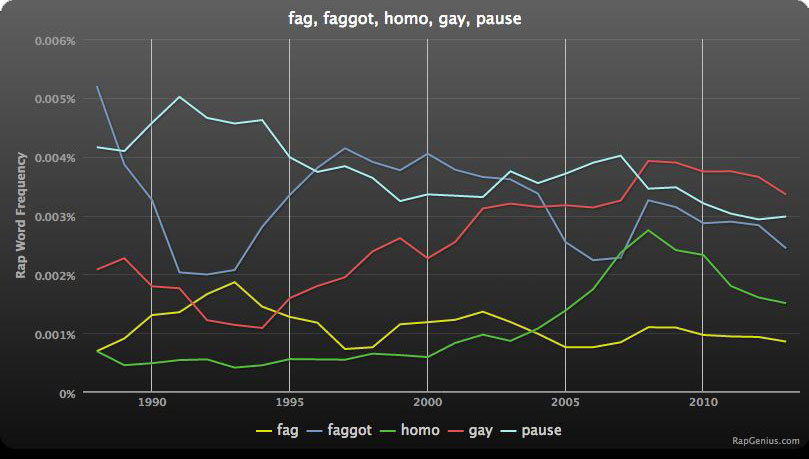
I like this article on anti-gay language in hip hop (although the title seems unnecessary). The above graphic is from the much hated rapgenius.com (not affiliated with the GZA). But the graphic was included in a nice long write up on Gawker by Rich Juzwiak where he does some lyrical analysis. While discussing a Frank Ocean lyric Juzwiak writes:
“This is a conversation that hasn’t made its way to mainstream hip-hop before now. It’s probably not as tidy as the most sensitive listeners would prefer. There’s ambiguity there as to whether Ocean’s proposed gunplay is a reaction to homophobia (because saying “faggot” is wrong) or an insult (because being “faggot” is wrong). Ocean is typically terse and selective on these identity matters—it’s possible that he’s still working out this question himself.”
When talking about the number of hit records that seemed to have made it without needing verbal violence toward gay people, Juzwiak explains:
“Hip-hop doesn’t hate gay people. Not all of it, at least. Even when it stumbles in these attempts, even when rappers don’t exhibit the full enlightenment that we’d want from them (Too $hort: “Just go with it, it’s just a lifestyle, you know, so whatever“), it’s still making attempts at engagement, which is more than it was doing even last year and far more than it was doing two years ago.
Still, we’re talking about a vast, varied pool of points of view and opinions. There’s still plenty of homophobic language.”
And, well, there’s a cat. It’s a nice-looking cat, of the gray-and-black tabby variety, and while I assume it’s Joni Mitchell’s pet, I hope it was a Hollywood stunt cat, because Mitchell subjects the poor thing to a series of spine-wrenching contortions not seen since Ferdinand II of Aragon sent my converso forbears packing off to the strappado. She dances a kind of pas de deux with the cat, see, which sounds cute, but in practice involves stretching and distending the feline’s extremities, twirling it in circles, lifting it overhead, etc. I can’t decide whether to contact the ASPCA about the statute of limitations on animal torture, or to make a bunch of GIFs and ROTFLMAO. In any case, I think we all can agree that “Dancin’ Clown” is the worst song ever, and the greatest video ever made. And that Joni Mitchell has no business owning a cat.
John Spong has a narrative essay in Texas Monthly describing the rebellious country music scene around Austin Texas in the early seventies. A few of my favorite quotes:
JERRY JEFF WALKER I had a whole lot of money available, and I knew what people like the Band were doing. You buy the equipment, make your record, and when you’re done, you own the shit! I thought that might be a good thing to do.
BOB LIVINGSTON Someone had gutted the old Rapp Cleaners on Sixth Street, put burlap on the walls, and made it one of Austin’s first recording studios. We’d been with Murphey in a Nashville studio, and now we’re with Jerry Jeff in this funky little place, plugged into a sixteen-track tape recorder in the middle of the room, with no board, no nothing. We’d get there about seven each night, and Jerry Jeff would be standing in the doorway, mixing sangria in this big metal tub.
JERRY JEFF WALKER The sound engineers wanted to bring in this souped-up equipment. I said no. This needed to be like one of those nature shows: [He whispers in an affected English accent]“This is the first time we’ve ever seen the birthing of a Tibetan tiger baby.” I figured if somebody could sneak up on a tiger, we could be recorded where we’re comfortable.
I like this next quote by James White about letting these new country rebels play at his club. Maybe it’s because he judges everyone so much on their shoes. And of course — musical integration comes because five hundred hippies will buy a lot of beer.
JAMES WHITE opened the Broken Spoke in 1964. They drew over five hundred people. And I guess about 70 to 80 percent were hippies. Some of them were barefoot or wearing moccasins or tennis shoes, like a PF Flyer. None of them could two-step. They all did a dance I called the Hippie Hop, jumping around like old hoedown dancing. But there were five hundred of them, and I figured anybody who can draw five hundred people is okay.
I know that Willie Nelson is fundamentally bad-ass, but this article gives me a whole new perception. Here he is calming down redneck violence during the transition:
STEVE EARLE I saw Willie play this joint in Pasadena called the Half Dollar. Pasadena was where the Ku Klux Klan clubhouse was in the Houston area. It was as redneck as Texas got, full of refinery workers who went dancing every weekend. But that night, a bunch of us hippies wanted to sit on the floor and watch Willie play. So as the regulars go around the dance floor, they’re kicking us in the back. Willie stopped in the middle of a song and said, “You know what, there’s room enough for some to dance and some to sit.” That chilled it out.
Austin gave Tom T. Hall a lesson in gender politics. Visible here is the understanding that the power/disempowerment of gender dynamics is the pleasurable thing for male-dominant sex:
TOM T. HALL My show at the Armadillo was the first time I was ever propositioned by a woman. I came out of Kentucky and had this naive notion that men were supposed to chase women. That was the sport of it. So this beautiful, blond-haired girl came out of the audience looking like one of the Dallas Cowboys Cheerleaders. She said, “Hey, you want to go screw?” I said, “Oh, I don’t think so.” The charm had gone out of the thing.
I’ve got to search for the first season of Austin City Limits.
BILL ARHOS That first year of Austin City Limits was crazy. Doug Sahm was on, and the air in the studio turned purple from marijuana smoke. I had to throw a guy out for spraying silver paint up his nose. Seriously. And God, Jerry Jeff was supposed to tape one night, but he’d gone to Miami to see the Cowboys play in the Super Bowl. If they’d won, he would’ve never shown up. But they lost, and he came, walking onstage while the Gonzos were singing “London Homesick Blues,” just grinning like an idiot. I said, “What the hell?” And someone said, “There’s a guy in the audience wearing a gorilla suit.” There was.
Perhaps the best musical defense against a drug charge by Waylon Jennings:
RICHIE ALBRIGHT The next day Waylon was booked for possession, and that was big news in Nashville. And it was funny because Willie played in Nashville that night and had Waylon come out onstage. The place went nuts. The day after that, we were at the lawyer’s office, and Waylon said, “You got a guitar around here?” They did. He said, “You’ve got to hear this new song.” He started playing “Don’t You Think This Outlaw Bit’s Done Got Out of Hand.” He got to the part where he says, “They got me for possession of something that was gone, long gone,” and the lawyers faces all drained. They said, “You can’t say that.” Waylon goes, “Hell, it is gone.”
Interesting how common gun play was at this point:
RAY BENSON We were filming a show at the Alliance Wagon Yard, and I’m in the video truck with a guy from CBS Records named Herschel. I put my hand on the board and suddenly go, “Ow! Was I just shocked?” and then Herschel goes, “Ow! My leg!” and I turn and see his jeans going dark with blood. One of Willie’s guys had shot at Joe Gracey’s brother with a .22, and the bullet went through the side of the van, grazed my left hand, and then went into Herschel’s leg. But when CBS found out who shot him, they decided not to press charges. They didn’t want to alienate Willie.
LEON RUSSELL That was my video truck. But I figured that if you send your million-dollar truck down to Austin, you’ve got to expect to get a bullet hole or two in it.
Hip hop syncretism — the aggressive combinations of sounds and players from many cultures. Here visible in the nice B+ film — Brasilintime w/ a cadre of great drummers and DJs. It includes:
–> One of the best examples of cultures appropriating culture ad infinitum when Jay Rocc cuts up “Apache.”
–> The Brazilian parallel with “Comanche!”
–> Not enough Nelson Triunfo.
–> Babu’s scratch session which seems the most inspired and flexible — connected to the music.
–> Paul Humphrey and Ivan “Mamao” Conti seem to jam exceptionally well together.
–> The inspired chaos of the polyrhythms made when six drummers get down and DJs cut on top of each other is a little much at times. Maybe my ears aren’t big enough . . .
–> The graphics seem excessive in the first half.
–> Hip Hop’s version of the colonial lens includes shopping for rare records in the field. American learning is commensurate with getting a bargain or getting something that other people can’t as easily get. In this case we get Paul Humphrey, Derf Reklaw and James Gadson shopping for out-of-the-ordinary percussion instruments and Cut Chemist, Egon, Madlib, Jay Rocc, and Babu shopping for records.
In some ways we can call this syncretism — where distinct cultures inform each other – exchanging language, food and music. The nod to difference that comes when the American DJs and drummers acknowledge they don’t know something about Brazilian music is matched by the assumption that they can buy and lift chunks of that music for western audiences.
I don’t have any problem with people traveling to other nations — there is something funky about this particular narrative — hunting for nuggets of music seems so crass at points. Like Egon getting the group price for all the records the crew was buying.
I dislike it when the specifics of the culture blend into the background and I like the moments of the film where the details pop out. The interviews with Brazilian drummers make this film (despite my linguistic inabilities to get chunks). I’ll probably mark some cue points in the video and chop it up — take the parts that I like and leave the rest on the digital scrap heap.
Consider this a juxtaposition to the clip about Paul McCartney and Fela. Here is Fela narrating a portion of his life. Included in this film are some great musical moments and some insights about what made Fela so dangerous.
In my opinion the liberated space he embodied and willingness to share risks make him a poignant anti-colonial force. Of course I have problems with Fela’s sexism, but the quotes from the queens in this film give us some insight into their experience.
Of course when you google “Fela’s queens” you get western women reprising the roles of the women who married and risked with Fela. Perhaps this is colonialism, that I can’t find any interviews with the “queens,” but I can find interviews with Americans playing Fela’s wives on broadway. Some communications pushes out other communications.
This website is intended for educational purposes. We attempt to make sure that all external artifacts, including article quotes, photos, graphics, and music correctly attribute the creators and sources.
If you are the owner of any of the media on this website and you would like it taken down, please contact us and we will be glad to respect your wishes.


 Life of refinement