Category Archives: representation

I’m going to do more stuff.

I just finished a nice essay from Bernadette Murphy about riding a motorcycle.  It’s a great piece of writing.  At the heart is an encouragement to take risks and to follow your desires.  I’m not going to get a motorcycle, but I am going to do more stuff.

But what about when we voluntarily choose to do things that scare us? Even little things? That’s different. When we voluntarily wrestle with the boogieman of fear, we gain skills and self-knowledge that steel us for the rest of life – those soul-numbing, bone-crushing times when we have no say in how much hardship we can take, how long we can last, how strong at our core we might be. Nothing so strengthens our resolve as having a regular, intimate encounter with the fear that tries to stifle us, that tells us we’re not smart enough, or young enough, or pretty enough, or strong enough.

When we’ve made peace with our fears and have taken risks at our own volition, we learn the most powerful bit of self-knowledge possible: that we have what it takes. Joy often hides in the very things we’re afraid of, and if we can move past fear, we can see how much more there is to life.

via Sunday Rumpus Essay: Don’t Call Me Biker Chick – The Rumpus.net.

Leave a comment

Filed under communication, learning, representation

I know rappers steal mics

Friday morning.  What a lovely series of rap video treats in my RSS feed.  First up Joell Ortiz, one of the finest with a fantastic a capella.

Stalley and Curren$y with “Hammer and vogues.”  I don’t love the silly sexist chorus on this tune, but the rest is pretty legitimate.

Fridays belong to Killa Kyleon.  I’m feeling the black T and Raiders cap (a nod of respect for this NWA instro).  Waiting patiently for T.R.I.L.L. from Killa K.

There is something wonderful about enjoying rap music these days.  For every tune that covers the predictable territory (guns, sex, drugs), there is another song that references Jason Seigel, teenage mutant ninja turtles, and is essentially about self-doubt.  If you don’t know Gerald Walker, now you know.

Thanks to you heard that new for almost all these videos.

And of course, the news that Brother Ali went to jail to help #occupy a soon-to-be-repossessed home.

Props go out to Minneapolis artist Brother Ali for getting himself arrested a couple of weeks ago. No Ali wasn’t doing the Chris brown/ Drake number and tossing bottles in a club. He got arrested for standing up and helping Occupy a House that was scheduled to be foreclosed on by greedy bankers. That’s who we need to be tossing bottles at. bankers who have made record profits and yet still insist on fraudulently foreclosing on homes.

In this recent case, the Cruz family in Minneapolis attempted to make a payment online, which the bank refused. This triggered the bank to impose a two month fine, which the family couldn’t pay which then led to foreclosing proceedings. Such tactic are not unusual and in this particular case, lots of folks came out to help the family keep their home. One of them was Brother Ali who wound up being charged with trespassing when he refused to walk away and let the bankers keep the house.

via Davey D Top 21 & Music Notes: Good bye Ms Melodie.. Brother Ali Gets Arrested ..Miller vs Finesse « Davey D’s Hip Hop Corner-(The Blog).

Leave a comment

Filed under hip hop, protest, representation

Bike Snob fakes out the Paris Review

I like the blog the Bike Snob.  I ride a bicycle a couple times a week and I’m a snob, so it fits.  The Bike Snob is heavy on witty trash talking.  One of his favorite techniques is to make something ridiculous up, for instance imagining the septuagenarian founder of the Paris Review, George Plimpton riding around on an ugly Trek Y-frame.

Anyway, when my friend (I do actually have a friend) forwarded me the Paris Review post, my first thought was, “So by some extraordinary coincidence did George Plimpton actually ride a Y-Foil?” Then I wondered, “Maybe I didn’t make up the quote after all and I just think I did because it seems like something I’d come up with.” Finally though, it became clear that somehow the current editor of The Paris Review must have come across my bullshit quote and accepted it as fact. Furthermore, now that it’s actually been published on their website, everyone else will accept it as fact as well, and thanks to a certain popular search engine poor George Plimpton will be forever associated with one of the ugliest and Fredliest bicycles ever made.

It really makes you think about the complex relationship between reality and absurdity. Take religion for example. Sometime back in the Iron Age some wiseass probably made a joke about milk and meat, and now thousands of years later Jews need to have two dishwashers.

via Bike Snob NYC: Foiled Again: Truth is Faker than Fiction.

Leave a comment

Filed under bicycle, communication, learning, media, representation

Sports music, cultural appropriation and Das Racist

I’m getting prepared to DJ the roller derby bout today.  Thinking about sports-music — the stuff that gets the crowd pumped. A number of quirky tunes came up in my searches, including this catchy number:

But it reminded me of the Das Racist tune which I might just play.

The Das Racist video was created by the brilliant Dallas Penn by the way.

Leave a comment

Filed under Animals, communication, cultural appropriation, music, representation, roller derby

I want to have a beer with Michael Keaton

Thanks to Wikia for the photo

Daniel: And were there other names you were considering besides Keaton?

Michael: Hand to God, I swear this is true: My middle name is John, and where I come from, people throw around nicknames all the time. So they’d call me John or Johnny. And for a long time my brothers would call me Jackson, and I thought, Oh, that makes sense. I’ll just be Michael Jackson.

[Both laugh.]

Daniel: Michael Jackson!

Michael: I’m going to find a way to ease it back into my name.

Daniel: You worked on Mister Rogers back in 1975, right? What was he like?

Michael: Yeah. He was funny, just deceptively funny. So authentic, but also so unusual. I worked on the crew at the local PBS station in Pittsburgh. I was making like $2.25 an hour or something. When you work there, you kind of do everything. And when you did his show, you did everything from pull cable for the cameras, to running the trolley, to dressing up in the black-and-white panda suit for 25 bucks.2

Daniel: Really?

Michael: What people don’t realize is what his crew looked like — they almost all had hair down to their lower backs, one guy just dripped with patchouli and marijuana smoke, worse than Tom Petty. But everyone was really funny and would do these insane things — and Fred just loved them. And they loved him back.

Daniel: So he’d never just lose his shit and scream at a gaffer for getting in the shot?

Michael: No! In fact, one time, my friend Nicky Tallo, who was this really funny, big Italian kid who was his floor manager — and I don’t think I’m telling tales out of school when I say generally Nick was feeling the effects of smoking dope the night before — or maybe even that morning …

Daniel: It was a different era …

Michael: So one day, we were taping, and Fred comes in, and starts singing, “It’s a beautiful day in the neighborhood, a beautiful day … ” puts the shoes down here, goes to hang up the sweater in the closet. And he’s singing, and he opens the door — and there’s his floor manager, Nick, this big guy with his long goatee, pierced ears, hair all over the place, totally nude, just standing there naked in the closet. Well, Fred just fell down; it was the most hysterical thing you’ve ever seen. He was totally cool.

via Dinner With Daniel: A Q&A with ‘Batman’ and ‘Beetlejuice’ star Michael Keaton about Mister Rogers, fly-fishing, roles he turned down, and more – Grantland.

Leave a comment

Filed under media, representation

Science can be awesome

This is the University of Maryland’s Gamera II, a human-powered helicopter breaking a world record for human-powered flight.

Yep human -powered.

It makes me want to quit my job and start building my own Max-o-copter.

Of course yesterday while women scientists were helping to make the Gamera II fly for the extra couple of seconds it takes to break the world record, the European commission decided to unveil their “science: it’s a girl thing” campaign.  I won’t insult you with a link, but it is a stunningly sexist take on why women might be interested in science.  Pink clothes, music videos and lip gloss.

s.e. Smith has the insightful analysis of this video over at Tiger Beatdown:

This patronising, pathetic campaign in which science was swaddled in pink sparkles and packaged as something girls can totally do was ridiculous and self-defeating. The video focused entirely on fashion and cosmetics, and the organisation’s site was littered with pinkness and more cosmetics promotion, even though the actual profiles of real women scientists on the site focus on topics like veterinary virology and food security, all of which are fascinating and interesting and might attract interest from young women who would be totally turned off by the offensive framing, and thus are unlikely to see them.

Young women and girls do not in fact need everything to be wrapped in pink in order to be interested in it, nor do they need to see highly traditionalised performances of femininity to believe that something is ‘for them.’ In fact, for girls thinking about science, such displays could be a turnoff; maybe they aren’t interested in performing femininity, or they aren’t conventionally attractive, or, hey, they’re actually smart and independent enough to care about science regardless as to what scientists look like and what they wear in the damn lab, because they’re interested in the research, not the clothes.

via Tiger Beatdown › This may be the most patronising attempt to get girls involved in science ever.

In contrast to the human-powered copter, this misstep seems particularly noxious.  Rather than simply including women in science projects, mentoring women, and encouraging all students to be inquisitive about the world around them, the desire to condescend helps to protect the sciences as the realms of sexism.

Humans are pretty awesome animals and when we get thinking creatively, wonderful stuff emerges.  Cheers to those who believe that everyone is an intellectual.  Cheers to those who trust and like women.  Cheers to those who build flying machines without oil.  And cheers to Zombie Marie Curie who told us all about this years ago . . .

Leave a comment

Filed under academics, bicycle, juxtaposition, learning, representation, resistance

Rhetoric, sports and ability

Sporting events are exceptionally significant in human culture.  In every corner of the planet kids kick a ball around.  While sports are ever present, we also have to navigate the stories that define what that play means.  Competition, fair play, hard work, hierarchy, teamwork — we are steeped in the narratives that permeates sports stories.  These stories invite participation, and they also exclude.  It is worth considering what happens when the desire to play a sport doesn’t conform to the bodily requirements of that sport.

One punchline for these stories ends with Rudy Ruettiger, the pint-sized Notre Dame football player whose hard work eventually leads the coach to put him in the game.  Another possible ending is for accommodation through the development of a new sport.  Wheelchair rugby comes to mind.

Recent convert to wheelchair racing, Victoria Stagg Elliott wonders why more  people don’t get involved in adaptive sports in an essay at The Rumpus.

What if more runners, when faced with having to hang up their shoes for whatever reason, switched to wheelchair racing rather than cycling or swimming or giving up physical activity completely?

Here’s what I think would happen:

So-called disabled athletes would have more opportunities to participate in able-bodied sports and vice-versa. We would all realize that we are more alike than different, and that playing alone really isn’t very much fun.

via What If Wheelchair Racing Were Just Another Sport? – The Rumpus.net.

I like Elliot’s take on adaptive sports, and the encouragement for people to simply play.  It seems like sports and play are worthwhile fundamental human desires — it is worth crafting a world where people who wanted to participate in any activity would get the chance.

It also takes a certain amount of work to change sports stories.  With sports the concept of fairness can help to persuade some people to make sports inclusive, but the Title IX separate-but-equal is a predictable pressure release valve.  It seems valuable to push forward on all intellectual fronts to bring forward inclusion.  To support adaptive sports, to fund and celebrate sports communities who become more inclusive, and to engage in sporting play ourselves — regardless of our level of ability.

Leave a comment

Filed under communication, disability, health, human rights, representation, sport

Michael Kimmel and ‘No Homo’

I spent some time last semester talking about the phrase “no homo” as gender policing.  My argument is that it verbalized patterns of behavior that were not generally sexualized.  Quite often bringing sexual attention to something that was previously mundane. Consider rap intellectual Dallas Penn’s use of “no homo” to ensure heterosexuality is mapped when getting a compliment about his Polo scarf.

He didn’t introduce himself as a rapper, a graff artist or anything spectacular. All he did was compliment me on the ‘Lo scarf I was rocking. No homo, of course.

via dallaspenn.com » Blog Archive » MEYHEM LAUREN IS REALITY….

I have traditionally argued that “no homo” is simply gender policing.  Making sure that people around you know that it is not acceptable for your version of a man to compliment another man on a scarf for instance.  It seems like this is an extension of pathological homophobia.  Not just fear of gay sex, but fear that non-sexual acts would be read as the precursor for gay attraction.

It seems like an interesting subject because it makes an easy map to see the boundary lines for modern masculinity.  The rules for men-to-be-real-men are seldom as explicitly verbalized as with “no homo.”

I’m a fan of Michael Kimmel.  I think he is a smart man who gets a lot of the power dynamics of gender. In the case of “no homo” he argues that this is a kind of linguistic development which marks a loosening of the boundaries of new heterosexual masculinity.

I think we’re a little less homophobic. There’s good evidence that young men are less homophobic than older men are. And I illustrate this often by the difference between “that’s so gay” and “no homo.” Because “that’s so gay” is a way of policing other guys, saying don’t do that, that’s gay. But “no homo” says “you can do it, no homo.” Or “I love you, no homo.” It gives us permission to say something but then back away from it. That’s really different than not being able to do it at all. It’s a small step. The next step is to be able to say it and then not back away from it at all. I think it’s a little bit progressive, not a lot bit progressive.

via An Interview with Michael Kimmel | fbomb.

I think this is quite interesting.  It seems as though the “permission-with-commentary” may come with substantial linguistic homophobic baggage.


Leave a comment

Filed under communication, feminism, homophobia, representation

Autocritical hip hop: David Banner, Killer Mike and Stalley

I don’t have any particular expectations that an entertainment medium like rap music should be political.

All music speaks to the politics, ideology and identity of the forces that create them.  In 2012 hip hop is a particular series of almost mockable ultra-capitalist tropes.  It makes sense that right wing pundits would continue to amplify moral panic out of rap music because most of music and imagery is created to be increasingly outrageous.

The fun part is that twenty years of cultural saturation has shared the tools to make rap music with millions of young people.  Quite a few of them grew up and made rap music.  Some of them currently make excellent rap music.

I agree with El-P (shown here with Killer Mike).  There is a lot of good rap music out there.

The people who make rap music have a certain investment in the art form.  Stalley’s new video “Live at Blossom’s” from the Savage Journey to the American Dream mixtape is a good example of the internal reflection about materialism, violence and sexism in hip hop.

Edward Said would call this kind of poetic monologue autocritical.  To encourage the listener to layer their own political awareness against books, movies, videos, songs, and unpack the politics represented in the media artifact.

Killer Mike’s rant rap is always excellent.  You can basically buy anything he has put out or download any of his mixtapes and you’ll get something quite entertaining from it.  Here Killer Mike represents his deep seated loathing for the Reagan era in “Big Beast,” a horror movie/jacker/gore fest.  Assists from Bun B, T.I. and El-P in this almost ten-minute mini-movie.  Not safe for work.

You could argue that the cannibalism of T.I. and Killer Mike is a thinly veiled mockery of consumers of violent hip hop.  David Banner makes those arguments explicit, calling out rap music in a particularly dramatic fashion.  Enjoy “Malcolm X” for that critical perspective on hip hop.


Leave a comment

Filed under capitalism, communication, hip hop, music, representation, resistance

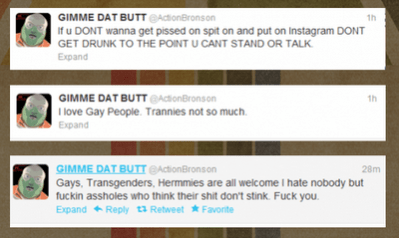
Juxtaposition on transgender discrimination: Action Bronson and Feministing

Artifact one:

Recent wins don’t undermine these tragedies in any way. In fact, it’s all that much harder to see the most marginalized in our community facing violence at the same time that we’re winning victories. Changes in our laws don’t mean people automatically stop hating us. Sometimes increased visibility can mean increased violence. We have to continue working to change people’s minds while we also work to change the laws. Trans women of color continue to face the worst transphobic violence. So we have to continue working deliberately to lift up the voices of trans women of color, to make sure the community most impacted can speak for themselves and humanize themselves.

via A sea change in transgender rights.

Artifact two:


Leave a comment

Filed under communication, feminism, hip hop, homophobia, human rights, juxtaposition, representation