Category Archives: resistance

Best arguments from the supreme court hip hop brief

I grew up with the notion that hip hop was opposition to mainstream culture.  Regardless of lyrical content, hip hop (and hip hop fans) were deeply mocked and policed for years.  Rappers might have been saying mundane things but if you rhymed over beats, you carried the weight of the genre.

You could get in trouble for playing hip hop lyrics.  Radio stations would proudly broadcast that they played everything “except rap.”  There was a kind of stigma that stuck with hip hop artists and fans.   Hip hop concerts weren’t booked at Madison Square Garden until Jay-Z broke through with the Black Album.

It seems so clearly racist from my current perspective.

We might add in capitalism.  The nineties saw a rush to absorb, market and exploit hip hop culture by advertisers.  The stereotypes and old discourse lingered as hip hop became mainstream culture.

It doesn’t surprise me that the choice of hip hop as a medium stigmatizes the participant.  (It saddens me).

Taylor Bell, a thoughtful high school senior was informed that two PE coaches were commenting and touching female students, Bell wrote a rap song.  Instead of praising this whistle blower, Bell was kicked out of school and had to go to an alternative school for his senior year.

His eventual lawsuit hinges on the ability of a high school student to express their political views outside of school.  This seems like a first amendment no-brainer to me . . . so of course it is before the Supreme Court.

Killer Mike (Michael Render), Erik Nielson, Travis Gosa and Charis E. Kubrin submitted an supporting brief to the court.  Here are my favorite parts:

  1.  It is actually the bad words that disturb administrators, not the report of sexual harassment.

Following a lengthy decision-making process, Bell was suspended and sent to an “alternative school” by the school’s Disciplinary Committee. A Committee member suggested that Bell’s use of profanity in the song was the reason for his suspension: “Censor that stuff. Don’t put all those bad words in it . . . The bad words ain’t making it better.”

Source: Microsoft Word – 151206 Taylor Bell amicus 12-17-15.docx – Taylor-Bell-Amicus.pdf

2.  Hip hop is an alternative to fighting.

Hip hop—a cultural movement comprised of performance arts such as MCing (“rapping”), DJing (“spinning”), breakdancing (“b-boying”), and graffiti (“writing”)—began as a response to these dire conditions. Pioneers like Afrika Bambaataa (once a gang leader himself) used spiritual and political consciousness (“knowledge of self”) to develop hip hop as a tool for ending gang violence by providing an outlet that transformed the inherent competitiveness and territoriality of gang life into something artistic and productive. Dance competitions, rap battles, and other competitive performances replaced actual fighting , and rap in particular eventually became an alternative, legal source of income for blacks and Latinos otherwise cut off from labor market opportunities. Travis L. Gosa, The Fifth Element: Knowledge , in T HE CAMBRIDGE COMPANION TO H IP -H OP 56, 58-61 (Justin A. Williams ed., 2015).

Source: Microsoft Word – 151206 Taylor Bell amicus 12-17-15.docx – Taylor-Bell-Amicus.pdf

3.  Bell was intending to spread the word via hop hop.

Like Tupac Shakur, Taylor Bell was using his music to effect changes . In the final portion of the video for his song PSK da Truth , Bell says that in rapping about sexual misconduct at his high school, he is trying to raise awareness about similar injustices around the world: “It’s something that’s been going on, you know, worldwide for a long time that I just felt like, you kn ow, I needed to address.”

Source: Microsoft Word – 151206 Taylor Bell amicus 12-17-15.docx – Taylor-Bell-Amicus.pdf

4.  Threatening gun metaphors are widely used in hip hop.

When Bell raps, “fucking with the wrong one gon’ get a pistol down your mouth (Boww!),” he is channeling well-worn phrases used by popular and established artists like Lil Wayne (“Pistol in your mouth, I can not make out what you tryin’ to say”), Gucci Mane (“Put the pistol in ya mouth like dentures”), Waka Flocka Flame (“Niggas know I got a pistol in his mouth”), E-40 (“Put the pistol in his mouth and make it hurt, ooh”), and Scarface (“Put a pistol in his mouth, and blow his fucking brains out”). L IL WAYNE , Bill Gates, on I A M  NOT A HUMAN BEING (Young Money, Cash Money & Universal Motown 2010); GUCCI MANE , Texas Margarita, on BRICK FACTORY : VOLUME I (available for download from http://www.livemixtapes.com 2014); WAKA FLOCKA FLAME , Where It At, on DU FLOCKA RANT : HALF -TIME S HOW (available for download on http://www.livemixtapes.com 2013); SCARFACE , Diary of a Madman, on M R . SCARFACE IS BACK (Rap-A-Lot Records 1991); E-40, It’s On, On Sight, on T HE ELEMENT OF SURPRISE (Jive & Sick Wid It Records 1998).

Source: Microsoft Word – 151206 Taylor Bell amicus 12-17-15.docx – Taylor-Bell-Amicus.pdf

5.  Discourse influences stereotypes about hip hop: experimental studies

A handful of studies have examined the direct impact of these stereotypes. In these studies, people who are given identical sets of lyrics—but who are told these lyrics come from different musical genres—are asked about their perceptions of the lyrics. One study, for example, presented respondents with sexually explicit rap lyrics or sexually explicit non-rap lyrics. Importantly, the researchers discovered that the sexually explicit music was considered more offensive and less artistic when it was rap compared to when it was non-rap. Dixon & Linz, supra , at 234-35.

In a related study, participants read a set of lyrics from folk group Kingston Trio’s 1960 song, Bad Man’s Blunder , and were told that the lyrics were either from a rap or country music song. After reading the lyrics, participants evaluated them and responded to questions about the offensiveness of the song, the threatening nature of the song, the need for regulation of the song, and if the song would incite violence. The responses were significantly more negative when the lyrics were represented as 24 rap, revealing that the same lyrical passage viewed as acceptable in a country song is considered dangerous and offensive when identified as a rap song. Carrie B. Fried, Who’s Afraid of Rap: Differential Reactions to Music Lyrics , 29 J. A PPLIED SOC . PSYCH . 705, 711 (1999).

All of this research reveals that stereotypical assumptions play a far greater role in our decision- making than we may realize. And some of this stereotyping may account for what happened in this case. If we don’t work to acknowledge and, when necessary, combat these stereotypes, the consequences can be serious and life altering— particularly for a young man like Taylor Bell.

Source: Microsoft Word – 151206 Taylor Bell amicus 12-17-15.docx – Taylor-Bell-Amicus.pdf

***

I think this brief is a strong set of arguments.  It also makes several key arguments about hip hop and metaphoric violence that need further discussion.  Good opportunity for amplification and discussion.
Leave a comment

Filed under capitalism, communication, hip hop, music, punishment, representation, resistance, rhetoric, sexism

Obama pardons Valerie Bozeman: drug war reflections

Kyle Swenson has an excellent write up on Valerie Bozeman in the Broward Palm Beach New Times.  Bozeman was convicted of drug charges and received federal mandatory minimum penalties.  She was pardoned from her life sentence by President Obama after 23 years in prison.  This is an excellent read complete with a sympathetic protagonist, grimy drug kingpins, incompetent defense attorneys and a guilty judge.

Swenson does a good job explaining how low-level offenders were getting astounding sentences.

But as anxiety over crack grew, the statute was hijacked. The use of “851 enhancements,” as they came to be called, became a huge prosecutorial hammer. The marching orders for federal prosecutors were for no mercy.

In 1989, then-Attorney General Richard Thornburgh ordered U.S. attorneys to “charge the most serious, readily provable offense.” Victory in the courtroom was “measured by the length of sentence you could get if you secured that prosecution,” explains Price. So 851 enhancements — which could trigger a life sentence if an individual had two prior felony convictions — became an easy way for the government to notch a heavy win.

“It was a time when we turned our backs on rehabilitation and support, and our criminal justice system and sentencing law became much more punitive,” Price says. “We were locking up people who we didn’t like and were afraid of. But we were also locking up a lot of people who really didn’t deserve the lengthy sentences we were doling out.”

Source: Valerie Bozeman Is Pardoned by Obama as America Wrestles With Fallout From the War on Drugs | New Times Broward-Palm Beach

Bozeman got a life sentence and learned about the 851 (mandatory minimum) penalties that sent her to prison only years later.  Note that the ‘old timers’ — the prisoners who are sentenced to life became a legal research unit under the direction of Bozeman.

In between chores, Bozeman shot off urgent letters to court-appointed lawyers, like SOS messages stuffed in bottles and pitched into the ocean. Most were ignored. Eventually, she received a letter from Judge Ungaro patiently explaining that Bozeman had been sentenced to life because of a statute known at “851 enhancement.”

With that phrase in her mind, she began visiting the prison law library, where she finally began to unlock what exactly had happened to her.

Soon, Bozeman called together the old-timers. Bozeman had a one-question pop quiz. “Do you know why you got a life sentence?”

Blank looks bounced back at her. One by one, Bozeman sent the women to their cells for their sentencing paperwork. Together they bushwhacked through the legalese until they found it: 851. “The ladies didn’t understand why they were sitting there with a life sentence,” she says today. “They just didn’t know.”

Source: Valerie Bozeman Is Pardoned by Obama as America Wrestles With Fallout From the War on Drugs | New Times Broward-Palm Beach

The essay is also ripe with some terrifying statistics about the drug war and incarceration.  In particular the use of the federal 851 statute (mandatory minimums) to coerce suspects to admit guilt.

Between 1980 and 2013, the number of drug defendants incarcerated in federal custody had exploded from 4,749 to 100,026 — a 2,006 percent uptick. Fifty percent of all federal inmates were serving time on drug charges.

Not only did mandatory minimums put small-time dealers in prison for long periods but 851 enhancements also had another harsh effect. Because the decision to file rested solely with the prosecution, it could be used as a threat: If you go to trial, we’ll file an enhancement.

A study by Human Rights Watch showed that in 2012, “the average sentence of federal drug offenders convicted after trial was three times higher (16 years) than that received after a guilty plea (5 years and 4 months).” When sentencing enhancements were in play for defendants with prior convictions, defendants “who went to trial were 8.4 times more likely to have the enhancement applied” than those who pleaded guilty.

New York Federal District Judge John Gleeson noted that use of 851s had gotten out of control. He wrote in an October 2013 decision that they brought on “the sentencing equivalent of a two-by-four to the forehead.” As a result, so many people chose to plead guilty rather than take chances at trial that a federal criminal trial was “on the endangered species list,” he said. “The government’s use of [851 enhancements] coerces guilty pleas and produces sentences so excessively severe they take your breath away.”

Proof was in the data: In 1980, only 69 percent of defendants in federal drug cases pleaded guilty and took plea deals; by 2010, 97 percent did.

Source: Valerie Bozeman Is Pardoned by Obama as America Wrestles With Fallout From the War on Drugs | New Times Broward-Palm Beach

This essay is a worthwhile read and a thoughtful reflection on the drug war.  Thanks to Longreads for the suggestion.

Leave a comment

Filed under capitalism, class, do-it-yourself, drugs, human rights, prisons, punishment, race, representation, resistance

Defection from white supremacy

What does it look like when white people defect from the traditions of white supremacy?  It probably looks (and sounds) like South Carolina Representative Jenny Horne talking about removing the confederate flag from the South Carolina state house.

Leave a comment

Filed under communication, human rights, kindness, memorial, race, representation, resistance, vulnerability

Changing culture vs. changing laws: gay marriage

It is important to understand the distinction between changing culture and changing laws.   Legal institutions (courts, legislatures, or leaders) might grant rights to people, but other people (some of them prejudiced) are likely to impliment those laws.   Many will circumvent legal changes and continue to use systems of power to discriminate.

Thus we have a lengthy history of changes in law that required years of enforcement.  For Example, federal troops being sent to Arkansas to protect the Little Rock Nine — black students attempting to enroll in a previously white high school.

It is worth viewing the 30 for 30 “Ghosts of Ole Miss,” an ESPN documentary that gives some similar context to educational changes for civil rights.

It is always worth taking note of the tactics used to resist change.  Thinkprogress has an astounding rundown of the circumvention efforts of Hood County (Texas) clerk Katie Lang to deny Jim Cato and Joe Stapleton a marriage license.

Since June 29, the Monday after the ruling, Jim Cato and Joe Stapleton, who have been together for 27 years, have been trying to obtain the marriage license they’ve waited so long for. When rejecting them, Lang claimed that her staffers would issue the license instead, but Cato and Stapleton were then told they couldn’t be helped because the clerk’s office did not have the new gender-neutral forms, which would supposedly take “three or more weeks” to arrive.

Last Thursday, they brought their own copy of the state’s new form, and still they were refused a license. When they insisted, Lang told everyone to leave the office and called the Sheriff’s Department, who stood guard but did not force anyone out. Cato and Stapleton had been in touch with their lawyer, who arrived at Lang’s office to deliver a letter warning of a suit if a license wasn’t issued. A staffer began to process their application, but then asked, “Which of you will be the husband?” When they insisted upon the new form, which lists “applicant 1″ and “applicant 2″ instead of “husband” and “wife,” the staffer then refused to accept their payment of the $83 fee. Lang reappeared and confirmed that they would still have to wait several weeks to get their license anyway because she had to wait for revised certificate forms, even though a different-sex couple could have filed the form and left with a license the same day.

Monday morning, Cato and Stapleton filed a federal lawsuit, which describes their experiences being rejected as “humiliating and degrading.” Less than two hours after the suit was filed, Lang’s office issued the couple a marriage license.

via This Is What Happens To Court Clerks Who Refuse To Issue Same Sex Marriage Licenses | ThinkProgress.

Cheers to Cato and Stapleton for their fierce pursuit of equal rights.

Leave a comment

Filed under Gay, gender, human rights, representation, resistance

Killer Mike gets some time to talk

Tavis Smiley invites Killer Mike for two sincere discussions on PBS.  Killer Mike does not pull any punches and the topics are legit.  Righteous, respectful and thoughtful.   I can’t figure out how to embed, but these are both worth watching.

http://video.pbs.org/viralplayer/2365520459

http://video.pbs.org/viralplayer/2365520563

Leave a comment

Filed under class, do-it-yourself, hip hop, media, protest, race, representation, resistance

Deadpan administrators: Emma Sulkowicz graduates with mattress

Most of you know of the case of Emma Sulkowicz who was raped at Columbia university.  Sulkowicz committed to carry around the mattress where the crime took place until the university expelled her rapist.  Activism, performance art and a compelling articulation of the burdens that survivors of sexualized violence carry.

Sulkowicz graduated and walked across the stage in her gown carrying that mattress.  Worth a moment of reflection to look at the administrators who simply gape at her and her colleagues who help carry the mattress.  If you want to know which administrators to fire, start with the ones that won’t shake Sulkowicz’s hand as she completes her degree.   Please note the crowd volume for Sulkowicz.

Stick around for the short video on the Black Student Union’s die-in at the tree lighting ceremony.

Leave a comment

Filed under academics, feminism, gender, human rights, protest, representation, resistance, sexual assault

Technology extending activism #blacklivesmatter

1.  Thanks to Feministing for the best framing of the uprising in Baltimore.  I appreciate the foregrounding of gender, class, and the juxtaposition of Wholefoods feeding the National Guard and community members organizing (through technology) to feed local kids.

2.  The New York Times seems to think that activism documented through the internet focusing on police violence is a new thing.  It isn’t, but Jay Caspian Kang’s write up of the radicalization of the leaders of this movement is a useful connection point.  Here Kang outlines the articulation of long-standing injustices into first-person experiences of tear-gas saturated outrage in Ferguson.

Mckesson was radicalized that night. “I just couldn’t believe that the police would fire tear gas into what had been a peaceful protest,” he told me. “I was running around, face burning, and nothing I saw looked like America to me.” He also noticed that his account of that night’s tear-gassings, along with a photo he took of the rapper J. Cole, had brought him quite a bit of attention on Twitter. Previously, Mckesson had used the social-media platform to post random news articles that interested him, but now he was realizing its documentary power. He quickly grasped that a protester’s effectiveness came mostly from his ability to be present in as many places as possible: He had to be on West Florissant when the police rolled up in armored vehicles; inside the St. Louis coffee shop MoKaBe’s, a safe haven for the protesters in the city’s Shaw neighborhood, when tear gas started to seep in through the front door; in front of the Ferguson Police Department when shots rang out. He had to keep up a steady stream of tweets and carry around a charger so his phone wouldn’t die.

via ‘Our Demand Is Simple: Stop Killing Us.’ – NYTimes.com.


Leave a comment

Filed under colonialism, communication, do-it-yourself, human rights, juxtaposition, media, memorial, police, protest, representation, resistance, technology

Make this the year YOU discover a new destination!

Excellent visual argument about Palestine.  Compelling visuals, crisp juxtaposition and significant argument about the importance of graffiti.

Leave a comment

Filed under capitalism, colonialism, critique, do-it-yourself, graffiti, human rights, juxtaposition, media, propaganda, protest, representation, resistance, vulnerability

Police violence and mentally ill: firing dissidents

Toshio Meronek has a thoughtful piece about police violence toward mentally ill people.  I appreciated the article, but one part stuck out.  Meronek writes:

Statistics and history show there’s little accountability for cops who use excessive force, like in central New Jersey, where a 2014 study by the Courier News and the Home News Tribune found that 99 percent of police brutality complaints went uninvestigated. Last year, a police officer in Monterey, California was fired not for using too much force, but for using too little. In February of 2014, Corporal Thanh Nguyen a campus officer at California State University Monterey Bay, refused to tase a mentally ill black student when prompted by officers from the nearby Marina, California police force. After the Marina police filed a complaint with the university citing “failure to act,” Nguyen was fired. (In an interview with The Huffington Post, Jeff Solomon, president of the Statewide University Police Association, the officer’s union, explains that Nguyen refused to participate in the tasing because he believed it was unnecessary. Nguyen is now suing his former employer for wrongful termination.)

via Cops shouldn’t be above the Americans with Disabilities Act | Fusion.

There is an interesting groupthink dynamic in the firing of Nguyen.  Seems similar to the Border Patrol firing border agents who humanize people who cross the border.

Leave a comment

Filed under communication, human rights, intersectionality, police, punishment, representation, resistance

Gamergate, autoblocker, anti-trans violence and sea lions: Katherine Cross for the win

One of the most productive commentators about so-called gamergate is Katherine Cross.  Her recent post on Feministing is so on point that it deserves some archival / expansion work.

1.  There is an autoblocking program for twitter that removes most of the posts from gamergate trolls.  For anyone out there interested in civil space, this is a big improvement.  Cross describes it this way:

What offends GamerGaters about the autoblocker, aside from the fact that a woman found a technical solution to a social problem, is that it denies them the ability to impose themselves on targets. The idea that the women, people of colour, and queer folk who’ve comprised the majority of GG’s targets might be able to curate their online spaces and have certain discussions only with those of their choosing is repugnant to many GamerGaters. In the absence of genuine legal recourse, the worst thing you can do to a bully, harasser, or troll is ignore them after all.

via Revenge of the Sealion: GamerGate’s crusade against blocking.

2.   Underscoring much of the gamergate vitriol is a toxic anti-trans politics.  Much of the visibility of the violence seems to have a direction.  Again Katherine Cross gathers enough targeted tweets and message board quotes to rile me up.   For those who are trans-inclusive, trans-positive, or simply kind human beings, it is worth marking gamergate as a particularly anti-trans moment in time.

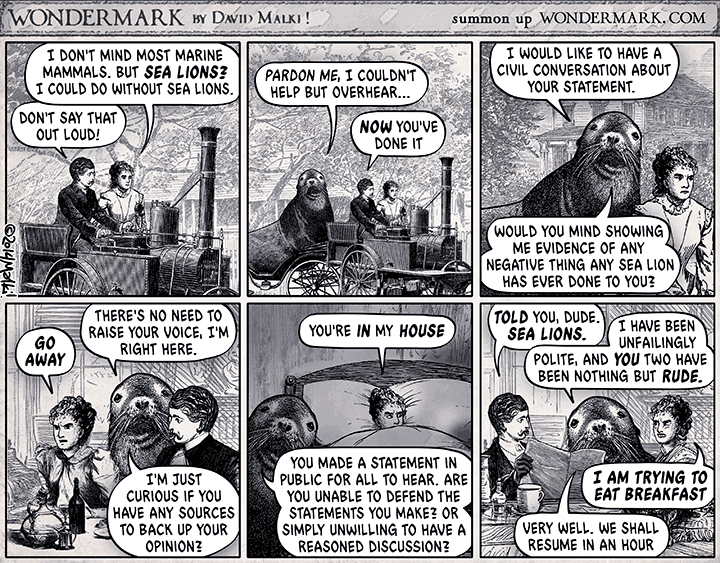
3.  Katherine Cross introduces me to the idea of “sealioning” — a refined bullying tactic.  Cross explains:

“Polite” GGers, defined as those who do not explicitly swear or use slurs, nevertheless harry the people they target because they do not take no for an answer and come in packs. The phenomenon of “sealioning”– barraging a target with politely worded but interrogating questions asked in bad faith– gained a name under GamerGate because of how common the tactic was.

via Revenge of the Sealion: GamerGate’s crusade against blocking.

Also provided is this nice comic!

Sealion-Comic


Leave a comment

Filed under Animals, communication, feminism, Gay, hacking, human rights, intersectionality, protest, representation, resistance, sexism, Surveillance, technology, video games