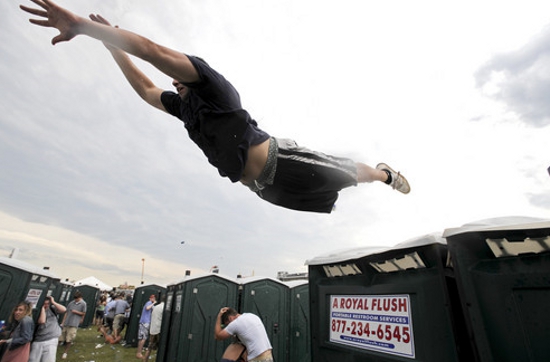
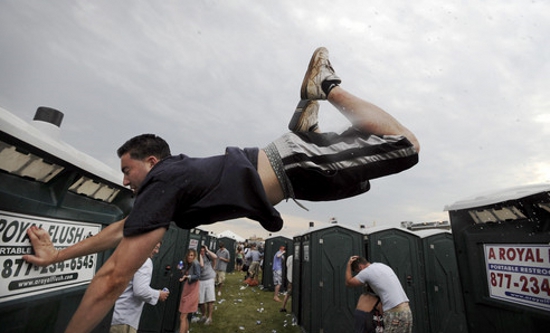
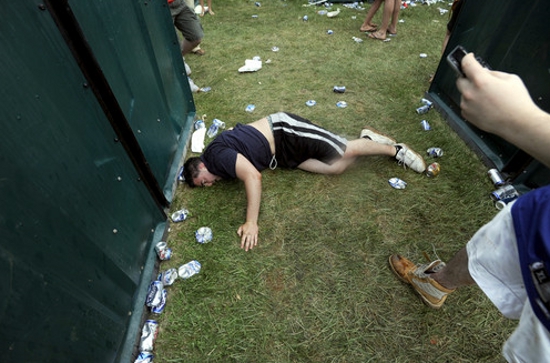
Uncle Barry pointing out the foibles of modern society in his subtle and gentle exposition:
What else have the dumb Americans been persuaded to buy? Three or four wars and a bankrupt country. Enough corporations to pollute a thousand solar systems. A military big enough to conquer south China. Global warming, plus geoengineering to make it worse. A house full of air fresheners, air conditioners, oven cleaners, bug spray, chlorine bleach, scented candles, antimicrobial soap, water softeners, spray-on furniture polish, lawn mower exhaust, red dye #2, out-gassing plastic products by the hundreds, and some fragrant radon for dessert. And that’s before the exterminator comes for his monthly visit. Got to pay for that too, right?
Nancy Silverton is one of the greatest food intellectuals I’ve read. She is smart, and capable of sharing her insights. She recently took on the doughy focaccia and also provided insight into how she refines her understanding of breads. I love the passages where she observes an Italian bakery to take some notes. Reminder, this is one of the foremost experts on bread — who still takes time to learn from others. Silverton:
But the other thing I did, which anyone can do, is observe very carefully.
My first clues came when I visited a panificio, or bakery, in Conversano, in Puglia. Although I wouldn’t be completely sold on focaccia for a few more days, I liked what I had there enough to ask if I could peek in the kitchen, where I saw three things that would change my focaccia-making world.
First, I saw that the focaccia was baked in a round cake pan. Until then, I had always baked focaccia in large rectangular sheet pans. But after seeing it baked in cake pans, I realized that by working with such an unwieldy lump of dough, I had been mishandling it and thereby taking the air out of it, which makes for a dense bread. Using the smaller pans means working with dough in a more manageable size and shape — a simple thing that seems obvious in hindsight.
I also saw that the baker was cutting the dough into portions, immediately putting each in the pan in which it was going to be baked, and then leaving it there to relax for its second rise. This eliminated the step of shaping the dough in the pan, which, again, would de-gas it and make for a denser bread.
The third and maybe most significant thing I saw was that the cake pans had olive oil in them, and not just enough to coat the pan, but a layer one-eighth to one-quarter inch deep. It was a substantial enough amount that the oil would be absorbed into the bottom crust, making it crunchy and flavorful.
Less than five minutes in this baker’s kitchen, without asking a single question, and my focaccia had already improved exponentially.
The LA Times is hosting four master classes with world renowned chefs. Looks to be some cool insights, although even Thomas Keller can’t quite convince me to go stock up on xanthan gum.
Nice work from Simon Winchester in the New York Times about the word run. The Oxford English Dictionary says that run is the word with the most number of distinct usages — six hundred forty five distinct potential articulations. Winchester connects the development of new meanings with the tempo of the industrial age. Despite the arty conclusion to the essay, the heart of it contains some good data.
For while in the first edition of the O.E.D., in 1928, that richest-of-all-words was “set” 75 columns of type, some 200 senses, the victor in today’s rather more frantic and uncongenial world is, without a doubt, the three-letter word “run.”
You might think this word simply means “to go with quick steps on alternate feet, never having both or in the case of many animals all feet on the ground at the same time.” But no such luck: that is merely sense I.1a, and there are miles to go before the reader of this particular entry may sleep.
It took Peter Gilliver, the O.E.D. lexicographer working on the letter R, more than nine months harnessed to the duties of what Samuel Johnson once called “a harmless drudge” plus many more months of preparatory research to work out what he believes are all the meanings of “run.” And though some of the senses and their derivations try him — Why does a dressmaker run up a frock? Why run through a varlet with a sword? How come you run a fence around a field? Why, indeed, run this essay? — Mr. Gilliver has finally calculated that there are for the verb-form alone of “run” no fewer than 645 meanings. A record.
In terms of sheer size, the entry for “run” is half as big again as that for “put,” a word on which Mr. Gilliver also worked some years ago. But more significantly still, “run” is also far bigger than the old chestnut “set,” a word that, says Mr. Gilliver, simply “hasn’t undergone as much development in the 20th and 21st centuries as has ‘run.’ ”
I also liked the cool little graphic quiz for the article. Without the text, this is a wonderful exposition of the current state of our nation: boat run aground, robbed by capital, some left behind, patriotism, empty tanks, brain explosions, homeruns and James Joyce.
Who says a zombie apocalypse has to stop a working girl from making a little cash? Guide Lola past hordes of undead zombie hookers to collect weapons and cash AND guide your still-living Johns back to your trailer for a little “business.” Fulfill the night’s quota, hop in your trailer and do it again the next night.
One feeling is that white women are in the club as a side thing: a hobby, for a good workout, to pay for college, etc. While women of color in the business are in it as a long-term career and to support children. Women of color also talk about how difficult it is to get into a strip club in the first place. Pornography already has a reputation for producing films with many racist themes. These are just some basic examples of racism that affect sex workers. It pits workers against each other and makes it nearly impossible to forge a truly cohesive community. I will explore this topic more in the future but for this post I would like to elaborate on how sex workers respond to clients who are men of color and how this directly affects our ability to fight against racism.
One of the most memorable part of working at that club was my experience dancing for white men. I am light-skinned but my features often prompted men to ask if was Latina or Asian. An affirmative answer nearly ALWAYS produced a response of “How exotic” “Ooh I love Latinas, they are so….(insert ridiculous comment here)”. I also noted that white men propositioned me for sex much more often than men of color and were much more persistent about it. Once again, a boring stereotype that is reproduced often in the media and carried out in the club (and online, in the street, etc) which paints women of color as exotic, and excessively sexual. Such bodies are so promiscuous that they are easy to buy – the sale of these bodies is assumed, even.
You don’t have to touch Johns to get them to follow you. Pressing X will get almost any John you can see on the screen to follow you as long as zombies aren’t currently attacking them.
In order for us to effectively fight racism and racist institutions, we must reach out to sex workers and begin a dialogue. This dialogue is necessary because sex workers encounter so much racism (in such blatant forms) and reproduce these racist behaviors as well. Without a connection to anti-racism efforts, change will not happen in this industry-not for sex workers, not for our clients and not for our community.
The question of national amnesia – the defensive forgetting to avoid traumatic national history — strikes me as central to the condition of humans in this era.
Getting at what you (or someone else) has forgotten is a rough path filled with the potential for hurt feelings and self-defensive justification.
British national service and colonialism send a young man (the film’s creator and narrator McWilliams) to Kenya where he photographs the people and the scenery of the land. It isn’t simple. He doesn’t simply travel back to get that souvenir connection at the end of his days, instead he layers his own admittedly faulty memory with the films and images of Kenya under colonial rule. A Mau Mau forest fighter is given healthy space to describe the politics of the time from the militant perspective, and a colonial governor gets screen time. Both contribute to the sense of deepening — counter forgetting, marking in space and time.
This film helps to get at the process of forgetting/obscuring. I also points at the potential for uncovering and exposing those pieces missing.
Honestly, I can’t recommend this film enough. It is up on the National Film Board website in full for a few more days.
Lets get the obvious out of the way: Jadakiss is a great emcee. Lets also give him kudos for heading to Swaziland to do a show promoting awareness about HIV (see first comment).
But dang, this film is so colonial it could have been scripted by Teddy Roosevelt.
1. The first half of the film is boring footage of Jadakiss hopping airplanes, walking through terminals, and lamenting about how far Africa is. We get it, Africa is a long distance away and you are putting yourself out by traveling so far. Of course, in the traditional versions of this travelogue narrative (see the Vice travel shows, or When we were kings) the travellers face difficulty in their transit, Jadakiss and his crew slide through sanitized airports.
2. The perspective on HIV in Africa is pretty simplistic. The overloaded fear statistics are so heavy-handed that no one could ever imagine doing anything about them. At one point the film claims that if HIV transmission rates continue to climb in Swaziland, all adults will be dead by 2020. That’s right, nine years from now, every single grown-up in an African country will be dead from HIV transmission.
3. The only hope, is of course, Jadakiss. Obviously, the solution to AIDS in an African country is a solitary rapper without any significant recent pop hits.
4. The exotic other-ness of Africa is central to this video. From the vagueness of going to somewhere-in-Africa (the film clip says Jadakiss is going to South Africa, he himself admits at the front end that he isn’t sure where he is going before showing us the ticket to his flight to Johannesburg.) In fact Jadakiss is performing in the Kingdom of Swaziland — a landlocked dictatorship with strong state control whose primary export appears to be children for slave labor and sex slaves (according to the C.I.A., who y’know, might not always be on the up and up). The royal family of Swaziland get’s a representative in African garb. What is interesting is that Jadakiss still wants to play this like he is Jay-Z going to the garden. Flashing in a convoy line of luxury automobiles, Jada’s grin is visible from a satellite. There are a few seconds of presumed African poverty filmed out of the racing automobiles as Jadakiss heads for the resort for his show.
5. Despite this charity event being about HIV positive Africans, the film sticks with the representations of wealth. The camera lingers around Jadakiss’s luxury suite while he explains, “the king laid out something . . . for the other king.” There is no discussion of AIDS, African AIDS, or the conditions in Swaziland that make it hard to fight the virus (maybe like dictatorships). No Africans speak or narrate into the camera.
6. Sadly, there isn’t even a show clip of Jada rapping! I guess this is just the first episode. I look forward to the next colonial day dream from a Western emcee. At least one where we get to hear some rapping!
One of the best takes on African hip hop comes from Patrick Neate, who authored Where you’re at. In his chapter on Johannasburg, the white-identified Neate is talking to Mizhif, a Zimbabwean/US/South African hip hop TV host. Mizchif reflects on the recent visit from Dead Prez:
“Dead Prez left so much conflict amongst heads, it was hectic. They had said that the cover of their album (a sepia-touched photograph of black women waving guns above their heads) was from the Soweto Uprising. But it wasn’t. Actually, as a Zimbabwean, I know it was from the chimurenga. (Neate FN95: Chimurenga is a Zimbabwean (Shona) word meaning struggle. It is specifically used to refer to the war of independence.) No one had guns at the Soweto uprising except the cops. So before Dead Prez even got here, people had a beef about that. Then they cam on YFM and they were just preaching their revolutionary stuff, ‘ don’t rely on the man,’ that kind of thing. At the time kids were calling in going, ‘yeah, I feel you man. Fuck white people.’ But the minute they left everyone was saying, ‘Who are they to come to South Africa and tell us about our struggle?’
“It’s difficult because there’s already so much conflict between people here because the focus of the rest of the world had always been on Soweto. But there’s been struggle all over; every township had struggles from Soweto to Guguletu.”
I ask Mizchif what he thought, personally, and he laughs. “I just thought it was funny because the Dead Prez show was half-and-half, white and black. Because who has the money and the transport to go to a show like that?”
I think back to the Mos Def gig in London, a performance to the self-consciously conscious. I mention it to Mizchif and he shakes his head and smiles.
“Really it’s just typical of Americans. They have such a stereotyped view of Africa. When I was at high school in New York, my father ended up coming to teach our Social Studies class because, when I took the worksheets about Africa home, he was absolutely disgusted. Yes there’s a rural Africa and a poor Africa and AIDS in Africa, but there are modern and urban and rich sides too.” (117-118).
This website is intended for educational purposes. We attempt to make sure that all external artifacts, including article quotes, photos, graphics, and music correctly attribute the creators and sources.
If you are the owner of any of the media on this website and you would like it taken down, please contact us and we will be glad to respect your wishes.