Category Archives: representation

Technology extending activism #blacklivesmatter

1.  Thanks to Feministing for the best framing of the uprising in Baltimore.  I appreciate the foregrounding of gender, class, and the juxtaposition of Wholefoods feeding the National Guard and community members organizing (through technology) to feed local kids.

2.  The New York Times seems to think that activism documented through the internet focusing on police violence is a new thing.  It isn’t, but Jay Caspian Kang’s write up of the radicalization of the leaders of this movement is a useful connection point.  Here Kang outlines the articulation of long-standing injustices into first-person experiences of tear-gas saturated outrage in Ferguson.

Mckesson was radicalized that night. “I just couldn’t believe that the police would fire tear gas into what had been a peaceful protest,” he told me. “I was running around, face burning, and nothing I saw looked like America to me.” He also noticed that his account of that night’s tear-gassings, along with a photo he took of the rapper J. Cole, had brought him quite a bit of attention on Twitter. Previously, Mckesson had used the social-media platform to post random news articles that interested him, but now he was realizing its documentary power. He quickly grasped that a protester’s effectiveness came mostly from his ability to be present in as many places as possible: He had to be on West Florissant when the police rolled up in armored vehicles; inside the St. Louis coffee shop MoKaBe’s, a safe haven for the protesters in the city’s Shaw neighborhood, when tear gas started to seep in through the front door; in front of the Ferguson Police Department when shots rang out. He had to keep up a steady stream of tweets and carry around a charger so his phone wouldn’t die.

via ‘Our Demand Is Simple: Stop Killing Us.’ – NYTimes.com.


Leave a comment

Filed under colonialism, communication, do-it-yourself, human rights, juxtaposition, media, memorial, police, protest, representation, resistance, technology

Make this the year YOU discover a new destination!

Excellent visual argument about Palestine.  Compelling visuals, crisp juxtaposition and significant argument about the importance of graffiti.

Leave a comment

Filed under capitalism, colonialism, critique, do-it-yourself, graffiti, human rights, juxtaposition, media, propaganda, protest, representation, resistance, vulnerability

Police violence and mentally ill: firing dissidents

Toshio Meronek has a thoughtful piece about police violence toward mentally ill people.  I appreciated the article, but one part stuck out.  Meronek writes:

Statistics and history show there’s little accountability for cops who use excessive force, like in central New Jersey, where a 2014 study by the Courier News and the Home News Tribune found that 99 percent of police brutality complaints went uninvestigated. Last year, a police officer in Monterey, California was fired not for using too much force, but for using too little. In February of 2014, Corporal Thanh Nguyen a campus officer at California State University Monterey Bay, refused to tase a mentally ill black student when prompted by officers from the nearby Marina, California police force. After the Marina police filed a complaint with the university citing “failure to act,” Nguyen was fired. (In an interview with The Huffington Post, Jeff Solomon, president of the Statewide University Police Association, the officer’s union, explains that Nguyen refused to participate in the tasing because he believed it was unnecessary. Nguyen is now suing his former employer for wrongful termination.)

via Cops shouldn’t be above the Americans with Disabilities Act | Fusion.

There is an interesting groupthink dynamic in the firing of Nguyen.  Seems similar to the Border Patrol firing border agents who humanize people who cross the border.

Leave a comment

Filed under communication, human rights, intersectionality, police, punishment, representation, resistance

Gamergate, autoblocker, anti-trans violence and sea lions: Katherine Cross for the win

One of the most productive commentators about so-called gamergate is Katherine Cross.  Her recent post on Feministing is so on point that it deserves some archival / expansion work.

1.  There is an autoblocking program for twitter that removes most of the posts from gamergate trolls.  For anyone out there interested in civil space, this is a big improvement.  Cross describes it this way:

What offends GamerGaters about the autoblocker, aside from the fact that a woman found a technical solution to a social problem, is that it denies them the ability to impose themselves on targets. The idea that the women, people of colour, and queer folk who’ve comprised the majority of GG’s targets might be able to curate their online spaces and have certain discussions only with those of their choosing is repugnant to many GamerGaters. In the absence of genuine legal recourse, the worst thing you can do to a bully, harasser, or troll is ignore them after all.

via Revenge of the Sealion: GamerGate’s crusade against blocking.

2.   Underscoring much of the gamergate vitriol is a toxic anti-trans politics.  Much of the visibility of the violence seems to have a direction.  Again Katherine Cross gathers enough targeted tweets and message board quotes to rile me up.   For those who are trans-inclusive, trans-positive, or simply kind human beings, it is worth marking gamergate as a particularly anti-trans moment in time.

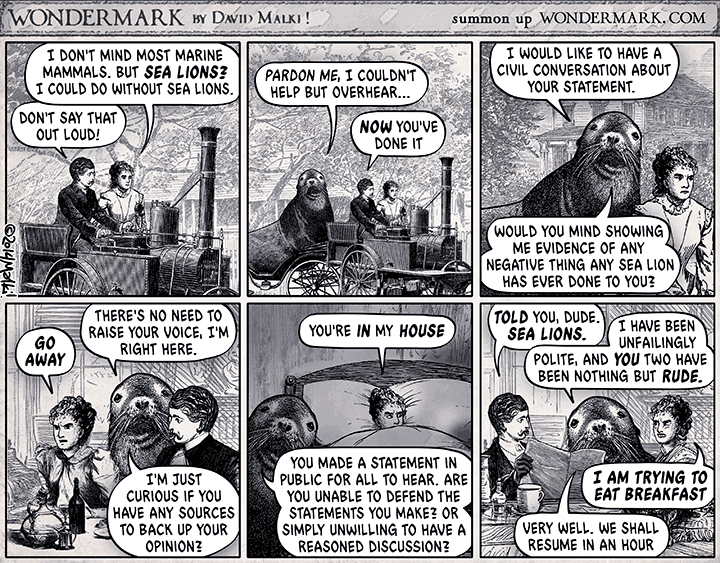
3.  Katherine Cross introduces me to the idea of “sealioning” — a refined bullying tactic.  Cross explains:

“Polite” GGers, defined as those who do not explicitly swear or use slurs, nevertheless harry the people they target because they do not take no for an answer and come in packs. The phenomenon of “sealioning”– barraging a target with politely worded but interrogating questions asked in bad faith– gained a name under GamerGate because of how common the tactic was.

via Revenge of the Sealion: GamerGate’s crusade against blocking.

Also provided is this nice comic!

Sealion-Comic


Leave a comment

Filed under Animals, communication, feminism, Gay, hacking, human rights, intersectionality, protest, representation, resistance, sexism, Surveillance, technology, video games

Thinking about racist fraternities who love Waka Flocka Flame

Yesterday the noxious video of Oklahoma frat guys chanting racist stuff on a bus hit the interwebs.  The chant not only bragged about preventing “niggers” from joining the fraternity, but also threatened lynching.

The fraternity was dismantled and student members told to move out of their house (and two members were kicked out of school).  I think it is worth thinking about this moment in time not only for the accountability for racist insults (which I support) but also the redemptive narratives of those-kids-weren’t-that-bad (which I think is worth examination).

One redemption thread was that the closure of the house was going to mean that the long-time chef of the fraternity house Howard Dixon would lose his job.  Fundraisers quickly raised tens of thousands of dollars for Mr. Dixon.  In addition to brightening the reputation of the fraternity members, this also points toward the nasty preference to imagine that a ‘few bad apples’ are what spoiled the bunch.

Having attended several fraternity-rich universities, my take is that the whole system is a nostalgic white supremacist dream.  To select your friends and cloister is an invitation for toxic entitlement to blossom.   (Thinkprogress has some good context for this particular fraternity.)

My initial thought about SAE was that the interwebs were enraged because this example is such old-school bigotry that its an easy critique.  The language about gamergate or sexualized violence at college campuses seldom gets this kind of swift action.  I think we doth protest too much.   It’s easy to point as SAE as racists while ignoring larger structural injustices.

Waka Flocka Flame, an unlikely political advocate, rushed in with a quick cancellation of a show.  Initially I was wondering how many of the racist chanting frat guys on the bus ALSO had tickets to go see Waka Flocka Flame?   Quite a few it turns out.

Racism doesn’t mean that you aren’t into black culture or hip hop.  The poisonous element of this racist chant was the proud exclusionary bragging of a (mostly white) frat in keeping out black people.   Checking in with the Reddit thread on this discussion, a number of people made the same observations.  That they had known white-identified people who were into rap music and also prejudiced.   As one commenter put it: “It’s sad… they can be performers, servers or the nannies. They could be their life-saving doctor, their pastor, their therapist, their mailman, and pretty much everything else in the world. Except simply a person.”

The double consciousness of racists.  To objectify and divide marking difference to ensure that white supremacy continues.   I wasn’t surprised when someone mentioned that Waka Flocka had been hired by this very fraternity to perform at a show.   Thus the video of Waka Flocka Flame shotgunning beers and performing for what seems like a mostly white Oklahoma SAE crowd last year.

It puts Waka Flocka’s cancellation of the show in a slightly less charitable light.  We might read it as solidarity against racist injustice.  We might also call it covering your public relations.

Turns out Waka Flocka has a ton of fraternity shows on youtube. Check the Baylor video where he explains that he doesn’t like a woman in the crowd grabbing his ass.  Note his justifications at 2:05.

Let’s note that the Baylor Waka Flocka show has some visibility  of the entitled audience members who are consuming Waka Flocka Flame.  When Waka is grabbed he explains that he “feels like a bitch.”  It is dumb sexist stuff, but we can also note his refusal to be grabbed and the part about “in my community.”  I think Waka Flocka Flame probably has crazy stuff happen during his live shows (including being grabbed), but something about this rebuttal suggests that this moment is ‘beyond the pale.’

The normalcy of partying to Waka Flocka and then having a racist admission policy (and chanting about it) seems like the interesting part of this SAE duality.  Challenging racism in our day and age needs to be more rigorous and intersectional than this one example, but its a good thread to get access to some key arguments.

Leave a comment

Filed under academics, hip hop, juxtaposition, race, representation

Mimi Thi Nguyen: punk and resistance

There are a lot of smart insights in this Bluestockings interview with Mimi Thi Nguyen.  Feministing shared the link and gave me the heads up that there was some discussion of guilt and professional expectations in the essay.  Nguyen seems persuasive to this punk professor when she writes:

The disjuncture then comes when I consider how we are encouraged to carry ourselves in the academy. I feel a lot of pressure to professionalize, and the prescriptions for professionalization often run counter to my way of being in the world. I also struggle with the directive that I am supposed to professionalize my students. I don’t hold with the idea that I should train students to be better workers, because the content of “better” — more obedient, more efficient, whatever — runs counter to what I want to teach. In my feminist theories courses, I say, “Yeah, I just gave you assignments with deadlines! But I also want to say to you, what’s so great about work? Why do we believe work is supposed to be edifying? Should we always have to be productive? Why do we imagine work as something that gives us dignity? What if it’s just wearing us down?” My history in punk totally informs these attempts to practice other ways of being in a classroom, and other ways of being a professor.

via (Un)productivity in the Digital Age — A Conversation with Mimi Thi Nguyen | Bluestockings Magazine.

Like Nguyen I was a reader of Maximum Rock and Roll since my teens.  I was deeply informed by the DIY spirit and raw love of music and counterculture that ran through MRR.  Along with that inspiring freedom were some toxic interview discussions and columns that also were a big part of MRR.  I remember a particularly racist / sexist sex column, perhaps from Mykel Board?  Nguyen as a young punk writes MRR and challenges the columnist for MRR and gets a hateful column in reply.  The scrap with MRR inspires her to create her own zine Race Riot.

The impetus for Race Riot came when a columnist at Maximum Rockandroll wrote about his Asian fetish, suggesting that Asian women’s eyelids look like vulva, and that their vulva might be also horizontal. It is an old imperial joke — there are all kinds of imperial jokes about how racial, colonial women’s bodies are so inhuman that their genitalia might reflect this alien state. I wrote a letter to Maximum, cussing and citing postcolonial feminist theory. He then wrote a lengthy column in response about how though I’m Asian, because I’m an ugly feminist, he wouldn’t want to fuck me anyway. There was a discussion at the magazine about whether or not to publish this column because the magazine had a policy — no racism, no sexism, no homophobia. But the coordinator and founder of the magazine decided that this column qualified as satire, and so it was acceptable.

It was really infuriating for me to be 19 years old, totally invested in punk and politics, to be attacked under the guise of racist cool in the punk magazine. I was like, “Fuck it, I’m quitting punk.” But I figured I should do something, to leave something behind as a practice and as a document, to reach other punks of color who might feel as isolated as I did in the aftermath.

via (Un)productivity in the Digital Age — A Conversation with Mimi Thi Nguyen | Bluestockings Magazine.

I know a lot of punks who saw the academy as a reasonable place to continue thinking about punk praxis.  Or more particularly, many of us go to an academic job and are reasonably punk in that and other parts of our lives.  Many of the punks I knew are still working with intentional collectives, creating media, hosting shows, playing music, creating alternative spaces and doing-it-themselves.  I’ll give a shout out to my friend Zack Furness and his book Punkademics.  I think you can read the whole book at Minor Compositions.

I’ll note my appreciation and agreement with Nguyen’s analysis of internet communications and the need for pauses for reflection.   She argues:

New technologies have produced expectations that we now have more democratic access to more knowledge, and that we must accommodate ourselves to an accelerated sense of time. But I am wary of this internalization of capital’s rhythms for continuous consumption and open-ended production. I hate feeling obliged to produce a post or tweet on a timetable. It makes me anxious. There is value in being about to respond quickly to an object or event, of course, but I also want to hold out for other forms of temporal consciousness, including untimeliness and contemplation of deep structures, sitting with an object over time to consider how it changes you, how the encounter with it changes the nature of your inquiry.

via (Un)productivity in the Digital Age — A Conversation with Mimi Thi Nguyen | Bluestockings Magazine.

Good interview and strong arguments.

Leave a comment

Filed under academics, capitalism, communication, do-it-yourself, feminism, media, music, punk, race, representation, resistance, sexism, technology

Fighting the trolls: Lindy West engages

I like Lindy West’s pop culture analysis.  She writes for a few online spots like Jezebel.  Feministing noted that she had been harassed by a troll who opened a twitter account in the name of her deceased father.  This is the feministing quote:

Lindy, who you might know from her writing at Jezebel and GQ, was trolled by someone who set up a Twitter account in the name of her dead father. She wrote about how awful that made her feel, and to her surprise, he wrote to her again – but this time, to apologize.

Then, she called him and interviewed him about what had gone through his mind when he decided to do what he did. And recorded it all. “It felt like if I could just get the specifics,” she says, “gather them up and hold them in my hands — then maybe I could start to understand all the people who were still trolling me.”

They talked for two hours, and by the end, she’d forgiven him for the terrible things he’d done – the meanest thing anyone has ever done to her. She understood what his life looked like at the time that he was trolling (he’s since stopped, he says) and she felt sorry for him. Still, she says, it’s disturbing to know that there was nothing wrong with him per se. “It’s frightening that he’s so normal,” she says. He’s not your idea of a monster, and unlike a fairy tale troll, he certainly doesn’t live alone under a bridge. He has women coworkers, and a girlfriend, and women friends. “They have no idea that he used to go online and traumatize women for fun.”

via “It’s frightening that he’s so normal.”.

In a Jezebel essay, West notes her reasoning to humanize and engage with trolls:

I feed trolls. Not always, not every troll, but when I feel like it—when I think it will make me feel better—I talk back. I talk back because the expectation is that when you tell a woman to shut up, she should shut up. I reject that. I talk back because it’s fun, sometimes, to rip an abusive dummy to shreds with my friends. I talk back because my mental health is my priority—not some troll’s personal satisfaction. I talk back because it emboldens other women to talk back online and in real life, and I talk back because women have told me that my responses give them a script for dealing with monsters in their own lives. And, most importantly, I talk back because internet trolls are not, in fact, monsters. They are human beings—and I don’t believe that their attempts to dehumanize me can be counteracted by dehumanizing them. The only thing that fights dehumanization is increased humanization—of me, of them, of marginalized groups in general, of the internet as a whole.

via Don’t Ignore the Trolls. Feed Them Until They Explode..

Leave a comment

Filed under communication, critique, feminism, gender, hacking, health, kindness, representation, resistance, rhetoric, sexism, technology

Remember Leslie Feinberg as a revolutionary Communist

Leslie Feinberg has left the world.  In the Advocate, Feinberg’s partner Minnie Bruce Pratt describes the radical politics which made Feinberg such an inspiration:

She died at home in Syracuse, NY, with her partner and spouse of 22 years, Minnie Bruce Pratt, at her side. Her last words were: “Remember me as a revolutionary communist.”

Feinberg was the first theorist to advance a Marxist concept of “transgender liberation,” and her work impacted popular culture, academic research, and political organizing.

Her historical and theoretical writing has been widely anthologized and taught in the U.S. and international academic circles. Her impact on mass culture was primarily through her 1993 first novel, Stone Butch Blues, widely considered in and outside the U.S. as a groundbreaking work about the complexities of gender. Sold by the hundreds of thousands of copies and also passed from hand-to-hand inside prisons, the novel has been translated into Chinese, Dutch, German, Italian, Slovenian, Turkish, and Hebrew with her earnings from that edition going to ASWAT Palestinian Gay Women.

In a statement at the end of her life, she said she had “never been in search of a common umbrella identity, or even an umbrella term, that brings together people of oppressed sexes, gender expressions, and sexualities” and added that she believed in the right of self-determination of oppressed individuals, communities, groups, and nations.

via Transgender Pioneer Leslie Feinberg of Stone Butch Blues Has Died | Advocate.com.

Leave a comment

Filed under class, feminism, memorial, representation, resistance, trans

Justice for Mike Brown: disrupting the symphony

Beautiful music.  A moment of public dialogue interjected into a space for beautiful music.   I don’t know how I missed this  St. Louis symphony showdown.

Elizabeth Vega on the conception of the symphony as a protest space.   Daily KOS reports:

Elizabeth: Two weeks ago, Sarah and I participated in a direct action at Cardinal Stadium. We did a series of banner drops at a baseball game with folks. We are both middle aged I am a grandmother and I am brown and Sarah is white. People were incredibly rude and racist to us at the game. They booed us. Told us “Pants up dont loot” etc.. They clearly saw what they wanted to see. We were escorted out in handcuffs and chanted “No justice! No Peace!” It was a rough night where we didnt feel any love. Sarah suggested that night, jokingly, that perhaps we needed another venue. The next day she said she wanted to do an action at the symphony. I was on board and immediately brought on Derek. When we found out the next performance was a requiem we had to do it.  It took us about two weeks among planning other actions and events for the national mobilization. We are all very busy but carved out about five hours total to recruit, plan and organize.

via Requiem for Mike Brown protest at St. Louis Symphony exposes both white privilege and support.

Thanks to feministing for the suggestion, link and video.

Leave a comment

Filed under art, class, human rights, memorial, music, protest, representation, resistance

Van Halen & rape culture: Jamie’s Crying

This morning I decided to burn a CD of the first Van Halen studio album.  As I arrived at work, I was deep in a lyrical analysis of “Jamie’s Crying”.

In addition to being the sixth or seventh best song on the record, it is also a funky track about consent.  Sung from the perspective of a young woman who said no to a ‘one night stand,’ and is now sad that the only romance her prospective lover wants is quick sex.  (Hence, why she is cryin’).

It seems like an interesting take on consent.  In this case, the lover pressures Jamie and Jamie refuses.  I appreciate that the pressuring lover simply ups and leaves when “Jamie wouldn’t say alright.” But the prevailing message of the song is that if someone doesn’t sleep with the band, they’ll never get any other interaction (‘gone forever.’).   A sort of nod to consent in a forward motion toward rape culture.

Cue Van Halen groupie reel.

Leave a comment

Filed under music, representation, sexism, sexual assault