An alligator named Mr Teeth was apparently guarding a marijuana stash, California officials said Thursday after coming across the 5ft reptile during a routine probation check. Deputies entering Assif Mayar’s home on Wednesday also found 34lb of marijuana valued at an estimated $100,000. Mr Teeth was in a Plexiglass tank nearby.
“We get guard dogs all of the time when we search for grow houses and people stashing away all types of dope. But alligators? You just don’t see that every day,” said Alameda County sergeant JD Nelson.
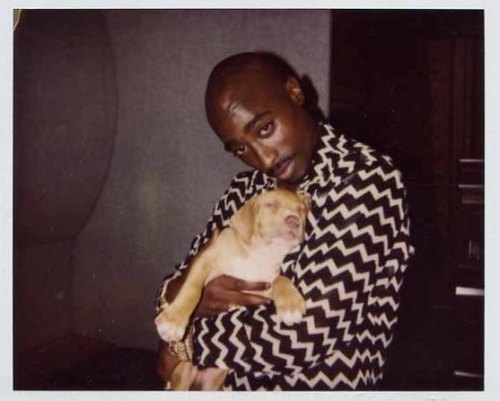
Mayar, 32, told deputies he got the alligator to commemorate rapper Tupac Shakur’s 1996 death.
Used to be you could mouth off in the cheap sheets about a mediocre musician who hasn’t had a hit in twenty years. Not in 2013. Artists have access to the internet too and they will drive their Lexus to your local dive bar and hold you accountable!
Why would someone who sold 30 million records care what a TV station blogger says? Then on Sunday I got this email:
No explanation for why you write that I’m “shameless?” You act pretty tough sitting alone in your little room behind your laptop.
If you’d written you hated my music, that’s cool. Like I could give a shit. But saying I’m “shameless” calls into question my character and integrity.
This is my hometown…where my kids live…where my mother lives…and this will not stand with me.
Would you say that to my face? Let’s find out. I’ll meet you anywhere in the city, any time. I don’t travel again until the end of the week. Let’s hash this out like men.
Never heard of you in my life before, but between various columnist/radio friends and an array of people at NBC, I now know plenty about you. You don’t know anything about me. But you’re about to.
This isn’t going away.
Richard Marx
I called my editor.
“I’ve been getting emails from some guy who says he’s Richard Marx,” I said. “I think it’s an impostor. The only thing that makes me think it might really be Richard Marx is that it’s from an AOL account.”
My editor had been a waiter at a pizzeria in Lake Bluff, where Richard Marx ate with his family.
“He was a terrible tipper and a real douche,” my editor said. “We used to argue about who had to serve him. His wife is taller than he is.”
And of course, what happens if Weather Underground organizers offer to cook a dinner for a local charity? Conservative bloggers buy the seats:
There was a little “Buy Instantly” button on our dinner item that someone could select for $2,500, which seemed absurdly high. But in early December TV celebrity and conservative bad boy Tucker Carlson clicked his mouse, and we were his.
I loved it immediately. Surely he had some frat boy prank up his sleeve—a kind of smug and superior practical joke or an ad hominem put-down—but so what? We’d just raised more for the Public Square in one bid than anyone thought would be raised from the entire auction. We won!
Well, not so fast—this did mean we had to prepare dinner for Carlson plus five, and that could become messy. But, maybe it wouldn’t, and anyway, we argued, it’s just a couple of distasteful hours at most, and, then bingo! Cash the check.
Colorlines have the *science* on Django Unchained and slavery. Among their “Top ten things you should know about slavery but won’t learn at ‘Django’ are the following crucial insights:
3) Africans possessed unique expertise which Europeans required to make their colonial ventures successful. Africans knew how to grow and cultivate crops in tropical and semi-tropical climates. African rice growers, for instance, were captured in order to bring their agricultural knowledge to America’s sea islands and those of the Caribbean. Many West African civilizations possessed goldsmiths and expert metal workers on a grand scale. These slaves were snatched to work in Spanish and Portuguese gold and silver mines throughout Central and South America. Contrary to the myth of unskilled labor, large numbers of Africans were anything but.
And this nice reminder about the violent disciplinary work of slavery economics:
6) The brutalization and psychological torture of slaves was designed to ensure that plantations stayed in the black financially.
Slave revolts and acts of sabotage were relatively common on Southern plantations. As economic enterprises, the disruption in production was bad for business. Over time a system of oppression emerged to keep things humming along. This centered on singling out slaves for public torture who had either participated in acts of defiance or who tended towards noncompliance. In fact, the most recalcitrant slaves were sent to institutions, such as the “Sugar House” in Charleston, S.C., where cruelty was used to elicit cooperation. Slavery’s most inhumane aspects were just another tool to guarantee the bottom line.
And key to remember that many of those who made profits from slavery continue to be the global elite:
9) Many firms on Wall Street made fortunes from funding the slave trade.
Investment in slavery was one of the most profitable economic activities throughout most of New York’s 350 year history. Much of the financing for the slave economy flowed through New York banks. Marquis names such as JP Morgan Chase and New York Life all profited greatly from slavery. Lehman Brothers, one of Wall Street’s largest firms until 2008, got its start in the slave economy of Alabama. Slavery was so important to the city that New York was one the most pro-slavery urban municipalities in the North.
I like this list and would only add an eleventh argument – fleshing out some discussion of gender. I agree with Angela Davis that a lot of the violent responses by white folks during reconstruction was mobilized around the representation of the threat of black men raping white women. I think we can track some of current American tensions about sexuality to this decade of image/cultural construction: white male supremacy, female purity and implications of criminality associated with black skin. Despite being incorrect and made up, these ideas stuck around.
In the comments section of the Colorlines article, one person asks:
‘Django Unchained’ was FICTION why does everyone want to hold it up to fact-checking? These 10 points are correct but had nothing to do with the film. I know so many people that have been discouraged from seeing a great film because the net is flooded with articles about how historically inaccurate the film is. It’s a cowboy styled revenge film where the hero is a black man…
I wouldn’t speak for the Colorlines author, Imara Jones, but in my opinion the importance of Django is precisely that it is a popular fictional representation about slavery. I don’t think it’s real, but Django, along with a long-line of films (Gone with the wind) about slavery can be probed for shared themes, threads, preferred representations. The fictional liberties are worth examining not for historical accuracy, but for current political implications.
It was late at night when I stumbled onto Eddie Huang’s new Vice TV show Fresh Off the Boat. I like food travel shows, and I like degenerates, so this show was already in my wheelhouse.
I’m a vegetarian, and I wouldn’t recommend the first episode of Eddie’s Bay Area show because he spends much of the episode with a Bay Area motorcycle crew killing rabbits. (Although I’ll note that I enjoyed his ending rant where he suggests to meat eaters who don’t kill their own critters that they imagine the dead bunny every time they take a bite.)
Yeah, there are a bunch of things to discount these Eddie Huang shows: the slang which seems both forced and out-of-date, the relentless sexism (women appear only as sex objects or as servants), and the hipper-than-thou tone which permeates the whole project.
But I’m not going to pretend that I don’t like parts of the show. Eddie comes across as pretty smart, adding complexity to some of the traditional narratives about food, culture and popularity. And more than that, he simply shows his foolishness. He tells self-deprecating stories, snaps on absolutely everyone, sports terrible fashion, and spends more than enough time mired in drugs. Witness his first episode in Taiwan where he not only explains how to buy Betel nuts, but also how to use them, showcases a juvenile aversion to penis shaped waffles, and spends some time at the late night shrimp pool. Not your traditional travel food show.
I’m bored with the moral panic associated with Beyonce’s decision to take a big pile of money from Pepsi. I’m not sure it is fair to expect political leadership or moral consistency from Beyonce. She is a staggeringly talented entertainer — and anyone who makes personal decisions based on what Beyonce does has their own problems.
I think we should criticize Pepsi, not the celebrities that they rent to hock their brand. In some ways Beyonce is an easy target. Attacking her might even distract from the substantial conversations we need to have about the health harms of soda. We could note the historical antecedents of disrespecting and diminishing the power of black women entertainers.
And I can’t help but feel a little sorry for Beyonce, because, as a child of the eighties, the Pepsi sponsorship was a sign that a star had become a mega-star. It is a sign of the shifting culture that we are now moving soda manufacturers into the category with cigarette companies, and her sponsorship is now *bad press*.
I like Mark Bittman, and he is welcome for dinner at my house any time. I appreciate that he uses his platform in the New York Times to talk about important cultural and health dynamics of food. In this essay he reminds us of the pervasive ability of sugary beverage manufacturers to advertise to us. Product placement for instance:
My friend Laurie David counted 26 on-air shots of Coke during last season’s “American Idol” finale and an incredible 324 shots of Snapple in a June episode of “America’s Got Talent.” (“There are Snapple cups placed in front of each judge,” she wrote me. “I counted every time I saw a Snapple cup.”)
To those jaded enough to ask “So what?” I’d reply that’s a measure of how successful these kinds of campaigns are.
I’m impressed with Compressorhead — the three-piece robot band (three and a half if you count the little robot who drives one of the cymbals). I went to their website to see if I could discern the origins of the project, DIY, corporate, academic, or whatever and couldn’t really find anything on the makers.
Then I tracked down the drummer.
Stickboy was created by Robocross Machines and a whimsical roboticist named Frank Barnes. A quick tour through the other robots created from this shop and you get the robot tent intended to “hunt children.”
And of course, the robotic shark.
Reminds me of the Survival Research Labs robot machines, built for public performance and disturbance.
When my old band couldn’t find a drummer we used a computer to make some mediocre drum tracks. Will the future hold the chance for fourteen year old folks to go to the robot shop and rent a bass player robot?
I can also imagine the perspective of my uncle, a working musician who would immediately complain about humans losing gigs to this robot monstrosity (despite the fact that he doesn’t know how to play ‘Ace 0f Spades’). When I lived in the Hudson Valley I remember friends who hated the automated toll booth (EZ Pass?) and would prefer to wait in line for humans to take their money.
I appreciate these perspectives which all seem to be anchored in a nostalgia for the real. But of course in 2013 all of these experiences are reflections of an ideal of the real — with no real connection. Real isn’t a human taking your money at the toll booth, it is certainly more human, but it isn’t a move of resistance commensurate with the degree of changes toward digitization and computer-mediated life. Nostalgia is getting to choose between having a human taking your money and a machine and preferring the machine. Of course, the ability to have a human-to-human interaction with the toll booth operator is a sincere and real advantage to those who choose that lane. But since the exchange is one that takes place at someone’s workplace, you have to doubt the sincerity of the exchange (in these cases, the employee is often not permitted to speak their mind while at work).
In this case the machine is humanized and the human is made mechanic.
I”m not trying to emphasize the division between human/machine but suggesting that it is more complicated. Are the humans at the toll booth in part using machines in the booths to keep track of money, time, and vehicle size? Of course they are. And in the same way that the new human-free check out stations in grocery stores require a human to staff them (to check IDs, troubleshoot machines, and help confused human customers), the humans in the toll booths support their digital replacements.
The human is made mechanic — we long for the cool replacement. Of course I would like to be in a band that I could program. Plan their every note and move for a performance. But I doubt I could keep up with the robot bass player, so I could imagine slowly moving from participant to planner, and making my own robot replacement in the band. Wizard of Oz-like, one becomes the master controller who programs all of the moves and music, even for your own character. They are simultaneously something new and a reflection of your genius.
There is something about the setlist (it includes Black Sabbath’s ‘Iron Man’) and the note-for-note simulacrum that is played to copy sloppy that is digging at me. The distrust to let the machine make it’s own music. I guess that is the moment where you give your Robot musician some degree of autonomy and we probably head toward the world of the Terminator movies.
But I’m curious about the sound. What comes out when we let the circuits overheat and do their own thing. A guy built a random shopping robot for himself. Consider Darius Kazemi:
In the recent year he and his spouse have bought a house, and with it comes increased thought on the conscientious couple’s part to ideas about consumerism, “things.” Kazemi noticed how the occasional sudden arrival of back-ordered Amazon products he’d long since forgotten about ordering feels somehow more exciting, “like a gift you bought yourself,” and wondered what it would feel like to design a program that buys you things seemingly at random?
The bot’s purpose, in Kazemi’s words, is largely to “fill [his] life with crap,” to see if somehow those purchases feel more or less meaningful than something he would have conscientiously chosen himself; a way, if you will, of exploring his attachment to that “crap.”
Thus Random Shopper was born, complete with controls that keep it from buying anything too expensive or too physically large (spouse Courtney was “supportive,” Kazemi says, but “was also like, ‘I don’t want skis showing up at the house.'”). Random Shopper has its own Amazon account, and its budget is limited to a set amount on a gift card. For now, Kazemi’s restricted its categories to CDs, DVDs and paperback books — that keeps the size issue under control, and limits purchases to stuff that’s easily digitized, consumable and can be given away or donated, “as opposed to, like, a plug for a device that I don’t own,” he explains.
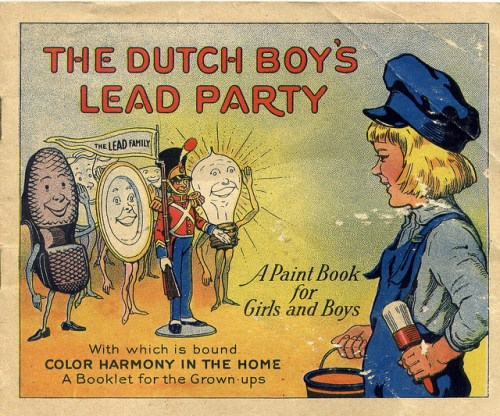
We used to market toxins to little kids with ads like the above. Seems appropriate to connect up with the new studies that suggest that lead toxicity is a lot more destructive than we thought.
Put all this together and you have an astonishing body of evidence. We now have studies at the international level, the national level, the state level, the city level, and even the individual level. Groups of children have been followed from the womb to adulthood, and higher childhood blood lead levels are consistently associated with higher adult arrest rates for violent crimes. All of these studies tell the same story: Gasoline lead is responsible for a good share of the rise and fall of violent crime over the past half century.
1. I wish the New York Times didn’t publish so many good articles. Behind their paywall I gotta believe that all those learned motherfuckers get so much good content they don’t even know what to read. C’mon New York Times, let free the information and let the world know that y’all write some good stories!
2. This is another Longreads best-of-the-year recommendation this time from Geoff Van Dyke. Thanks Longreads, Geoff and the New York Times (you still suck). And of course props to the author of this zippy article, Patrick Radden Keefe, who creates an enjoyable read.
3. This is a lot of money. . . flossing, one might call it flossing.
In 2007, Mexican authorities raided the home of Zhenli Ye Gon, a Chinese-Mexican businessman who is believed to have supplied meth-precursor chemicals to the cartel, and discovered $206 million, the largest cash seizure in history. And that was the money Zhenli held onto — he was an inveterate gambler, who once blew so much cash in Las Vegas that one of the casinos presented him, in consolation, with a Rolls-Royce. “How much money do you have to lose in the casino for them to give you a Rolls-Royce?” Tony Placido, the D.E.A. intelligence official, asked. (The astonishing answer, in Zhenli’s case, is $72 million at a single casino in a single year.) Placido also pointed out that, as a precursor guy, Zhenli was on the low end of the value chain for meth. It makes you wonder about the net worth of the guy who runs the whole show.
4. One marker of power is the mask. As in the cases of the ALF and Zapatista those disempowered wear the mask to obscure the identity of the participant, but also to make the struggle less about the individual. In the case of the Mexican drug war, the use of the mask seems to be more clearly about retaliation and safety.
The tacit but unwavering tolerance that Mexican authorities have shown for the drug trade over the years has muddled the boundaries between outlaws and officials. When Miguel Angel Martínez was working for Chapo, he says, “everyone” in the organization had military and police identification. Daylight killings are sometimes carried out by men dressed in police uniforms, and it is not always clear, after the fact, whether the perpetrators were thugs masquerading as policemen or actual policemen providing paid assistance to the thugs. On those occasions when the government scores a big arrest, meanwhile, police and military officials pose for photos at the valedictory news conference brandishing assault weapons, their faces shrouded in ski masks, to shield their identities. In the trippy semiotics of the drug war, the cops dress like bandits, and the bandits dress like cops.
December 21, 2012 Arcata CA. A showdown where the story of the end-of-the-world met six DJs who used real records to ground a party to this earth. A brief accounting of the participants from my simple perspective.
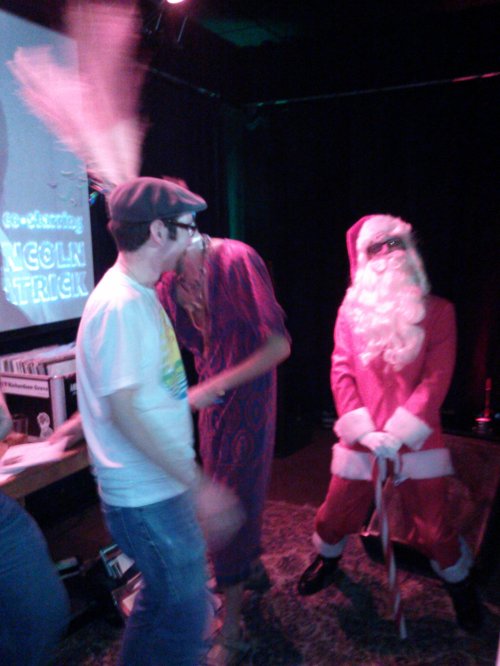
The first DJ of the night was perhaps the most adventurous DJ in Humboldt county — Spaceman Spliff who not only killed his set, but dropped a Cure song to knock out small-minded fools. Mantease played pretty hard and seems to be bringing more soul-inspired global stuff. But it was his afrobeat shit that get’s me the most hype, and since I spent half the sent dancing on the side of the stage, that was pretty obvious. Matt “Skinny Santa” Jackson and Adam “ugly ass sweater” certainly brought the heaters. “Back door Santa” got played and it took about half of the first verse before people clued in, then the dance floor got nasty. And of course, the E.L. Michaels Wu-Tang song, another Soul Night first. And I’m not talking about Skinny Santa smashing his giant candy cane across the chest of his DJ partner (saint Ad-rock), but a couple hundred people chanting “Wu-Tang!”. I looked at Jay Morg’s set before he took the stage and I knew that he was coming with some great dancing records. I wasn’t surprised that he gave one of the best sets of back-to-back dance floor jams that any of us have thrown and the people were feeeeeeling it. Not to mention the dude rocking a purple velour jump suit. I had to slow it down to gospel speed just to give people a chance to catch their breath when I took over for the final shift.
I played the above set. It was an incredible blessing to be able to look out as a simple music nerd and see hundreds of people dancing to the flute jazz jam by Sam Most. Not to mention the appreciation and respect for the good sounds. Thanks to all the wonderful people who buy tickets and who support Soul Night. Thanks to La Dolce Video who provide an astounding cinema backdrop for the party. And much thanks to Humboldt Brews for the nice venue, respectful door staff, good sound guy, great bartenders, and generous dancing space.
Next soul night is January 18, expect the ridiculous. If you are in Humboldt and want to join Matt, Adam & King Maxwell for a soulful New Years Eve at the Siren’s Song a few tickets are left at the Missing Link.
This website is intended for educational purposes. We attempt to make sure that all external artifacts, including article quotes, photos, graphics, and music correctly attribute the creators and sources.
If you are the owner of any of the media on this website and you would like it taken down, please contact us and we will be glad to respect your wishes.


 Life of refinement