Category Archives: communication

Police violence and mentally ill: firing dissidents

Toshio Meronek has a thoughtful piece about police violence toward mentally ill people.  I appreciated the article, but one part stuck out.  Meronek writes:

Statistics and history show there’s little accountability for cops who use excessive force, like in central New Jersey, where a 2014 study by the Courier News and the Home News Tribune found that 99 percent of police brutality complaints went uninvestigated. Last year, a police officer in Monterey, California was fired not for using too much force, but for using too little. In February of 2014, Corporal Thanh Nguyen a campus officer at California State University Monterey Bay, refused to tase a mentally ill black student when prompted by officers from the nearby Marina, California police force. After the Marina police filed a complaint with the university citing “failure to act,” Nguyen was fired. (In an interview with The Huffington Post, Jeff Solomon, president of the Statewide University Police Association, the officer’s union, explains that Nguyen refused to participate in the tasing because he believed it was unnecessary. Nguyen is now suing his former employer for wrongful termination.)

via Cops shouldn’t be above the Americans with Disabilities Act | Fusion.

There is an interesting groupthink dynamic in the firing of Nguyen.  Seems similar to the Border Patrol firing border agents who humanize people who cross the border.

Leave a comment

Filed under communication, human rights, intersectionality, police, punishment, representation, resistance

Gamergate, autoblocker, anti-trans violence and sea lions: Katherine Cross for the win

One of the most productive commentators about so-called gamergate is Katherine Cross.  Her recent post on Feministing is so on point that it deserves some archival / expansion work.

1.  There is an autoblocking program for twitter that removes most of the posts from gamergate trolls.  For anyone out there interested in civil space, this is a big improvement.  Cross describes it this way:

What offends GamerGaters about the autoblocker, aside from the fact that a woman found a technical solution to a social problem, is that it denies them the ability to impose themselves on targets. The idea that the women, people of colour, and queer folk who’ve comprised the majority of GG’s targets might be able to curate their online spaces and have certain discussions only with those of their choosing is repugnant to many GamerGaters. In the absence of genuine legal recourse, the worst thing you can do to a bully, harasser, or troll is ignore them after all.

via Revenge of the Sealion: GamerGate’s crusade against blocking.

2.   Underscoring much of the gamergate vitriol is a toxic anti-trans politics.  Much of the visibility of the violence seems to have a direction.  Again Katherine Cross gathers enough targeted tweets and message board quotes to rile me up.   For those who are trans-inclusive, trans-positive, or simply kind human beings, it is worth marking gamergate as a particularly anti-trans moment in time.

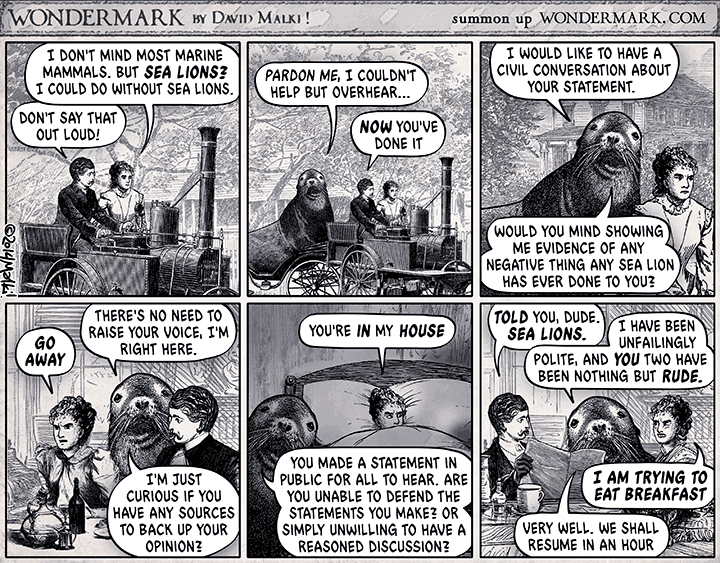
3.  Katherine Cross introduces me to the idea of “sealioning” — a refined bullying tactic.  Cross explains:

“Polite” GGers, defined as those who do not explicitly swear or use slurs, nevertheless harry the people they target because they do not take no for an answer and come in packs. The phenomenon of “sealioning”– barraging a target with politely worded but interrogating questions asked in bad faith– gained a name under GamerGate because of how common the tactic was.

via Revenge of the Sealion: GamerGate’s crusade against blocking.

Also provided is this nice comic!

Sealion-Comic


Leave a comment

Filed under Animals, communication, feminism, Gay, hacking, human rights, intersectionality, protest, representation, resistance, sexism, Surveillance, technology, video games

Mimi Thi Nguyen: punk and resistance

There are a lot of smart insights in this Bluestockings interview with Mimi Thi Nguyen.  Feministing shared the link and gave me the heads up that there was some discussion of guilt and professional expectations in the essay.  Nguyen seems persuasive to this punk professor when she writes:

The disjuncture then comes when I consider how we are encouraged to carry ourselves in the academy. I feel a lot of pressure to professionalize, and the prescriptions for professionalization often run counter to my way of being in the world. I also struggle with the directive that I am supposed to professionalize my students. I don’t hold with the idea that I should train students to be better workers, because the content of “better” — more obedient, more efficient, whatever — runs counter to what I want to teach. In my feminist theories courses, I say, “Yeah, I just gave you assignments with deadlines! But I also want to say to you, what’s so great about work? Why do we believe work is supposed to be edifying? Should we always have to be productive? Why do we imagine work as something that gives us dignity? What if it’s just wearing us down?” My history in punk totally informs these attempts to practice other ways of being in a classroom, and other ways of being a professor.

via (Un)productivity in the Digital Age — A Conversation with Mimi Thi Nguyen | Bluestockings Magazine.

Like Nguyen I was a reader of Maximum Rock and Roll since my teens.  I was deeply informed by the DIY spirit and raw love of music and counterculture that ran through MRR.  Along with that inspiring freedom were some toxic interview discussions and columns that also were a big part of MRR.  I remember a particularly racist / sexist sex column, perhaps from Mykel Board?  Nguyen as a young punk writes MRR and challenges the columnist for MRR and gets a hateful column in reply.  The scrap with MRR inspires her to create her own zine Race Riot.

The impetus for Race Riot came when a columnist at Maximum Rockandroll wrote about his Asian fetish, suggesting that Asian women’s eyelids look like vulva, and that their vulva might be also horizontal. It is an old imperial joke — there are all kinds of imperial jokes about how racial, colonial women’s bodies are so inhuman that their genitalia might reflect this alien state. I wrote a letter to Maximum, cussing and citing postcolonial feminist theory. He then wrote a lengthy column in response about how though I’m Asian, because I’m an ugly feminist, he wouldn’t want to fuck me anyway. There was a discussion at the magazine about whether or not to publish this column because the magazine had a policy — no racism, no sexism, no homophobia. But the coordinator and founder of the magazine decided that this column qualified as satire, and so it was acceptable.

It was really infuriating for me to be 19 years old, totally invested in punk and politics, to be attacked under the guise of racist cool in the punk magazine. I was like, “Fuck it, I’m quitting punk.” But I figured I should do something, to leave something behind as a practice and as a document, to reach other punks of color who might feel as isolated as I did in the aftermath.

via (Un)productivity in the Digital Age — A Conversation with Mimi Thi Nguyen | Bluestockings Magazine.

I know a lot of punks who saw the academy as a reasonable place to continue thinking about punk praxis.  Or more particularly, many of us go to an academic job and are reasonably punk in that and other parts of our lives.  Many of the punks I knew are still working with intentional collectives, creating media, hosting shows, playing music, creating alternative spaces and doing-it-themselves.  I’ll give a shout out to my friend Zack Furness and his book Punkademics.  I think you can read the whole book at Minor Compositions.

I’ll note my appreciation and agreement with Nguyen’s analysis of internet communications and the need for pauses for reflection.   She argues:

New technologies have produced expectations that we now have more democratic access to more knowledge, and that we must accommodate ourselves to an accelerated sense of time. But I am wary of this internalization of capital’s rhythms for continuous consumption and open-ended production. I hate feeling obliged to produce a post or tweet on a timetable. It makes me anxious. There is value in being about to respond quickly to an object or event, of course, but I also want to hold out for other forms of temporal consciousness, including untimeliness and contemplation of deep structures, sitting with an object over time to consider how it changes you, how the encounter with it changes the nature of your inquiry.

via (Un)productivity in the Digital Age — A Conversation with Mimi Thi Nguyen | Bluestockings Magazine.

Good interview and strong arguments.

Leave a comment

Filed under academics, capitalism, communication, do-it-yourself, feminism, media, music, punk, race, representation, resistance, sexism, technology

Fighting the trolls: Lindy West engages

I like Lindy West’s pop culture analysis.  She writes for a few online spots like Jezebel.  Feministing noted that she had been harassed by a troll who opened a twitter account in the name of her deceased father.  This is the feministing quote:

Lindy, who you might know from her writing at Jezebel and GQ, was trolled by someone who set up a Twitter account in the name of her dead father. She wrote about how awful that made her feel, and to her surprise, he wrote to her again – but this time, to apologize.

Then, she called him and interviewed him about what had gone through his mind when he decided to do what he did. And recorded it all. “It felt like if I could just get the specifics,” she says, “gather them up and hold them in my hands — then maybe I could start to understand all the people who were still trolling me.”

They talked for two hours, and by the end, she’d forgiven him for the terrible things he’d done – the meanest thing anyone has ever done to her. She understood what his life looked like at the time that he was trolling (he’s since stopped, he says) and she felt sorry for him. Still, she says, it’s disturbing to know that there was nothing wrong with him per se. “It’s frightening that he’s so normal,” she says. He’s not your idea of a monster, and unlike a fairy tale troll, he certainly doesn’t live alone under a bridge. He has women coworkers, and a girlfriend, and women friends. “They have no idea that he used to go online and traumatize women for fun.”

via “It’s frightening that he’s so normal.”.

In a Jezebel essay, West notes her reasoning to humanize and engage with trolls:

I feed trolls. Not always, not every troll, but when I feel like it—when I think it will make me feel better—I talk back. I talk back because the expectation is that when you tell a woman to shut up, she should shut up. I reject that. I talk back because it’s fun, sometimes, to rip an abusive dummy to shreds with my friends. I talk back because my mental health is my priority—not some troll’s personal satisfaction. I talk back because it emboldens other women to talk back online and in real life, and I talk back because women have told me that my responses give them a script for dealing with monsters in their own lives. And, most importantly, I talk back because internet trolls are not, in fact, monsters. They are human beings—and I don’t believe that their attempts to dehumanize me can be counteracted by dehumanizing them. The only thing that fights dehumanization is increased humanization—of me, of them, of marginalized groups in general, of the internet as a whole.

via Don’t Ignore the Trolls. Feed Them Until They Explode..

Leave a comment

Filed under communication, critique, feminism, gender, hacking, health, kindness, representation, resistance, rhetoric, sexism, technology

Anita Sarkeesian and accountability for online harassment

Anita Sarkeesian does really good critical analysis of video games.  For that work she has received death threats and brutal online harassment.  What do you do with this kind of vitriol?  Sarkeesian explains her approach in an IGN interview:

I have a few strategies for dealing with harassment. First having a good support network is important. Whenever possible I try to look through the worst of the comments and messages with friends who can offer moral support and witty observations. Second, I never respond to any of the hateful messages, emails or comments directly. Its just not worth it on a tactical level or frankly, on an emotional level. You really can’t have a well reasoned argument with folks spewing blatant sexism all over the place.

Instead, after long discussions and careful consideration, I decided to document the abuse I was receiving and strategically post portions of it online. I knew that by refusing to be silent, and making the abuse public, I ran the risk of further enraging my attackers and becoming even more of a target but ultimately I felt it was worth it to try and bring more attention to the epidemic of sexist harassment that women face everyday just for wanting to be full participants online.

via Full IGN interview with Anita Sarkeesian | Feminist Frequency.

Sarkeesian also notes some potentially fruitful tactics to think structurally about accountability.

When it comes to the question of accountability, we obviously need our service providers to take online harassment seriously with built in structures and functionalities that actively deter bad behaviour and actually encourage good behavior. We also need to be creating a larger cultural shift away from impunity and towards a measure of social accountability.  This is a long process of course but it starts with community members especially men publicly calling out harassment and challenging misogyny when they see it. It’s critically important to make it clear that abusive behavior will not be tolerated in our digital spaces.  These small personal actions might not immediately change the mind or world view of the person doing the harassing, but if enough people speak up it can definitely help to create an environment where perpetrators will feel less comfortable and less supported in their abusive behaviour. Harassers might think twice before making a sexist, racist or homophobic comment next time around because they can’t be sure that their fellow gamers will just ignore or go along with it.

via Full IGN interview with Anita Sarkeesian | Feminist Frequency.

I also like her response to the idea that she should “grow a thicker skin.”

AS: Honestly, this is kind of a difficult question to answer. The events in question have of course had a pretty substantial impact on my life both professionally and personally. I would be lying if I said that it isn’t sometimes a struggle to deal with this kind of persistent vitriol on a daily basis.  I think one possible response to this much vicious hostility would be to simply become jaded and cynical or to “grow a thicker skin” so to speak.  But I don’t think that the price of admission to the world of gaming should be to have to disconnect from your emotional capacity or distance yourself from your own humanity. I don’t think that’s a fair trade. Its simply not ok to ask people to jettison their ability to feel in order to deal with a constant barrage of threats, slurs and abuse. So instead I try to balance it all by focusing more on the tremendous outpouring of support for my project. That incredible encouragement has really inspired me and deepened my convictions about the work I do and I think is an indication that the industry, and gaming culture more broadly, is already in the process of changing for the better. Although, this metamorphoses may be slow and painful at times, there can be no doubt that change is happening and will result in a better more inclusive gaming culture for everyone.

via Full IGN interview with Anita Sarkeesian | Feminist Frequency.

Leave a comment

Filed under communication, critique, feminism, media, video games

Limitations of solidarity: Vanderbilt rape

A few months ago I wrote about two tactics of solidarity with a survivor of sexual assault.

I’m looking at some recent press and it turns out that neither was all that effective and may not be very survivor-centered.

Survivor-centered means that the focus of analysis and decision-making reflects the desires of the survivor.  It is an ethical lens that is valuable in fighting against rape culture.

In the case of the fraternity rape of a Vanderbilt student who reported the incident.  I had previously appreciated that the editor of the newspaper had held accountable the fraternity message board which encouraged retaliation against the survivor, calling her the “girl who ratted.”

Well that hasn’t stopped the survivor from experiencing a lot of harassment.  Here in an interview she makes evident the retaliation she has received.

S: I’ve been approached by people I’ve never met before a number of times and verbally harassed. People have threatened to testify against me and say that I am crazy. I’ve also been approached a number of times in social settings and been yelled at and even booed by multiple people. Things that people have said to me were: ‘you suck,’ ‘we had so many parties planned that we can’t have now because of you,’ ‘do you really think that’s a reason to fuck over a whole fraternity,’ ‘you’re ruining all of their senior years.’ I’ve been called ugly, a slut, and a liar by people I’ve never met. They claimed to make sure every fraternity ‘blacklisted me and all of my friends.’ I was asked to leave a different fraternity and I’ve been labeled as a risk by some others.

I’d like to immediately clarify that these are the actions of individuals and I do not believe they reflect the fraternity or Greek Life as a whole. This is just my response to those who claim that I have not been retaliated against. These individual actions together comprise a larger, unacceptable culture that needs to change.I am also incredibly impressed by the kindness of others who haven’t been afraid to stand behind me.

Also, many are trying to discredit the incident because I had consumed alcohol. But if girls can’t walk into a fraternity after drinking without the fear of being sexually assaulted, that’s an issue. Alcohol does not excuse sexual assault, which is stated in Vanderbilt’s sexual misconduct policy.

via Interview with the girl that ratted – The Vanderbilt Hustler: Safety.

Leave a comment

Filed under academics, communication, feminism, protest, representation, sexual assault

Stevie Wonder: Talk Box studies 103

Stevie Wonder on the David Frost show extending the notions of human expression.  I’m gonna see if I can make the ending note of this song my cell phone ringtone.

Leave a comment

Filed under art, communication, music

Americans are vampires: Ebola edition

I ran across a Boing Boing post where they point out that two American missionaries who contracted Ebola appear to have saved by an experimental treatment.  CNN describes the situation:

Its a story that could have come from a cinematic medical thriller: Two American missionary workers contract Ebola. Their situation is dire. Three vials containing a highly experimental drug are flown into Liberia in a last-ditch effort to save them. And the drug flown in last week appears to have worked, according to a source familiar with details of the treatment.Dr. Kent Brantlys and Nancy Writebols conditions significantly improved after receiving the medication, sources say. Brantly was able to walk into Emory University Hospital in Atlanta after being evacuated to the United States last week, and Writebol is expected to arrive in Atlanta on Tuesday.

via Ebola drug likely saved American patients – CNN.com.

1.   Starting in March 2014, Ebola started to be seen in West Africa.  More than 1600 Africans have shown up sick with more than half of those infected dying.  None of these people got a last-minute salvation.

2.  Everyone in the world has to be terrified of Ebola.  It is one of the most scary diseases I’ve ever heard about.  The notion that a pharmaceutical company in San Diego had a treatment that seems to have worked that was never shared with dying African people is offensive.

3.  I can only imagine what this looks like to people in Guinea, Sierra Leone and Liberia.

4.  The cure had to be pried out of the hands of a for-profit pharmaceutical corporation.  Turns out the months of Africans dying wasn’t sufficient incentive to release the treatment.   So how did these two white American missionaries find out about this miracle treatment?  CNN explains that the missionary charity (Samaritans Purse) made the connection:

As the Americans conditions worsened, Samaritans Purse reached out to a National Institutes of Health scientist who was on the ground in West Africa, according to the National Institute of Allergy and Infectious Diseases.”The scientist was able to informally answer some questions and referred them to appropriate company contacts to pursue their interest in obtaining the experimental product,” NIAID said.The experimental drug, known as ZMapp, was developed by the biotech firm Mapp Biopharmaceutical Inc., which is based in San Diego. The patients were told that the treatment had never been tried before in a human being but had shown promise in small experiments with monkeys.

via Ebola drug likely saved American patients – CNN.com.

5.  You might call these Americans vampires.  Back from the dead saved by the magical blood of the sacrifices of those who came before them:

The medicine is a three-mouse monoclonal antibody, meaning that mice were exposed to fragments of the Ebola virus and then the antibodies generated within the mices blood were harvested to create the medicine. It works by preventing the virus from entering and infecting new cells.

via Ebola drug likely saved American patients – CNN.com.

The rush of resources and last-minute miracle part of this narrative is worth talking more about.  But also the sacrifices of the mice, monkeys and the dead Africans have to be considered when thinking about these two saved missionaries.

I think this makes visible the hierarchy of human bodies — the idea that some people count more than others.

Worth noting that the Wall Street Journal reports that one of the Americans was also given a blood transfusion from an African Ebola survivor.

Dr. Brantly and Ms. Writebol began receiving supportive care as soon as they were diagnosed, according to their respective charities. Dr. Brantly also got a blood transfusion from a 14-year-old boy who survived Ebola under Dr. Brantlys care, in the hope that antibodies would help him, too, fight off the virus. Both Dr. Brantly and Ms. Writebol received an experimental serum, the charities said, though they didnt specify what the treatment was.

via U.S. Ebola Virus Patient Being Treated in Atlanta Faces Crucial Days – WSJ.

6.  Some people might ask: ‘don’t you think it’s worth it? Having a potential cure for Ebola is more important than any of these complaints about how the drug got made or released?

I would respond that the harm is done.  Any attempt to justify this kind of hierarchical violence is probably worth noting in itself as evidence of a pernicious desire in the questioner to defend the pharmaceutical company.

Of course I wish for a cure for Ebola and am glad that a treatment seems to be in the works.  I hope for an immediate and full distribution of this new treatment to everyone who has Ebola.

I haven’t seen any leader or press report advocating that the drug should be shared with other dying people.

It is always worth thinking about how we do things.   Few would deny that injustices are done in the name of best intentions.   And we should examine how CNN and the Wall Street Journal write about a phenomenon.

The Wall Street Journal  reports that the death rate of those who get Ebola is one reason why researching a cure isn’t a priority:

There are several vaccines and drug treatments in development and testing for Ebola, but none have been approved by regulators. Commercializing them is a challenge given that Ebola is a rare disease, said Thomas Geisbert, who works on potential Ebola vaccine platforms as a researcher at the University of Texas Medical Branch at Galveston.”Ebola is very rare—there is not a financial incentive for large pharmaceutical companies to make vaccines for Ebola,” he said. “Its really going to require government agencies or a foundation.”

via U.S. Ebola Virus Patient Being Treated in Atlanta Faces Crucial Days – WSJ.

7.  I’m glad that someone helped to save these two people’s lives.  Here is hoping that same impulse counts for everyone else in the world.

Leave a comment

Filed under Animals, capitalism, colonialism, communication, disaster, drugs, health, media, race, representation, rhetoric, technology

Birdman, consumption and representation

I launch the new video by Young Thug and Rich Homie Quan and the first image is . . . Birdman?

A month a go, Birdman splashed out in an effort to sign Young Thug.  While you are being courted by Birdman and Young Money why not shoot a video with a few of the symbols of conspicuous consumption?

Birdman, Birdman Birdman.  It is astounding how much space he takes up in this video.  Father figure, founder of the feast, center of the party, exceptionally wealthy and entitled.  The symbols are all there.  Lighting up a cigar in the middle of a boutique sneaker store, bored yacht face, neck yoke of control over attractive women, mansion hallway vignette with Young Money/Cash Money plaques, comforting stacks of cash to sooth weary fingers . . .

(What would it cost to create this video out of rented artifice?  Not actually that much real money . . . rent a mansion, boat, cars, shoot the plane scene with a landed dummy plane . . . )

Birdman doesn’t rhyme in the video — he just stars in it.  (He does give the exiting dialogue — a shout out to his deceased mother Miss Gladys).  I guess Birdman is the price you pay for entry into Young Thug and Rich Homie Quan’s video.

I appreciate that this opening verse gives Thug a chance to rhyme what to him is a kind of normal accelerated pace.  His lyrics are distorted by his own voice and he plays with the sounds in a pretty creative way.  I don’t know why I like the natural caterwauling squawks that emit from Young Thug more than the digital ones, but I do.

Quan always has a quality flow, and I like his subtly shifting styles through this verse.  His deep voice growling does good riding the bass line. It seems like his references and similes could step up a notch . . . but he certainly sounds good.

What to make of the brief scene where Young Thug gives a stack of money to an old woman?   Young thug is arguing in the song that he does all this to bring money home to his family — a little consciousness break in a snowstorm of sexism and consumption.  Hold on, Quan suggests that his motivation is his mom and dad.  And Birdman concludes the video with a sponsored vodka shout out and tribute to his deceased mom.

One of the early critical arguments about hip hop was that the representations of hip hop quickly became images constituted by the artists in order to sell an image to an audience.  That hip hop involved performers going to work and creating something intended to meet an audiences expectations (usually male and privileged).  One way to read hip hop was to imagine what kind of audience might enjoy and buy this kind of performance.  (I’ll note the writings of Eric Watts, Tricia Rose and Robin D. G. Kelley have mostly influenced my perspective on this subject).

To a degree this crass consumerism vs. I’m-just-doing-this-to-feed-my-family debate is played out in the video.  I would say that the dominant visual narrative of consumption clashes with any other message.    In some ways the class consciousness (dropping off a couple of stacks for mom) is part of the representation of excessive wealth.  (Gza: “Who promised his mom a mansion with mad rooms /She died, he still put a hundred grand in her tomb” Gold).

Leave a comment

Filed under capitalism, class, communication, gender, hip hop, media, representation, rhetoric

Janelle Monae & 500th post

This is the 500th post on life of refinement.  I’m proud of the non-linear series of artifacts gathered here that point toward new understandings.  I use this web site to archive interesting things.  Meaningful things.  This is a curation of the rambling series of artifacts and patterns of representation I find significant enough to be marked and analyzed in a free open public space.  This is as close to learning as we’ll ever get.

Thanks to all who read the website.

***


I knew of Janelle Monae and appreciated her music but only had singles in my library.  Inspired by a Wax Poetics write up, I bought a copy of “The Electric Lady” last night.  With two full listens into the album (barely enough to comprehend what is going on) I’m sold.

This project is wonderful dance music and a really good concept album (or an extension of a concept album to multiple projects — Monae plays an alter ego pretty consistently).   The record is an extended riff on technology, cyborg/human interactions, civil rights and living life with dual identities.  Given that “The Electric Lady” could be a Phillip K. Dick novel, the smooth inviting production and musicianship is what carries the project.

This albums sounds VERY eighties to me.  From the sonic structure and choices of beats/samples to the rock opera lyricism of the concepts.  At points I was reminded of my nostalgic childhood filled with Styx, Heart, Bon Jovi and Run DMC.    The strings sound eighties.  The drums sound eighties.  Even the vocal harmonies remind me of eighties hits.   But the eighties were a point of technological jump off and the slight broadening of pop music.

I like the futuristic world that Monae is painting.  And the willingness to build futuristic pop music out of the sonic blocks of the past.  Astute Monae names tracks after inspiring pioneers: “Sally Ride” (astronaut) and “Dorothy Dandridge Eye’s” (first black woman to be nominated for an Academy Award).

In the context of the blog, I’ll quote the end of the “Dance Apocalyptic” when Janelle Monae says: “I really really want to thank you for dancing to the end.”   Thanks for reading and dancing ’til the end.


Leave a comment

Filed under art, communication, funk & soul, hip hop, human rights, music, representation, resistance, rock and roll, technology