Category Archives: music

Is pre-written a freestyle? MF GRIMM to the jugular

We get some nice attention paid to one of the greatest: MF GRIMM in this interview in Unkut.  Robbie, the president of the conservative rap coalition, rocks a two-part interview with GRIMM.

I get offended when people say, “You’re not an MC if you don’t go off the top!” Making like writing is a crime. As a Black man in America, I take that as an insult, I feel like it’s subliminal bullshit where people want to get you away from a pen and paper. Back then, freestyle was two different things – it was a written that no one ever heard before, or it was off the top of your head. How dare some one say that because I have seven thousand rhymes in my head that I’m not equivalent to somebody making something spur of the moment! From the moment I lost that battle with Supernatural, I dedicated myself to being a writer. No more battling. I’mma learn to be like Edgar Allen Poe.

via unkut.com – A Tribute To Ignorance (Remix).

Don’t sleep on the new GRIMM LP!  “Good Morning Vietnam” is strong as hell and made by GRIMM and Drasar Monumental.   Drasar’s beats are really hard — and GRIMM showcases some serious wordplay.   And if you aren’t following Drasar’s hip hop battlefield your homework is lined up!

Leave a comment

Filed under art, hip hop, music

Cool “Disco” Dan documentary promo

Hell yeah!  Thanks to Dante Ross for the tip!

Leave a comment

Filed under art, communication, documentary, funk & soul, graffiti, music

Documentary on the Ghetto Brothers

Nice documentary on the formidable culture changers the Ghetto Brothers.  Filmmaker Andreas Vingaard has seven wonderful short films up on his page dedicated to New York City community activists and hip hop pioneers.  I appreciate the editing and the focus on the subjects telling their own stories.

And don’t sleep on the interview with Joseph Mpa who is a black panther organizer who becomes the manager of the Cold Crush Brothers.

Leave a comment

Filed under art, documentary, funk & soul, graffiti, hip hop, music, protest, race

Goblin live in 1978

Leave a comment

Filed under art, music

Nostalgia: robots and heavy metal

I’m impressed with Compressorhead — the three-piece robot band (three and a half if you count the little robot who drives one of the cymbals).  I went to their website to see if I could discern the origins of the project, DIY, corporate, academic, or whatever and couldn’t really find anything on the makers.

Then I tracked down the drummer.

Stickboy was created by Robocross Machines and a whimsical roboticist named Frank Barnes.  A quick tour through the other robots created from this shop and you get the robot tent intended to “hunt children.”

And of course, the robotic shark.

Reminds me of the Survival Research Labs robot machines, built for public performance and disturbance.

When my old band couldn’t find a drummer we used a computer to make some mediocre drum tracks.  Will the future hold the chance for fourteen year old folks to go to the robot shop and rent a bass player robot?

I can also imagine the perspective of my uncle, a working musician who would immediately complain about humans losing gigs to this robot monstrosity (despite the fact that he doesn’t know how to play ‘Ace 0f Spades’).  When I lived in the Hudson Valley I remember friends who hated the automated toll booth (EZ Pass?) and would prefer to wait in line for humans to take their money.

I appreciate these perspectives which all seem to be anchored in a nostalgia for the real.  But of course in 2013 all of these experiences are reflections of an ideal of the real — with no real connection.  Real isn’t a human taking your money at the toll booth, it is certainly more human, but it isn’t a move of resistance commensurate with the degree of changes toward digitization and computer-mediated life.  Nostalgia is getting to choose between having a human taking your money and a machine and preferring the machine.  Of course, the ability to have a human-to-human interaction with the toll booth operator is a sincere and real advantage to those who choose that lane.  But since the exchange is one that takes place at someone’s workplace, you have to doubt the sincerity of the exchange (in these cases, the employee is often not permitted to speak their mind while at work).

In this case the machine is humanized and the human is made mechanic.

I”m not trying to emphasize the division between human/machine but suggesting that it is more complicated.   Are the humans at the toll booth in part using machines in the booths to keep track of money, time, and vehicle size?  Of course they are.  And in the same way that the new human-free check out stations in grocery stores require a human to staff them (to check IDs, troubleshoot machines, and help confused human customers), the humans in the toll booths support their digital replacements.

The human is made mechanic — we long for the cool replacement.  Of course I would like to be in a band that I could program.  Plan their every note and move for a performance.  But I doubt I could keep up with the robot bass player, so I could imagine slowly moving from participant to planner, and making my own robot replacement in the band.  Wizard of Oz-like, one becomes the master controller who programs all of the moves and music, even for your own character.  They are simultaneously something new and a reflection of your genius.

There is something about the setlist (it includes Black Sabbath’s ‘Iron Man’) and the note-for-note simulacrum that is played to copy sloppy that is digging at me.  The distrust to let the machine make it’s own music.  I guess that is the moment where you give your Robot musician some degree of autonomy and we probably head toward the world of the Terminator movies.

But I’m curious about the sound.  What comes out when we let the circuits overheat and do their own thing.  A guy built a random shopping robot for himself.  Consider Darius Kazemi:

In the recent year he and his spouse have bought a house, and with it comes increased thought on the conscientious couple’s part to ideas about consumerism, “things.” Kazemi noticed how the occasional sudden arrival of back-ordered Amazon products he’d long since forgotten about ordering feels somehow more exciting, “like a gift you bought yourself,” and wondered what it would feel like to design a program that buys you things seemingly at random?

The bot’s purpose, in Kazemi’s words, is largely to “fill [his] life with crap,” to see if somehow those purchases feel more or less meaningful than something he would have conscientiously chosen himself; a way, if you will, of exploring his attachment to that “crap.”

Thus Random Shopper was born, complete with controls that keep it from buying anything too expensive or too physically large (spouse Courtney was “supportive,” Kazemi says, but “was also like, ‘I don’t want skis showing up at the house.'”). Random Shopper has its own Amazon account, and its budget is limited to a set amount on a gift card. For now, Kazemi’s restricted its categories to CDs, DVDs and paperback books — that keeps the size issue under control, and limits purchases to stuff that’s easily digitized, consumable and can be given away or donated, “as opposed to, like, a plug for a device that I don’t own,” he explains.

via Meet the random shopper: Amazon gifts bought at a machine’s whim – Boing Boing.

Sounds like it’s time for Robot Insurance!


Leave a comment

Filed under art, music, representation

Soul Night 14: Soulstice/last soul night on earth

December 21, 2012 Arcata CA.  A showdown where the story of the end-of-the-world met six DJs who used real records to ground a party to this earth.  A brief accounting of the participants from my simple perspective.

CAM00676


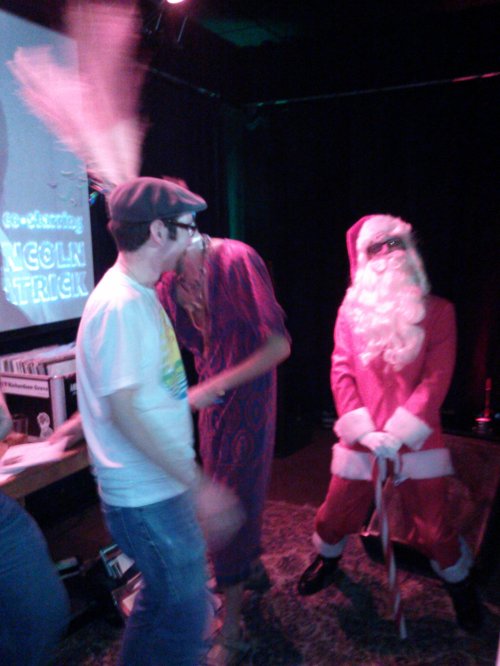
CAM00683The first DJ of the night was perhaps the most adventurous DJ in Humboldt county — Spaceman Spliff who not only killed his set, but dropped a Cure song to knock out small-minded fools.  Mantease played pretty hard and seems to be bringing more soul-inspired global stuff.  But it was his afrobeat shit that get’s me the most hype, and since I spent half the sent dancing on the side of the stage, that was pretty obvious. Matt “Skinny Santa” Jackson and Adam “ugly ass sweater” certainly brought the heaters.  “Back door Santa” got played and it took about half of the first verse before people clued in, then the dance floor got nasty.  And of course, the E.L. Michaels Wu-Tang song, another Soul Night first.  And I’m not talking about Skinny Santa smashing his giant candy cane across the chest of his DJ partner (saint Ad-rock), but a couple hundred people chanting “Wu-Tang!”.  I looked at Jay Morg’s set before he took the stage and I knew that he was coming with some great dancing records.  I wasn’t surprised that he gave one of the best sets of back-to-back dance floor jams that any of us have thrown and the people were feeeeeeling it. Not to mention the dude rocking a purple velour jump suit.  I had to slow it down to gospel speed just to give people a chance to catch their breath when I took over for the final shift.

CAM00684

I played the above set.  It was an incredible blessing to be able to look out as a simple music nerd and see hundreds of people dancing to the flute jazz jam by Sam Most. Not to mention the appreciation and respect for the good sounds.  Thanks to all the wonderful people who buy tickets and who support Soul Night.  Thanks to La Dolce Video who provide an astounding cinema backdrop for the party.  And much thanks to Humboldt Brews for the nice venue, respectful door staff, good sound guy, great bartenders, and generous dancing space.

Next soul night is January 18, expect the ridiculous.  If you are in Humboldt and want to join Matt, Adam & King Maxwell for a soulful New Years Eve at the Siren’s Song a few tickets are left at the Missing Link.

Leave a comment

Filed under funk & soul, hip hop, Humboldt, music

Making up your own language: Ithkuil

Nice essay in the New Yorker by Joshua Foer about a guy who invented a language in his spare time while working for the DMV. John Quijada created the new language Ithkuil which attempts to maximize clarity in human communication.  A few favorite passages and a little commentary:

1. Quijada’s idea to create a language was inspired Magma, french progressive rock band.

Quijada’s entry into artificial languages was inspired by the utopian politics of Esperanto as well as by the import bin at his local record store, where as a teen-ager, in the nineteen-seventies, he discovered a concept album by the French prog-rock band Magma. All the songs were sung in Kobaïan, a melodic alien language made up by the group’s eccentric lead singer, Christian Vander.

via Joshua Foer: John Quijada and Ithkuil, the Language He Invented : The New Yorker.

2. Quijada’s research drew on the multiple ways human’s language suggests dramatically different ways of being.

“I had this realization that every individual language does at least one thing better than every other language,” he said. For example, the Australian Aboriginal language Guugu Yimithirr doesn’t use egocentric coördinates like “left,” “right,” “in front of,” or “behind.” Instead, speakers use only the cardinal directions. They don’t have left and right legs but north and south legs, which become east and west legs upon turning ninety degrees. Among the Wakashan Indians of the Pacific Northwest, a grammatically correct sentence can’t be formed without providing what linguists refer to as “evidentiality,” inflecting the verb to indicate whether you are speaking from direct experience, inference, conjecture, or hearsay.

Inspired by all the unorthodox grammars he had been studying, Quijada began wondering, “What if there were one single language that combined the coolest features from all the world’s languages?” Back in his room in his parents’ house, he started scribbling notes on an entirely new grammar that would eventually incorporate not only Wakashan evidentiality and Guugu Yimithirr coördinates but also Niger-Kordofanian aspectual systems, the nominal cases of Basque, the fourth-person referent found in several nearly extinct Native American languages, and a dozen other wild ways of forming sentences.

via Joshua Foer: John Quijada and Ithkuil, the Language He Invented : The New Yorker.

3.  Joshua Foer, the author of the article, seems as intrigued by the potential of “constructed languages” (conlanging) to point toward innovative approaches to existence.

Many conlanging projects begin with a simple premise that violates the inherited conventions of linguistics in some new way. Aeo uses only vowels. Kēlen has no verbs. Toki Pona, a language inspired by Taoist ideals, was designed to test how simple a language could be. It has just a hundred and twenty-three words and fourteen basic sound units. Brithenig is an answer to the question of what English might have sounded like as a Romance language, if vulgar Latin had taken root on the British Isles. Láadan, a feminist language developed in the early nineteen-eighties, includes words like radíidin, defined as a “non-holiday, a time allegedly a holiday but actually so much a burden because of work and preparations that it is a dreaded occasion; especially when there are too many guests and none of them help.”

via Joshua Foer: John Quijada and Ithkuil, the Language He Invented : The New Yorker.

I have to wonder what my life would be like if I spoke only the one hundred twenty three word language!  I bet those little zen kids don’t even need grammar classes!

4. John Quijada’s representation of the clarity suggests a certain dislike in linguistic ambiguity.  What an interesting desire — to desire to write verbal play out of existence.  I suspect that Quijada would respond that the debate about the meaning would come down to difference in pronunciation of words!

“I wanted to use Ithkuil to show how you would discuss philosophy and emotional states transparently,” Quijada said. To attempt to translate a thought into Ithkuil requires investigating a spectrum of subtle variations in meaning that are not recorded in any natural language. You cannot express a thought without first considering all the neighboring thoughts that it is not. Though words in Ithkuil may sound like a hacking cough, they have an inherent and unavoidable depth. “It’s the ideal language for political and philosophical debate—any forum where people hide their intent or obfuscate behind language,” Quijada continued. “Ithkuil makes you say what you mean and mean what you say.”

via Joshua Foer: John Quijada and Ithkuil, the Language He Invented : The New Yorker.

5.  Foer’s story of the trip to Kiev where he and Quijada meet some of the most fervent fans of Ithkuil is pretty intense.

6.  Quijada meets George Lakoff, the thinker whose analysis of the power of metaphors propelled Quijada to create Ithkuil, in essence, to destroy the metaphoric by grounding every concept in a written/spoken concrete expression.

“There are a whole lot of questions I have about this,” he told Quijada, and then explained how he felt Quijada had misread his work on metaphor. “Metaphors don’t just show up in language,” he said. “The metaphor isn’t in the word, it’s in the idea,” and it can’t be wished away with grammar.

“For me, as a linguist looking at this, I have to say, ‘O.K., this isn’t going to be used.’ It has an assumption of efficiency that really isn’t efficient, given how the brain works. It misses the metaphor stuff. But the parts that are successful are really nontrivial. This may be an impossible language,” he said. “But if you think of it as a conceptual-art project I think it’s fascinating.”

via Joshua Foer: John Quijada and Ithkuil, the Language He Invented : The New Yorker.

Word.

Leave a comment

Filed under academics, communication, cultural appropriation, learning, music, representation

Sisters Love: I could never make a better man than you and Give me your love on Soul Train

Leave a comment

Filed under funk & soul, music

Andrew W.K. parties with the My Little Pony crew

I’m thinking about Iris Young and her notion of the city.

“What ever you want to play with, it’s okay.  It’s more than okay. It’s good.”

‘It was only released in Japan.  But you can get it on illegal downloading.  Please do.’

50 minutes and the party cannon emerges.

‘I would tell them.  It’s totally fine to be in the corner.’

Dude sounds wicked Canadian.

Previously, I wrote about Andrew W.K performing in a wheelchair.

Leave a comment

Filed under health, juxtaposition, learning, music, representation

Elvis Costello: waiting for the end of the world

Elvis Costello rocking with the Attractions.  Enjoy friday.  Give your best and hustle to make this planet a better place.

Stay free humanity, stay free.

Leave a comment

Filed under music